
AI policy is quickly becoming a commercial issue, not just an IT discussion. The most significant ISO 42001 adoption trends among SMEs are being driven by a simple question from customers, buyers and directors: can you show that AI is being used responsibly, securely and under control?
For smaller businesses, that question may arise when using generative AI to draft proposals, analyse customer data, support recruitment or automate routine work. It may also arise when an organisation sells an AI-enabled product or relies on software suppliers that do. ISO/IEC 42001 provides a structured way to manage those risks without turning every AI project into a lengthy compliance exercise.
ISO/IEC 42001 is the international standard for AI management systems. It gives organisations a framework for setting rules, assigning responsibility, assessing AI-related risks and showing that controls are reviewed over time. It does not ban AI or prescribe one piece of software. Instead, it helps a business make informed, accountable decisions about how AI is selected, used and monitored.
Adoption is growing because AI use has moved beyond experimentation. A team member may use a public AI tool to prepare marketing copy, summarise meeting notes or help with code. Each use can create questions about confidential information, accuracy, copyright, bias, data protection and customer commitments. Businesses do not need to stop benefiting from these tools, but they do need clear boundaries.
Customer expectations are also changing. Larger organisations, public-sector buyers and regulated clients increasingly expect suppliers to explain their approach to information security, privacy and emerging technology risks. ISO 42001 can provide a credible, organised response, particularly where AI is central to the service being supplied.
The trend is strongest in technology, software, professional services, recruitment, financial services support, healthcare suppliers and businesses handling large volumes of customer information. However, any SME using AI in decisions that affect people, money, safety or sensitive data should consider whether a formal management system is proportionate.
Many organisations begin by searching for certification, but the practical value lies in the system behind the certificate. A good AI management system gives staff straightforward instructions and gives directors better visibility of where AI is being used. It replaces informal assumptions with evidence-based controls.
For an SME, this does not need to mean a large compliance department or hundreds of documents. The scale of the system should reflect the scale, purpose and risk of the AI activity. A marketing agency using AI to produce first drafts needs different controls from a software provider whose platform makes automated recommendations to customers.
In practice, businesses are focusing on a few core areas. They are creating an inventory of AI tools and use cases, setting approval rules for new tools, defining what information must never be entered into public platforms, and establishing checks for outputs that could be inaccurate or discriminatory. They are also making someone accountable for oversight, even where that person has several other responsibilities.
This proportionate approach matters. Over-engineering the system can slow down adoption and frustrate employees. Under-controlling it can expose the business to avoidable errors, customer complaints or contractual problems. ISO 42001 helps organisations find a workable middle ground.
An AI policy is a useful starting point, but it is rarely enough on its own. Buyers and auditors may ask how the policy is put into practice, who approves higher-risk uses, whether staff have been trained, and what happens when something goes wrong.
This is where ISO 42001 is different from a one-page policy. It encourages organisations to establish objectives, assess risks and opportunities, maintain documented information, monitor performance and improve their approach. The aim is to demonstrate control rather than simply state good intentions.
For example, an organisation might allow staff to use approved AI tools for drafting internal content, provided no personal data, client-confidential information or commercially sensitive material is uploaded. A manager could review customer-facing outputs, while a quarterly review checks whether new tools have been introduced and whether the rules remain suitable. That is a manageable control process, and it creates evidence that the business is actively governing its AI use.
There is a trade-off. More evidence can make it easier to demonstrate compliance, but excessive paperwork creates work with little operational benefit. The most effective systems use concise procedures, practical registers and records that fit into existing workflows.
One of the clearest ISO 42001 adoption trends is integration with existing management systems. SMEs that already work to ISO 9001, ISO 27001 or ISO 22301 are often well placed to add AI governance because they already understand risk registers, internal audits, corrective actions and management reviews.
ISO 27001 is particularly relevant where AI tools process business information. Information security controls can help address access, supplier due diligence and data handling, while ISO 42001 adds the governance needed for AI-specific risks such as bias, explainability, human oversight and the quality of AI-generated outputs.
ISO 9001 can also provide a useful foundation. Where AI affects the delivery of products or services, quality processes help ensure outputs are checked, customer requirements are understood and mistakes are dealt with consistently. Rather than building separate systems, an integrated approach can reduce duplication and make ongoing management more affordable.
For businesses starting from scratch, it may still make sense to begin with ISO 42001 alone. The right route depends on your customer requirements, the sensitivity of the information involved and whether AI is central to your operations. A company using AI occasionally for administration may need a focused policy and risk assessment first. A company selling AI-enabled services may benefit from implementing the full standard sooner.
The fastest route is not to begin with documents. Begin with an honest view of current AI use. Speak to the people doing the work, not only senior management. Informal use is common, and a system can only manage risks that the business has identified.
Start by mapping the tools in use, their purpose, the data involved and the people affected by each use case. Then assess what could go wrong. Could an inaccurate output reach a customer? Could confidential data be exposed? Could an automated decision disadvantage an applicant, employee or customer? Could a third-party provider change its terms or model without your knowledge?
Next, decide what level of control is appropriate. Lower-risk uses may only need approved-tool guidance and staff awareness. Higher-risk uses may need formal approval, testing, documented human oversight, supplier checks and incident procedures. Make accountability clear, including who can approve a new AI application and who reviews its performance.
Training deserves particular attention. Staff should know that AI outputs can be persuasive and still be wrong. They need practical examples of permitted and prohibited use, along with a simple route for raising concerns. Rules that are hard to understand will be ignored, especially in busy small teams.
A digital-first certification process can keep this work focused. ISO-Cert Online supports SMEs with guidance, templates and remote assessment, helping them build a system that reflects their actual risks rather than a generic compliance file.
Certification is not automatically the right first move for every organisation. If a business has not yet decided how it will use AI, or is only trialling a low-risk tool with no sensitive data, it may be better to establish basic governance before committing to certification. The same applies where senior leadership has not assigned ownership for AI decisions.
However, waiting should not mean doing nothing. A short AI use policy, a tool register and clear data-handling rules can provide an immediate foundation. They also make future ISO 42001 implementation quicker when a customer request, tender requirement or growth plan makes certification commercially valuable.
The businesses best placed to benefit from AI will not necessarily be those using the most tools. They will be the ones that can use AI confidently, explain their controls clearly and show customers that innovation is being managed with care.
Ready to get started?
Contact us today on +44 (0)333 014 7720 or email info@isocertonline.net for a free consultation. You can also get a quote online in minutes.
Don’t let cost hold you back from achieving ISO certification. With ISO-Cert Online, management systems certification is affordable for every business.


A staff member pastes customer information into a public chatbot. A recruitment tool filters out an applicant without anyone being able to explain why. A marketing team publishes AI-written claims that have not been checked. These are not distant enterprise problems. They are everyday decisions that show why companies ask how ISO 42001 applies to companies using AI tools.
ISO 42001 is the international standard for an Artificial Intelligence Management System, or AIMS. It gives organisations a practical framework for governing AI properly: setting responsibilities, understanding risks, checking outcomes and improving controls over time. For UK SMEs, it is not about turning every employee into a data scientist. It is about using AI in a controlled, accountable way that customers, staff and regulators can trust.
ISO 42001 can apply whether your business builds AI products, embeds AI into software, or simply uses third-party tools such as generative chatbots, transcription platforms, HR screening systems, customer-service assistants and analytics packages. The depth of your system should reflect the scale, purpose and risk of your AI use.
That distinction matters. A small design agency using an AI assistant to produce first drafts does not need the same level of technical assessment as a software firm deploying an AI model that influences lending, medical decisions or recruitment. But both businesses need clear rules around data, human oversight, accuracy and accountability.
The standard asks a simple commercial question: can you demonstrate that your organisation understands how AI is being used and has proportionate controls in place? If a client, tender assessor or insurer asks who approved an AI tool, what data it receives, or how its output is checked, you should have a reliable answer rather than a collection of informal habits.
Many firms assume ISO 42001 is only relevant if they create algorithms. In reality, a company can be an AI user and still carry meaningful responsibility. If your team enters personal, confidential or commercially sensitive information into a tool, you need to know where that data goes, what the supplier does with it and whether the tool is suitable for the task.
Likewise, if employees rely on AI-generated answers to advise customers, write policies, make personnel decisions or assess compliance, the business remains accountable for the result. The fact that a tool produced the output does not remove the need for professional judgement.
ISO 42001 helps turn these concerns into a managed process. It does not ban useful tools. It helps you decide where they are appropriate, where human approval is required and where their use should be restricted.
An AIMS should fit the way your business works. For an SME, this is usually a focused set of policies, registers, assessments and review activities rather than a large corporate manual.
Start by defining the scope. You might cover all AI tools used across the business, or begin with a higher-risk area such as customer data, HR, finance or software delivery. A sensible scope is clear about which teams, processes, systems and locations it includes.
You then need an AI inventory. This is a current record of the tools in use, their intended purpose, the supplier, the types of data involved, the person responsible and the level of risk. It often reveals more than expected. Staff may be using browser-based tools under individual accounts that were never assessed or approved.
For each significant use case, carry out an impact and risk assessment. Consider not only cyber security and data protection, but also inaccurate outputs, bias, lack of explainability, intellectual property concerns, unsafe advice and damage to customers or your reputation. The aim is not to eliminate every risk. It is to identify the realistic ones and choose controls that make sense.
For example, an AI tool used to summarise internal meeting notes may require restricted data inputs and a quick human check. An AI system that ranks job applicants needs much closer scrutiny, defined approval authority, testing for unfair outcomes and a clear route for people to challenge a decision.
The right controls depend on your risk assessment, but most companies using AI tools will need a combination of documented rules and day-to-day checks. These may include an acceptable-use policy, approved-tool process, data-handling guidance, human-review requirements, staff training, supplier assessments and an incident process for when something goes wrong.
Staff awareness is particularly valuable. Employees should know not to enter confidential client information into unapproved tools, treat generated content as factual without checking it, or use AI to make sensitive decisions without authorised oversight. A short, clear policy that teams understand is more effective than a lengthy document left unread.
ISO 42001 also expects senior management involvement. This does not mean directors need to approve every prompt. It means leadership sets the policy, assigns ownership, provides resources and reviews whether the system is working. Someone must be accountable for keeping the AI register current, responding to concerns and making sure controls are followed.
Most SMEs will not train their own models. They will rely on external providers, which makes supplier management a major part of ISO 42001 implementation.
Before approving a tool, assess what it does with your information, whether it uses inputs to train its models, where data is processed, what security measures are available and how the supplier handles incidents. You should also consider service availability, contractual terms, intellectual property ownership and how easily the business could stop using the tool if needed.
A supplier’s popularity is not evidence that it is appropriate for every business use. Free consumer versions and paid business versions can have very different privacy, administration and retention settings. Your assessment should reflect the version your staff will actually use.
Keep records of the decision and review it when the supplier changes its terms, features or model. AI services develop quickly, so a one-off check at procurement stage is rarely enough.
For many businesses, ISO 42001 will sit alongside existing management systems rather than operate alone. If you already work to ISO 9001, the ideas of documented processes, responsibilities, internal audits, corrective action and management review will be familiar. ISO 27001 provides a useful foundation where AI use involves confidential information, access controls and supplier security.
An integrated approach reduces duplication. The same document-control process can govern AI policies; the same internal audit programme can test AI controls; and the same management review can consider quality, information security and AI performance together. The key is to add AI-specific risks and objectives rather than copy another standard without adapting it.
This can be especially useful when a customer asks for evidence of responsible AI alongside quality or information-security assurances. Certification will not make an unsuitable AI use case safe, but it gives your organisation a credible structure for evaluating and managing it.
The fastest route is usually to begin with a gap assessment against your current AI use. Identify the tools in play, decide your scope, assess the most material risks and set practical controls. From there, create the core AIMS documents, train relevant staff, gather evidence that the controls operate and carry out an internal review before certification assessment.
Do not over-engineer the system. An organisation with five employees and three approved tools needs a proportionate management system, not an enterprise governance department. Equally, avoid a paper-only exercise. Auditors will expect to see that your policies influence real decisions, including tool approval, staff behaviour, incident handling and management oversight.
A digital-first implementation can keep the workload manageable. ISO-Cert Online supports SMEs with customised templates, consultancy guidance and a central portal to organise documents, actions and progress without unnecessary site visits or disruption.
Certification is most compelling where AI affects customers, personal data, regulated activity, hiring, financial decisions or core service delivery. It can also strengthen tender responses where buyers want assurance that suppliers are adopting AI responsibly.
For lower-risk internal use, the business case may be more about getting ahead of unmanaged adoption. A clear AI management system lets you gain productivity benefits while protecting customer trust and avoiding avoidable mistakes. As AI becomes embedded in ordinary software, knowing what your organisation permits, monitors and reviews will become a practical business advantage.
Start with the AI tools your people are already using this week. A clear inventory, sensible approval rules and visible human accountability will give you a stronger foundation than waiting for every technology question to be answered.
Ready to get started?
Contact us today on +44 (0)333 014 7720 or email info@isocertonline.net for a free consultation. You can also get a quote online in minutes.
Don’t let cost hold you back from achieving ISO certification. With ISO-Cert Online, management systems certification is affordable for every business.

The year 2025 is a significant year for ISO certification, as two of the most widely used ISO standards are set to be updated after nearly a decade of waiting.…
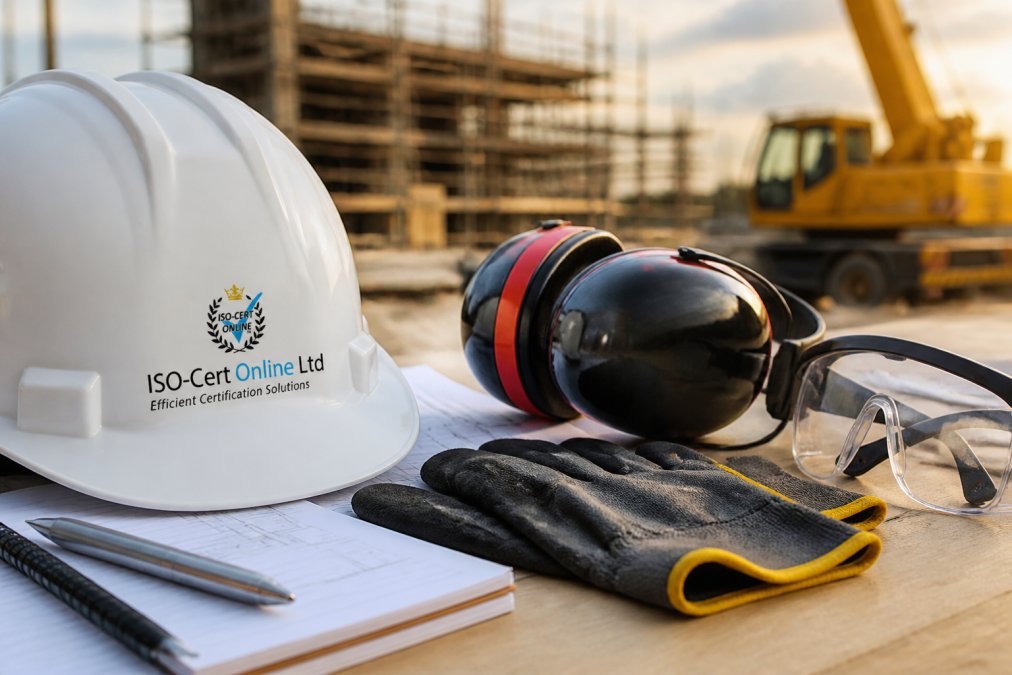
Construction remains one of the highest-risk industries for workplace accidents and fatalities (the CDC). Without a structured approach to health and safety management, even small oversights can result in serious incidents, regulatory fines, and reputational damage. ISO 45001 certification provides a framework that transforms how organisations identify, assess, and control workplace hazards.
ISO 45001 is an internationally recognised standard that establishes a management system for occupational health and safety. It replaces the older OHSAS 18001 standard and aligns with the ISO management system family, making it easier for companies to integrate multiple certifications. For construction companies, this certification demonstrates to clients, suppliers, and regulators that health and safety is embedded into every operation.
Many construction businesses find that implementing ISO 45001 reduces accident rates, improves worker engagement, and strengthens their competitive position when bidding for contracts. Clients increasingly require ISO 45001 certification as a condition of supply chain participation, particularly for larger infrastructure and public sector projects.
At ISO-Cert Online, we work with construction firms to simplify their certification journey. Below, we’ll walk you through exactly how to achieve ISO 45001 certification for construction, from initial gap analysis through to certification.
Achieving full ISO 45001 certification for construction follows a logical seven-step process. Each phase builds on the previous one, creating a management system that works in practice, not just on paper.

Before committing resources to implementation, you need to understand where your current health and safety practices stand relative to ISO 45001 requirements. A gap analysis compares your existing policies, procedures, and controls against the standard’s clauses.
This assessment examines your current health and safety policy, hazard identification and assessment processes, incident reporting and investigation procedures, worker training records, contractor management, and internal audit practices. The analysis identifies which elements already meet the standard and which require development or strengthening. Many construction firms discover they’re doing more than they realise; the gap is usually in documentation, consistency across sites, and evidence that demonstrates compliance.
Your health and safety policy is the foundation of your ISO 45001 certification for construction. This must reflect your organisation’s specific commitment to health and safety and set the direction for all management decisions.
The policy should include your commitment to comply with applicable legal requirements, prevent workplace injuries and ill health, and continually improve performance. It needs to define roles and responsibilities, establish how you’ll allocate resources, and explain how you’ll involve workers in health and safety decisions. Construction-specific policies must address site hazards: working at height, excavation safety, manual handling, noise exposure, and dust control. The policy should be signed by senior leadership to signal that health and safety is a board-level priority.
This step is where ISO 45001 certification for construction becomes operationally real. Hazard identification and risk assessment form the core of your management system. You’re systematically identifying what could cause harm and deciding what controls are needed.
For construction, this means evaluating hazards across all work activities: site setup, excavation, temporary works, working at height, manual handling, and equipment operation. You’ll consider hazards from plant and equipment, materials, environmental conditions, and work practices, including contractors and visitors on your sites. Risk assessment determines the likelihood and severity of harm, creating a prioritised list of control improvements needed before certification.
Documentation is essential but should focus on what’s necessary and what’s used in practice. You’ll need documented procedures for hazard identification, risk assessment, incident investigation, contractor management, emergency response, and internal audit. Work instructions should exist for high-risk activities. Records include training logs, incident reports, audit findings, and management review notes.
The key is making documentation practical for site teams. Digital documentation platforms can simplify access and ensure site teams have current versions, improving compliance because information is accessible when needed.
Your workforce is essential to ISO 45001 certification for construction success. Workers must understand the health and safety policy, their responsibilities, and how to report hazards and incidents. Managers and supervisors need deeper training on their roles in implementing the management system.
Training should cover the ISO 45001 standard itself, your specific policies and procedures, hazard identification on your sites, and incident reporting. Induction training for new workers must include site-specific hazards and emergency procedures. Training needs to be ongoing as procedures evolve and new activities emerge.
Internal audits verify that your management system is working as documented. They’re about identifying where controls are breaking down so you can strengthen them before the external audit.
Internal audits should examine compliance with documented procedures, effectiveness of controls in reducing risks, and worker understanding of health and safety requirements. Auditors should include both management and worker representatives. For construction, audits should cover multiple sites to ensure consistency. Most construction firms conduct internal audits quarterly, with findings documented and corrective actions tracked to completion.
The external auditor will review your documented system and examine records remotely. They’re verifying that your management system is documented, implemented, and effective.
Preparation involves ensuring documentation is complete and accessible, confirming corrective actions from internal audits and management review meetings are being addressed.
The timeline for ISO 45001 implementation for construction varies based on your current health and safety maturity and organisational size.
Initial gap analysis and planning typically takes 2-3 weeks. Policy development and hazard identification usually require 4-6 weeks. Documentation development and workforce training span 6-8 weeks. Internal audits and corrective actions take 4-6 weeks.
From start to full certification, construction firms typically complete the process in 4-5 months. Some organisations with strong existing health and safety practices complete it faster. Others with multiple sites or complex operations may require longer.
The Construction (Design and Management) Regulations 2015 (CDM 2015) establish legal duties for health and safety on construction projects (hse.gov.uk). ISO 45001 certification for construction complements CDM 2015 compliance by providing a systematic management framework.
CDM 2015 requires duty holders to manage health and safety throughout a project. ISO 45001 provides the organisational systems to fulfil these duties consistently. For example, CDM 2015 requires hazard identification and risk assessment; ISO 45001 provides the documented process for doing this systematically across all projects.
Many construction firms find that implementing ISO 45001 strengthens their CDM 2015 compliance. The standard’s requirements for contractor management align with CDM duties to coordinate and communicate with supply chain partners. The incident investigation and management review processes support the continuous improvement that CDM expects.
ISO 45001 is broader than CDM 2015, applying to all construction work and covering occupational health risks beyond construction-specific hazards. CDM 2015 compliance is a legal minimum; ISO 45001 certification demonstrates a more comprehensive commitment to health and safety management.
The external certification audit assesses your management system against ISO 45001 requirements. Understanding what auditors examine helps you prepare effectively.

Organisational Context and Leadership. Auditors verify that senior leadership understands the health and safety context, has committed resources to the management system, and can demonstrate involvement. They’ll review your health and safety policy and confirm it’s communicated throughout the organisation.
Planning and Hazard Management. The audit examines how you’ve identified hazards, assessed risks, and determined necessary controls. Auditors will verify that hazard identification is comprehensive, risk assessments are documented, and controls are appropriate for construction-specific hazards and contractor management.
Support and Competence. Auditors confirm that you’ve allocated resources, provided training, and established competence requirements. They’ll review training records and verify that contractors meet your competence standards.
Operational Control. This examines how you control high-risk activities. Auditors review work procedures, and verify that controls are actually implemented. They’ll check incident reporting systems, emergency procedures, and contractor supervision.
Performance Evaluation. Auditors review your internal audit programme, management review process, and how you monitor health and safety performance. They’ll examine incident records, audit findings, and corrective actions to verify you’re identifying and addressing problems.
Improvement and Continual Development. The audit confirms that you’re learning from incidents and audit findings, implementing corrective actions, and continually improving your management system.
Audit Area | What Auditors Examine | Common Construction Issues |
|---|---|---|
Health and Safety Policy | Leadership commitment and communication | Policy too generic or not site-specific |
Hazard Identification | Completeness and documentation | Missing site-specific hazards or contractor risks |
Risk Assessment | Appropriateness of controls | Insufficient controls for high-risk activities |
Training Records | Competence and understanding | Inadequate induction or refresher training |
Incident Management | Investigation and corrective action | Incomplete incident records or weak investigations |
Contractor Management | Competence verification and supervision | Inadequate contractor vetting or oversight |
Several tools and resources can simplify ISO 45001 certification for construction. The right support depends on your current maturity, available resources, and timeline.
Compliance Software Platforms. Organisations like Zebsoft and BuiltRight Technologies offer software specifically designed for construction health and safety management. These platforms centralise hazard registers, incident reporting, training records, and audit management. For construction firms managing multiple sites, integrated software reduces the documentation burden and ensures consistency.
Workforce Competency Management. Competency Cloud specialises in tracking worker certifications and training records, essential for construction where many roles require specific qualifications. The platform maintains audit-ready evidence of worker competence.
Consultancy Support. Other providers offer end-to-end implementation support. Consultants guide your gap analysis, help develop documentation, train your team, and prepare you for the external audit. This approach is particularly valuable if your team lacks health and safety expertise or if you’re managing multiple sites.
ISO-Cert Online Ltd offers remote assessment and digital documentation approaches that simplify the certification process. Remote assessments work effectively for construction firms because auditors can assess your documented system and site practices without requiring extensive on-site time.
ISO 45001 certification for construction is increasingly essential for competing in the modern construction market. Clients require it for tender participation, supply chain partners expect it, and it demonstrates genuine commitment to worker safety.
The seven-step implementation process provides a clear pathway. Construction firms typically complete implementation within 4-5 months when they allocate adequate resources and follow a structured approach.
The real value extends beyond the certificate. Organisations that genuinely implement ISO 45001 see reduced incident rates, improved worker engagement, and stronger operational discipline. The management system becomes part of how you work, not a compliance burden.
ISO Certification Online supports construction firms through remote assessments and digital documentation, making certification faster and more efficient. With flexible approaches designed for SMEs, the path to ISO 45001 certification for construction has become significantly more accessible.
ISO 45001 is not legally mandatory in the UK, but many construction clients require it as a condition of contract. Organisations working on major projects, particularly those governed by CDM 2015 regulations, often need certification to bid successfully. Additionally, insurance providers and supply chain partners frequently demand ISO 45001 as proof of a robust occupational health and safety management system. Achieving certification demonstrates your commitment to protecting workers and managing workplace risks systematically.
The timeline varies depending on your starting point and company size. Most construction businesses complete implementation within 2-6 months, though some take longer if significant changes to existing systems are needed. The process includes gap analysis, documentation development, staff training, internal audits, and the final external certification audit. Remote assessment options can accelerate timelines by reducing scheduling delays associated with on-site visits, allowing your team to progress documentation and training while audit scheduling is arranged.
ISO 45001 provides the management framework to fulfil many CDM 2015 obligations. Both standards require hazard identification, risk assessment, worker competence management, incident investigation, and documented procedures. ISO 45001 helps construction companies demonstrate systematic control of health and safety risks, which supports CDM 2015 compliance for duty holders. However, CDM 2015 imposes additional specific requirements around project notification, coordination, and health and safety file management that sit outside ISO 45001’s scope, so organisations must address both frameworks comprehensively.
A construction-specific audit checklist should verify: hazard identification and risk assessment for your site operations; documented procedures for high-risk activities such as working at height, manual handling, and machinery operation; evidence of worker competence and training records; incident and near-miss reporting systems with investigation records; personal protective equipment provision and inspection; site induction and toolbox talk documentation; contractor management and site safety rules; emergency procedures and first aid provision; and management review minutes demonstrating leadership commitment. The checklist should also confirm that your system addresses project-specific risks and aligns with CDM 2015 requirements where applicable.
Yes, remote assessment can work effectively for construction companies. The auditor will conduct interviews with your management and workforce via video, review your documented system and evidence digitally, and request photographs or video walkthroughs of your site and facilities. This approach works well for smaller sites and offices. However, for larger, complex operations across multiple locations, a hybrid model combining remote document review with limited on-site visits may provide more thorough verification. The key is ensuring your documentation, evidence, and worker testimony clearly demonstrate system compliance without requiring the auditor to be physically present.
Now, are you ready to get started with ISO 45001 Certification for Construction?
Contact us today on +44 (0)333 014 7720 for a free consultation regarding ISO 45001 Certification for Construction. Additionally, you can also get a quote online in minutes.
Don’t let cost hold you back from achieving ISO certification. With ISO-Cert Online, management systems certification is affordable for every business.

Picture this: you’ve spent weeks polishing a tender response for a massive buyer. Everything looks tight until you hit page six.
There it is: a strict requirement for an ISO 9001 quality mark. No exceptions. Deadline? Next Friday.
The traditional path feels hopeless right out of the gate. You’re looking at weeks of back-and-forth emails, thousands in consultant fees, and an auditor trailing your staff around the office with a clipboard.
Then you run into confusion: online ISO certification vs traditional certification.
Online ISO certification sounds almost too smooth: digital uploads, video interviews, fast turnaround, zero travel costs. But then that nagging doubt kicks in: If nobody actually steps foot in my building, does the certificate even hold up in the real world?
The short answer? Yes, 100%.
An online ISO certificate carries the exact same weight, validity, and commercial status as one earned through on-site visits, provided it comes from an accredited certification body. The difference isn’t what gets checked or how high the bar is set; it’s simply how the evidence moves from your hands to the auditor’s desk.
Let’s clear up a massive misconception straight away. Online certification isn’t a “diet” version of the standard, nor is it a legal loophole.
If your business goes after ISO 9001 (Quality), ISO 14001 (Environmental), ISO 45001 (Occupational Health & Safety), ISO 27001 (Information Security), or any other ISO standard online, you have to satisfy every single clause of the exact same international standard as a global enterprise being audited in person.
The difference comes down to the tools being used. Instead of paying an assessor to spend three hours in traffic only to sit in your conference room reading paper binders, the process uses modern digital auditing tools:
This whole setup operates under strict rules. Legitimate certification bodies comply with ISO 17021, the international standard governing how audit bodies behave and answer to national oversight bodies in the UK. Whether an auditor looks at your records over a desk or over Zoom, their corporate obligations don’t change.
Never done a remote audit? It’s surprisingly simple, stripped of the usual on-site drama.
Comparing online ISO certification vs traditional certification side-by-side reveals that the core work doesn’t change at all. You skip the travel invoices and empty tea-making etiquette, not the compliance rigour.
While both routes yield valid compliance, remote processes make far more sense for the way modern companies operate.
If your team spends 90% of their day behind screens, as IT support, recruitment agencies, digital marketers, or consultancies, having an auditor physically present adds almost zero assessment value. A remote ISO audit verifies your digital assets and workflows right where they live.
For a small company, hosting an assessor for two solid days means pulling key people away from actual revenue-producing work. Uploading evidence digitally lets you work through compliance checks on your own clock.
Need ISO certification without a site visit to hit a tender cutoff? On-site audits suffer from scheduling gridlock; assessors are often unavailable for months. Digital workflows eliminate travel overhead, cutting turnaround down to a matter of days.
Remote auditing isn’t a magic wand for every industry on the planet.
If you run a chemical plant, a steel workshop, or a busy production line, physical walkthroughs can be valuable. An auditor may want to see material flows, observe floor safety habits, and inspect physical machinery up close. A remote audit can still be useful in checking these things however, by focusing on the specifics involved, e.g. robust risk assessments and records of preventive actions that have been implemented, as well as corrective and follow-up actions carried out.
For the purposes of a remote audit, ISO 45001 certification for health and safety in high-hazard areas such as construction sites or demolition projects, desk review may not be adequate. The assessment of physical risk factors, personal protective equipment usage, and control of access to the site generally benefits from the auditor being on-site.
Rule of thumb: If your risks are contained within the physical equipment and hazardous environment, then you should invest in the on-site visit. If your risks are contained within information or software, or service delivery, then go remote.
The bottom line: Yes, online ISO certification is completely legitimate. Legitimacy comes down to accreditation, not where the auditor sits.
A common worry among Directors is that a prospective client might turn down a certificate earned remotely. But here’s the reality: procurement officers never ask, “Did the auditor physically drive to your office?” They ask, “Is this certificate backed by a recognised accreditation body?”
1. Is an online ISO certificate the same as one from an on-site audit?
Yes, totally identical. Both methods evaluate the same standards, use the same accreditation rules, and yield the exact same certificate. No client or tender board can tell or care how the audit evidence was collected.
2. Do auditors ever visit in person for online certification?
Not usually for office-based or low-risk setups. However, if your business scope involves complex physical hazards or an unexpected gap turns up during desktop review, a targeted physical visit might be requested.
3. Which ISO standards can be certified remotely?
Most management frameworks work great remotely, especially ISO 9001 (Quality), ISO 14001 (Environmental), ISO 27001 (Information Security), ISO 22301 (Business Continuity), and ISO 45001 (Health & Safety for low-risk environments).
4. How long does online ISO certification take compared to traditional?
Traditional on-site routes take anywhere from 3 to 9 months because of calendar conflicts, travel plans, and paperwork delays. Modern digital portals like ISO-Cert Unite™ compress that timeframe, letting prepared SMEs finish the whole cycle in days.
Getting your business certified shouldn’t mean drowning in paper, waiting months for audit dates, or losing days of productivity. If you need ISO 9001, ISO 14001, or an integrated management system for an upcoming tender, modern online assessments get you there fast without the stress.
Want to see how straightforward it can be? Get an instant quote or check out how our ISO-Cert Unite™ portal cuts the hassle out of compliance.
You’ve worked hard to achieve your first ISO certification. Now a key client is asking for a second standard, or a tender requirement has landed on your desk specifying three. The moment you start running two separate management systems, the administrative overhead increases significantly: two audit cycles, two sets of policies, two internal audit programmes, and two sets of annual fees. It quickly starts to feel like operating parallel businesses inside the same organisation.
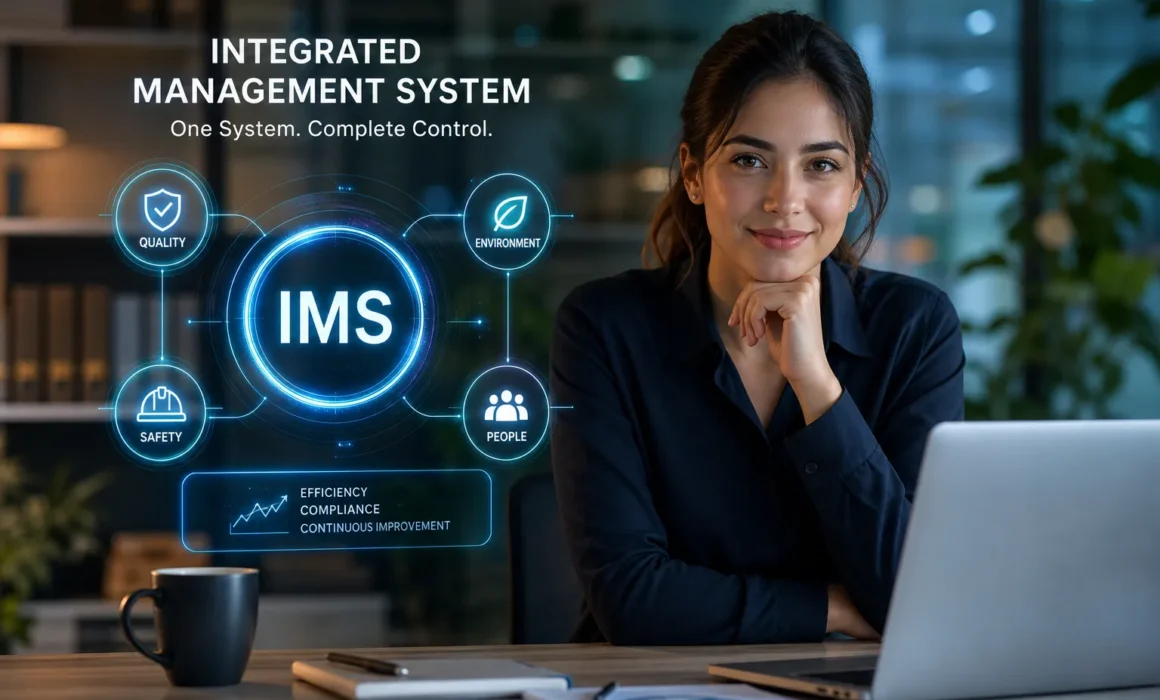
This is exactly the problem an integrated management system (IMS) is designed to solve. Rather than treating each ISO standard as its own silo, an integrated management system brings two or more standards together into a single coordinated framework. You manage one system, undergo one audit cycle, and maintain one set of shared documentation. ISO-Cert Online Ltd has made single-audit IMS certification accessible to UK SMEs without dedicated compliance teams, at a fixed, transparent price point.
This article covers what an IMS actually is, which standards get combined most often, how to build one from the ground up, what auditors look for at certification, and what it realistically costs. By the end, you’ll have a clear picture of whether the integrated route makes sense for your business.
An IMS is not a separate ISO standard you apply for. It’s a design decision. Instead of running three management systems that each have their own policies, risk assessments, internal audits, and management reviews, you build one system that satisfies the requirements of all your chosen standards simultaneously. The structure is shared; only the domain-specific requirements sit apart.
Any well-built integrated management system rests on the same core components: a unified policy and objectives, shared documentation and record control, integrated risk management, a single internal audit programme, and one management review cycle. These aren’t duplicated for each standard, they’re designed once and built to serve all of them. That’s where the real efficiency comes from.
ISO deliberately designed its modern management system standards to share the same high-level clause sequence. This framework, formally known as the Harmonized Structure (previously called Annex SL), runs from Clause 4 (context of the organisation) through to Clause 10 (improvement). ISO 9001, ISO 14001, and ISO 45001 all follow this same skeleton, which means the shared requirements covering leadership, planning, support, performance evaluation, and continual improvement can be written once and applied across all three.
This structural alignment is what makes an integrated management system practical rather than just a good idea on paper. The groundwork is already done inside the standards themselves. Your job during implementation is to build your system to take advantage of it, rather than recreating the same clauses three times over in three separate folders.
The most frequently combined set is ISO 9001 (quality management), ISO 14001 (environmental management), and ISO 45001 (occupational health and safety). This trio is particularly common in manufacturing, construction, and operations-heavy environments where quality, environmental impact, and worker safety are all active concerns. Their requirements genuinely overlap in areas like operational planning, risk assessment, competence and training, internal audit, and continual improvement.
ISO 27001 (information security management) is increasingly added by technology companies and businesses handling sensitive client data. ISO 50001 (energy management) is a natural addition for energy-intensive organisations, and ISO 22301 (business continuity) is frequently included by businesses where service resilience is critical. An IMS isn’t a fixed combination, it scales with whatever standards your business actually needs, making it a flexible form of integrated ISO management.
Each standard also carries domain-specific requirements that can’t be shared across the whole system. ISO 14001 requires an assessment of environmental aspects and impacts. ISO 45001 requires formal hazard identification. ISO 27001 goes further, requiring a formal information security risk treatment plan and a structured approach to asset classification. These requirements sit alongside the shared structure rather than conflicting with it. A well-designed IMS handles them as discipline-specific modules within one overall framework, not as separate systems bolted awkwardly together.
Implementation follows a clear progression. Start by defining your scope: which standards you’re integrating and what business outcomes the IMS needs to support. Then secure leadership alignment, because an IMS that lacks genuine buy-in from the top rarely survives contact with day-to-day operations. After that comes a gap analysis comparing your current practices against the combined requirements of all chosen standards. This stage is where most of the design decisions get made, and it’s worth taking seriously.
Once the gaps are mapped, you move into process and documentation design: creating shared policies, procedures, and work instructions that satisfy all applicable clauses without duplication. A phased rollout follows alongside employee training and a full cycle of internal auditing before the certification stage.
Timelines vary considerably depending on your starting point. SMEs building on an existing certified standard can often reach certification readiness in 3 to 6 months, but businesses starting from scratch or integrating more than three standards should typically allow 6 to 12 months. Existing management maturity, team capacity, and the number of standards involved all affect the pace.
A common concern is that an IMS means three times the paperwork. It doesn’t. The goal is shared documentation where requirements align, and standard-specific documentation only where they genuinely diverge. Auditors expect an integrated policy, a scope document, and shared procedures for risk management, internal audit, corrective action, and management review. Standard-specific procedures cover the unique requirements, such as environmental aspects registers for ISO 14001 or hazard and risk assessments for ISO 45001.
The guiding principle here is worth remembering: documents should exist because they help you run the system, not because they fill a folder. Over-documentation is one of the most common ways IMS projects grind to a halt, so keep it lean and purposeful from the start.
The gap analysis stage catches most businesses out, but it’s rarely the only stumbling block. The first mistake is treating integration as a filing exercise: putting three separate documents into one folder and calling it an IMS. Auditors see through this immediately, and it means you’ve gained none of the efficiency benefits. Rushing the gap analysis is the second problem; businesses that skip past this step tend to discover compliance gaps during the certification audit, which is the worst possible moment. The third pitfall is failing to train staff adequately, so the system exists on paper but not in practice.
Each of these is avoidable with proper planning. Build your shared processes first, verify them through internal audit, and make sure your team can explain what they do and why before the external auditor arrives.
Rather than three separate certification audits with three separate audit teams, an integrated management system is assessed in a single audit against all your chosen standards simultaneously. The auditors examine the combined management system as a whole: shared processes, combined management review records, and a single internal audit programme that covers all standards rather than just one. This approach is typically faster, less disruptive, and cheaper than running separate audits.
The two-stage certification process still applies. Stage 1 reviews your documentation and assesses readiness; Stage 2 assesses implementation on the ground. Both stages cover all integrated standards in one process, so your team only goes through the experience once rather than repeatedly across different audit cycles.
Auditors want to see that the system is genuinely integrated, not merely co-located. This means combined internal audit reports that cross-reference all standards, management review minutes that address all three domains, and staff who understand and follow shared procedures confidently. Experienced auditors are skilled at spotting a system assembled for the audit rather than operated in daily practice.
The most effective preparation is simply running the system properly from the start. If your internal audits are thorough, your management review is substantive, and your team understands the processes they follow, the certification audit becomes a confirmation of what you already know rather than an anxious test.
For a smaller UK business pursuing three-standard IMS certification, realistic Year 1 all-in costs (covering implementation support and certification fees) sit in the region of £3,200 to £12,000 depending on complexity and whether external consultancy is involved. A combined audit typically costs less than three separate audits, with indicative savings of roughly £700 to £2,500 per year on audit fees alone, though the actual figure varies by company size and audit scope. Documentation and admin overhead is often reported to run around 30% lower under an IMS compared with managing separate systems, and many SMEs find that the efficiency gains offset first-year investment costs within twelve months, though payback depends on your existing setup and the standards involved.
Timeframes for SMEs range from 3 to 6 months for businesses with an existing certified standard as a base, up to 12 months for those building from scratch across multiple disciplines. Surveillance visits are also consolidated under a single annual cycle, reducing the ongoing disruption that comes with staggered separate audits.
For SMEs without a dedicated compliance team, two barriers tend to dominate: cost uncertainty and process complexity. ISO-Cert Online Ltd is designed to address both. They offer single-audit IMS certification delivered entirely via remote audit, with a fixed-price model and a document portal that guides businesses through the documentation process step by step. You don’t need to know exactly where to start, the portal shows you.
Their scope covers multiple ISO standards including ISO 9001, ISO 14001, ISO 45001, ISO 27001, and ISO 22301, meaning most common IMS combinations can be handled under one provider, one process, and one annual audit cycle. For an SME managing multiple standards, that consolidation alone is worth considerable time and money each year. The service is built around the needs of smaller organisations, so the process is scaled appropriately rather than borrowed from an enterprise compliance model.
An integrated management system isn’t a luxury reserved for large organisations with compliance departments. It’s a smarter way for any business holding, or planning to hold, more than one ISO standard to manage its obligations without duplicating effort across parallel systems. The Harmonized Structure already does much of the structural heavy lifting at the standards level. Your job is to design shared processes that genuinely serve the business, then demonstrate through evidence that they work.
For UK SMEs looking to certify across multiple standards, the single-audit route is measurably more affordable and far less disruptive than managing separate certifications in parallel. The documentation is lighter, the audit process is streamlined, and the ongoing maintenance burden is significantly reduced.
If you’re ready to explore which IMS combination suits your business, visit ISO-Cert Online Ltd to find out more and get a fixed-price quote. One system, one audit, one straightforward path to certification.
Ready to get started?
Contact us today on +44 (0)333 014 7720 or email info@isocertonline.net for a free consultation. You can also get a quote online in minutes.
Don’t let cost hold you back from achieving ISO certification. With ISO-Cert Online, management systems certification is affordable for every business.

A leaking fuel bowser, a missed waste collection or concrete washout entering a surface-water drain can turn a routine construction project into an expensive problem. An ISO 14001 for construction example makes the standard easier to apply because it shows what an environmental management system looks like in the reality of live sites, changing subcontractors and tight programme deadlines.
This practical example follows a fictional UK SME contractor, BuildRight Projects Ltd. It carries out commercial refurbishments and small new-build schemes, employs 22 people directly and relies on specialist subcontractors. The business needs ISO 14001 certification to strengthen tender submissions, meet client expectations and demonstrate that environmental controls are managed consistently.
BuildRight begins by defining the scope of its environmental management system. Rather than attempting to cover activities it does not control, it includes its head office, estimating, procurement, project management and all construction sites managed by the company. It also recognises that subcontractors, waste carriers and material suppliers can affect its environmental performance.
The company considers the issues that matter most to its operation. These include increasingly strict client environmental requirements, rising disposal costs, local residents’ concerns over dust and noise, legal duties relating to waste, pollution risks and the availability of lower-impact materials. It also identifies opportunities: reducing skip movements, reusing materials where safe and practical, and winning more work from clients that assess environmental credentials during procurement.
This does not need to become a lengthy corporate report. For a small contractor, a concise context document and a clear list of interested parties are usually more useful than pages of generic wording. The key is showing that the business understands the conditions in which it operates and has built its system around them.
The central working document in this example is an environmental aspects and impacts register. An environmental aspect is an activity that can interact with the environment. The impact is the resulting change, such as pollution, resource depletion or nuisance.
BuildRight lists normal activities, abnormal events and reasonably foreseeable emergencies. It then scores each aspect using a simple method based on severity, likelihood, level of control and legal or client requirements. The scoring method matters less than applying it consistently and reviewing it when a project changes.
For its projects, BuildRight identifies several significant aspects:
Not every aspect needs the same level of control. A minor office-paper issue should not receive more attention than a fuel spill risk beside a drain. The register helps the company direct time and money where the environmental risk and commercial exposure are greatest.
For a six-month office refurbishment in Manchester, BuildRight creates a project environmental plan before work starts. The project manager adapts a controlled template rather than writing a new plan from scratch. This is faster, but it still has to reflect the site layout, client rules and nearby risks.
The plan records that the project is close to occupied offices and a public footpath. It identifies the nearest drains, confirms where skips will be located and specifies a designated, bunded area for fuels and chemicals. It also records relevant waste arrangements, emergency contacts and the person responsible for environmental checks.
The controls are practical. Fuel containers are inspected weekly, spill kits are placed near storage areas and plant operators report leaks immediately. Drain covers and washout controls are installed before concrete-related work begins. Waste is segregated where space allows, with clear signage to reduce contamination. Delivery times are planned to limit congestion and unnecessary idling.
There is a trade-off here. Segregating every waste stream can be impractical on a confined city-centre site. BuildRight documents the space constraint and uses a reputable waste provider that can separate mixed loads where appropriate. ISO 14001 does not demand perfection or a zero-waste claim. It expects the business to understand its impacts, meet applicable obligations and improve its control over time.
BuildRight sets environmental objectives that relate directly to its significant aspects. Vague aims such as ‘be greener’ do not give a project manager anything useful to manage. The company instead sets targets for the coming year: reduce mixed waste sent from projects, increase the proportion of waste streams segregated on suitable sites, complete environmental inspections on time and reduce avoidable plant idling.
For the Manchester project, the target is to divert at least 90% of non-hazardous construction waste from landfill, subject to the waste contractor’s reporting data. Another target is 100% completion of weekly environmental inspections. The site team also records fuel use where a project has enough plant activity for meaningful comparison.
A smaller contractor should avoid collecting data simply because it sounds impressive. If fuel is supplied through several subcontractors and cannot be reliably measured, the business may initially focus on controls, plant-maintenance records and idling observations. Honest, usable figures are better than ambitious numbers with no evidence behind them.
Environmental performance is often lost at the point where responsibility passes between the main contractor, subcontractor and site labour. BuildRight addresses this at induction. Every worker receives a short briefing on waste segregation, spill response, dust controls, reporting requirements and the location of environmental information.
Subcontractors with higher-risk activities receive more specific controls. The groundworks contractor must follow the fuel-storage arrangements. The demolition contractor provides waste information and follows dust-suppression requirements. Suppliers are told about delivery restrictions and packaging expectations.
The company keeps records of inductions and toolbox talks, but paperwork alone is not proof that controls are working. Site managers carry out visible checks, challenge poor practice early and record corrective actions. If a skip is contaminated or a spill kit has been used, the event is investigated in proportion to the risk. The aim is to prevent recurrence, not merely to close a form.
Each project manager completes a weekly environmental inspection using a simple checklist. It covers waste areas, chemicals, fuel, drains, dust, housekeeping, permits and previous actions. Photographs can provide useful evidence, especially where the inspection identifies a problem and its later correction.
BuildRight’s compliance lead reviews results monthly. Repeated issues, such as poorly labelled waste bins, trigger a wider action rather than repeated reminders on individual sites. The business also conducts internal audits to test whether the documented system matches what people actually do.
Before certification, BuildRight can expect to show its environmental policy, aspects register, objectives, project plans, legal and other obligations, competence records, inspections, internal audit findings and management review records. It should also be ready to explain how it deals with incidents and corrective actions.
A management review brings those threads together. The directors consider audit results, progress against objectives, complaints, incidents, changes in legislation or client requirements, resource needs and improvement opportunities. For an SME, this can be a focused meeting with clear minutes and actions. It does not need to be an over-engineered board paper.
The value of this ISO 14001 for construction example is not the number of documents created. BuildRight links risks to site controls, assigns ownership and keeps enough evidence to demonstrate that its system is being used. That is what makes the standard useful for tendering and everyday management alike.
A refurbishment contractor, civil engineering business and housebuilder will have different significant aspects. A highways contractor may place greater emphasis on traffic management, aggregates and drainage. A fit-out company may focus more on waste, material procurement and occupied-building controls. The framework remains the same, but the detail must fit the work.
For SMEs, a digital system with tailored templates and expert guidance can remove much of the administrative drag. ISO-Cert Online helps businesses build practical management systems without turning certification into a lengthy consultancy project.
The best time to build environmental controls is before the next site starts, when drainage, storage, waste routes and responsibilities can still be planned properly. That early decision is often where lower risk, lower waste costs and stronger tender evidence begin.
Ready to get started?
Contact us today on +44 (0)333 014 7720 or email info@isocertonline.net for a free consultation. You can also get a quote online in minutes.
Don’t let cost hold you back from achieving ISO certification. With ISO-Cert Online, management systems certification is affordable for every business.

A tender deadline, a major customer request or a plan to enter a new market can make ISO 9001 feel urgent very quickly. So, what does ISO 9001 certification cost for a small company? For most SMEs, a realistic first-year budget is commonly between £1,000 and £5,000, but the right figure depends on your company’s size, complexity, current systems and how much practical support you need.
The useful question is not simply, “What is the cheapest certificate?” It is, “What will get us certified credibly, without distracting the team or creating unnecessary consultancy bills?” A digital-first route, clear scope and remote assessment can make a significant difference to both cost and speed.
For a straightforward small business with one site, a limited team and uncomplicated processes, ISO 9001 certification can often be achieved at the lower end of the range. A business with several locations, field teams, regulated work, complex supply chains or little in the way of existing (documented) processes should expect a higher investment.
Your first-year cost usually has three parts: implementing a quality management system, completing the certification audit and allowing for support or training where internal time is limited. Some providers (such as ISO-Cert Online Ltd) package these elements together; others quote each separately. That is why two quotations that appear similar at first glance can produce very different final costs.
A low headline price may cover only an audit, leaving you to create policies, procedures, records and evidence alone. Conversely, an all-inclusive package may include tailored templates, consultancy time, an online portal and support through the audit. For a busy SME, that support can be more cost-effective than asking a director or operations manager to learn the standard from scratch while running the business.
The audit is the formal assessment of whether your quality management system meets ISO 9001 requirements and is being followed in practice. For a small, low-risk organisation, audit fees are often the most visible part of the quote.
Auditors consider the number of employees, business activities, sites, and the scope you want certified. A ten-person office-based consultancy needs less audit time than a twenty-person manufacturer operating from two premises. If your scope includes design, installation, production and servicing, the assessment is likely to take longer than one covering a single professional service.
Remote audits can reduce costs because there is no auditor travel, accommodation or unproductive site-visit time to pay for. They also make scheduling easier for small teams. However, remote does not mean less rigorous. You still need to demonstrate that your processes work, records are maintained and responsibilities are understood.
ISO 9001 does not require a mountain of paperwork, but it does require a workable management system. You will need to define processes, assign responsibilities, manage risks and opportunities, control documents, record corrective actions and review performance.
If you already have documented workflows, customer feedback processes, supplier controls and regular management meetings, implementation may be relatively light. In that case, customised templates and targeted guidance may be enough. If your systems sit mainly in people’s heads, you may need more hands-on consultancy to turn good practice into consistent, auditable evidence.
Before certification, your business should carry out an internal audit and a management review. These are not box-ticking exercises. They help you find gaps before the external audit and give directors confidence that the system is delivering useful information.
You can train an employee to complete these tasks, use guided online training resources or bring in an experienced consultant. The lowest-cost option is often to manage it internally, particularly where someone already owns quality or operations. The trade-off is time. If that person is stretched, external support may prevent delays and reduce the risk of avoidable findings.
Most well-prepared small companies complete the process without major difficulty, but it is sensible to allow a contingency. If the audit identifies a nonconformity, you may need to provide corrective-action evidence before certification is issued. This does not necessarily mean a large additional bill, but poorly prepared businesses can face extra consultancy or audit time.
Ask at quotation stage what is included if a corrective action is needed. Clear pricing matters more than an optimistic starting figure.
Employee numbers matter, but they are not the whole story. A small company can be operationally complex, while a larger office-based business may have very consistent processes. Cost is usually shaped by the certification scope, number of locations, type of work, existing level of control and how quickly you need to achieve certification.
Urgency can increase costs if you need intensive consultancy support, rapid document development or priority audit dates. It can also be managed well. A focused plan, ready-to-use templates and a secure online workspace can help a company prepare quickly without taking shortcuts.
Be accurate when describing your business to a provider. Trying to narrow the scope artificially may make the quote look attractive, but it can create problems if customers expect broader activities to be covered by your certificate. Your scope should reflect the services or products you genuinely need to demonstrate.
ISO 9001 is not a one-off purchase. After initial certification, you will need ongoing surveillance assessments and a recertification assessment at the end of the certification cycle.
The best way to keep renewal costs under control is to keep the management system alive. Continue internal audits, log customer feedback and issues, review supplier performance, record improvements and hold management reviews. Leaving everything until just before a surveillance audit creates a rush of work and may mean paying for additional support.
Digital document control and progress monitoring can make this far easier. Instead of searching through old folders at renewal time, you have current evidence, assigned actions and a clear record of what has changed.
When comparing ISO 9001 quotations, look beyond the total. Check whether the price includes implementation guidance, tailored documents, internal-audit support, management-review support, remote auditing, certificate issue and ongoing access to your documentation. Also ask whether travel expenses, additional audit days or renewal charges could be added later.
For many SMEs, a package with practical support is the better commercial choice. It reduces the chance of delay, protects internal time and gives staff a system they can maintain after the certificate is issued. ISO-Cert Online is built around that approach, combining online guidance, tailored support and remote delivery to make certification faster and more manageable for small and medium sized businesses.
If you are a small, single-site company with established processes, start by budgeting at the lower end of the £1,000 to £5,000 first-year range. If you have multiple sites, a complex scope or need substantial help building the system, plan towards the higher end and request a clear, itemised proposal.
The most economical route is rarely the one that leaves your team with the most work. Choose a provider that explains what is included, sets out the timescales plainly and helps you create a quality system that improves how the business runs. Done properly, ISO 9001 should support better customer service, fewer recurring problems and stronger tender opportunities long after the audit is finished.
Ready to get started?
Contact us today on +44 (0)333 014 7720 or email info@isocertonline.net for a free consultation. You can also get a quote online in minutes.
Don’t let cost hold you back from achieving ISO certification. With ISO-Cert Online, management systems certification is affordable for every business.

A tender can be lost before the buyer has read a word about your service, price or experience. If ISO certification appears as a mandatory requirement, it is often used as an early pass-or-fail check. The question, ‘why do clients require ISO certification in supplier tenders?’, is therefore not academic. For many UK SMEs, the answer directly affects whether they can compete for work.
Clients are not usually asking for ISO simply to create paperwork. They want a practical, independent indication that a supplier has controlled processes, understands its risks and can deliver consistently. Certification gives procurement teams a quicker way to reduce uncertainty when comparing several potential suppliers.
Tendering is a risk-management exercise. A buyer may be responsible for public money, a major contract, sensitive information, site safety or a supply chain that cannot afford disruption. They need confidence that every appointed supplier can meet the required standard without creating avoidable problems later.
ISO certification offers a recognised framework for assessing that confidence. Rather than asking every bidder to explain every policy, process and control from scratch, the client can specify a relevant standard and ask for a current certificate. It is a practical filter, particularly where procurement teams are managing high volumes of responses.
This does not mean certification guarantees perfect performance. A certificate cannot replace references, financial checks, technical evaluation or contract management. What it can do is show that an organisation has put a structured management system in place and had it assessed against a defined standard.
For the supplier, that can turn a difficult reassurance exercise into a straightforward evidence submission. Instead of trying to persuade a buyer that your business takes quality, safety or data security seriously, you can demonstrate that commitment through a recognised certification route.
The ISO standard requested usually reflects the risk attached to the work. Quality failures, accidents, environmental harm and information breaches can all be expensive for the client, even when they are caused by a contractor or subcontractor. Reputational damage can be just as serious.
ISO 9001 is commonly requested where consistent quality, controlled delivery and customer satisfaction matter. It helps show that a business manages processes, deals with issues properly and looks for continual improvement. This is relevant across construction, manufacturing, professional services, facilities management and many other sectors.
ISO 14001 may appear where the client has environmental commitments, planning conditions or supply-chain reporting obligations. Buyers want evidence that suppliers understand their environmental impacts and have a method for reducing waste, preventing pollution and meeting applicable requirements.
ISO 45001 is often central to tenders involving site work, construction, engineering, logistics or maintenance. A client needs assurance that health and safety is actively managed, not left to a generic policy filed away for inspection day.
ISO 27001 is increasingly important for IT providers, software companies, consultants, outsourced service teams and anyone handling confidential or personal information. It gives buyers a structured basis for assessing information security, including access controls, incident management and risk treatment.
Depending on the contract, clients may also look for ISO 22301 for business continuity, ISO 50001 for energy management or ISO 42001 where the responsible management of artificial intelligence is relevant. The requirement should be proportionate to the work. A simple supply arrangement does not always justify the same level of certification as a high-risk, long-term contract.
Procurement teams need a consistent way to evaluate suppliers. Without common requirements, assessments can become subjective. One bidder may provide a detailed quality manual, another may provide a one-page policy, and a third may make broad claims without evidence. Comparing them fairly takes time and leaves room for inconsistency.
Certification creates a common reference point. It does not make every supplier identical, but it helps buyers establish a baseline. This is particularly useful in framework agreements and public-sector procurement, where governance and audit trails matter.
It can also help clients meet their own obligations. Many larger organisations are certified themselves and need to show that they manage supply-chain risks. Requiring relevant ISO standards from key suppliers can support their quality, environmental, health and safety, or information-security objectives.
For SMEs, this is why ISO should be viewed as more than a badge for the website. It is often market access. Once certification is in place, your team can use it across multiple bids rather than rebuilding the same assurance evidence each time.
Not every ISO reference means the same thing. The tender documents should tell you whether certification is a condition of bidding, a scored question or simply a preference.
If it is marked as mandatory, failing to provide the requested evidence may lead to exclusion. Some buyers will accept an equivalent management system, proof that certification is in progress, or a clear plan to achieve it before contract award. Others will not. Do not assume an alternative will be accepted because your policies look similar.
If ISO is weighted within the quality section, a certificate may strengthen your response but will not necessarily win the work alone. You still need to show how your processes will work on that specific contract. Explain responsibility, reporting, risk controls, escalation routes and how you will measure performance.
There is also a timing issue. Starting certification after a tender is published can be possible, but it may not fit the submission deadline. If your business regularly sees the same standard in opportunities, treating it as a last-minute tender task is usually more costly and stressful than putting it in place ahead of time.
A valid certificate is valuable evidence, but strong tender submissions connect it to the buyer’s real concerns. If a client is worried about missed service levels, do not simply attach ISO 9001. Explain how you control scheduling, competence, corrective action and customer feedback.
For a contract involving sensitive data, link ISO 27001 to your approach to access permissions, secure devices, supplier controls and incident response. For site-based work, show how ISO 45001 supports risk assessments, worker competence, consultation and reporting.
Keep the evidence precise. Give the certificate number, expiry date, scope and the legal entity it covers. A common problem is submitting a certificate held by a parent company, sister company or previous trading entity when the tendering business is not within scope. Buyers notice these details.
You should also check whether the certificate scope matches the service being tendered. If you are bidding to provide IT support, but the scope only covers office administration, it may raise questions. Clear, relevant certification is more persuasive than a broad claim with unclear coverage.
The most effective management system is one that reflects how your business actually operates. Copying a large corporate manual may satisfy nobody if staff do not use it. Buyers are increasingly alert to generic policies that have no connection to day-to-day delivery.
Start by identifying the standards that recur in your target tenders. Review recent opportunities, supplier questionnaires and requirements from existing customers. This helps you prioritise the standard with the clearest commercial return rather than paying for certification that your market does not need.
Next, map your existing processes. Most established SMEs already have useful controls: job checks, staff training, supplier approvals, complaint handling, backups, safety procedures or environmental practices. The task is to organise them, identify gaps and make responsibilities and records clear.
A digital-first certification process can reduce the administrative burden significantly. With tailored templates, practical guidance and remote assessment, teams can work through the required evidence without arranging repeated site visits or pausing operations. The right level of support matters, especially where one person is managing compliance alongside their main role.
Speed should never mean cutting corners. Certification needs to be credible, current and properly scoped. However, it does not need to become a six-month paperwork project. For a focused SME with existing processes and responsive leadership, a well-supported route can be far quicker than traditional consultancy models suggest.
Once certified, keep a tender evidence pack ready. Store your current certificates, policies, insurance details, key procedures, training records, case studies and standard answers in one controlled location. Review it before each submission so dates, names and scopes remain accurate.
It is also worth monitoring renewal dates. An expired certificate submitted in error can create an avoidable compliance issue at precisely the point when a buyer is deciding whether to trust you. Assign ownership internally and keep management-system activities active between audits.
For businesses that need more than one standard, an integrated approach can prevent duplicated documents and repeated effort. Quality, environmental, health and safety and information-security controls often overlap in areas such as leadership, competence, risk, internal audits and corrective actions. Combining them sensibly can keep certification commercially manageable.
The practical aim is not to collect standards for their own sake. It is to make it easy for clients to choose you. When your certification reflects real working practices and is ready to evidence at tender stage, it stops being an obstacle and becomes a clear signal that your business is prepared for larger, more demanding opportunities.
Ready to get started?
Contact us today on +44 (0)333 014 7720 or email info@isocertonline.net for a free consultation. You can also get a quote online in minutes.
Don’t let cost hold you back from achieving ISO certification. With ISO-Cert Online, management systems certification is affordable for every business.

If you are asking should my SME get ISO 9001 or ISO 14001 first, the real question is usually simpler: which one will help the business sooner?
For most SMEs, ISO 9001 comes first. It is broader, more widely requested by customers and procurement teams, and usually gives you a clearer framework for getting processes under control. But that is not always the right answer. If your business has significant environmental responsibilities, customer pressure around sustainability, or contracts that require environmental management, ISO 14001 may need to move to the front of the queue.
The right choice depends less on theory and more on what your business is trying to achieve in the next 6 to 12 months.
If your immediate goal is winning work, ISO 9001 is often the better first step.
ISO 9001 is the quality management standard. In practical terms, it helps you run the business more consistently. It focuses on how you manage customer requirements, internal processes, non-conformities, improvement, responsibilities and documented controls. Many SMEs choose it first because it tends to support sales, tendering and day-to-day operations at the same time.
ISO 14001 is the environmental management standard. It is about identifying environmental aspects, managing impacts, meeting compliance obligations and improving environmental performance. That matters a great deal in the right context, but it is usually more specific in its commercial value unless your sector puts environmental performance under the spotlight.
A simple way to judge priority is to ask what is currently blocking growth. If customers are asking for evidence of quality controls, complaint handling, supplier management or consistent delivery, ISO 9001 is likely the faster commercial win. If tender portals, public sector frameworks or larger clients are asking about carbon reduction, waste handling, environmental controls or legal compliance, ISO 14001 may have stronger short-term value.
For smaller businesses, ISO 9001 often creates the strongest foundation because it brings structure without forcing unnecessary bureaucracy.
A good ISO 9001 system helps clarify who does what, how work should be carried out, how mistakes are picked up, and how customer expectations are reviewed. That can make a visible difference quite quickly, especially in businesses where growth has happened faster than process discipline. If you have reached the stage where too much lives in people’s heads, quality certification usually solves more than one problem at once.
It also tends to be easier for directors and operational teams to connect with. The benefits are obvious: fewer errors, clearer accountability, smoother onboarding, better consistency and stronger credibility with buyers. For many SMEs, that makes ISO 9001 the easier standard to justify internally.
There is another practical point. If you plan to add more standards later, ISO 9001 often gives you the management system basics you will reuse elsewhere. Document control, internal audits, corrective action, management review and risk-based thinking all create useful groundwork for future certifications.
There are cases where ISO 14001 should clearly take priority.
If your business produces waste, uses significant energy, handles chemicals, manages transport fleets, works in construction, manufacturing, engineering or facilities services, or operates under customer scrutiny on environmental issues, ISO 14001 may be the smarter first move. The same applies if you are already being asked for environmental policies, sustainability commitments or evidence of legal compliance.
In those situations, waiting to do ISO 14001 second can slow down opportunities. Some buyers will accept a plan for quality improvement, but they may be less flexible on environmental risk if your operations could affect sites, waste streams, emissions or regulated activities.
There is also a reputational angle. If environmental performance is central to your market position, ISO 14001 can support trust in a way ISO 9001 cannot. A recycling contractor, print business, manufacturer or logistics firm may gain more from demonstrating environmental control than from leading with quality alone.
That is why there is no one-size-fits-all answer. ISO 9001 is usually first, but ISO 14001 becomes first when environmental obligations are commercially material.
Instead of comparing standards in the abstract, look at four practical filters.
First, review customer and tender demand. Which certification is actually being requested? If bid documents, supplier questionnaires or prospect conversations mention one standard repeatedly, that is a strong signal.
Second, assess operational pain. If your business is struggling with inconsistency, rework, complaints or unclear processes, ISO 9001 will probably solve more immediate issues. If your main exposure is waste, environmental incidents, legal obligations or resource use, ISO 14001 may deliver more value.
Third, look at risk. Which area creates the bigger downside if ignored? A quality issue may lead to lost clients and poor delivery. An environmental issue can bring legal, contractual and reputational consequences. The higher the risk, the stronger the case to prioritise that standard.
Fourth, think about implementation effort and team readiness. Some SMEs can move faster with ISO 9001 because their existing procedures already cover much of what is needed. Others already track waste, environmental controls or compliance obligations, making ISO 14001 relatively straightforward. The faster path is not always the one people expect.
Yes, and in some cases that is the best option.
If you already know you will need both standards, implementing them as an integrated management system can save time, reduce duplicated work and make audits more efficient. Both standards share common management system principles, so it makes sense to build one joined-up framework rather than bolt on separate systems later.
For SMEs, this can be especially cost-effective when speed matters. You avoid creating one system now and reworking it again in six months. Policies, objectives, internal audits, corrective actions, management reviews and document control can often be designed to support both standards from the start.
That said, doing both together is not automatically the right move. If the business has limited internal capacity, one urgent tender deadline or no dedicated compliance resource, trying to tackle two standards at once can feel heavier than it needs to. In those cases, starting with the standard that gives the clearest short-term return is often the smarter decision.
The biggest risk is not failing an audit. It is spending time and money on a certification that does not move the business forward.
If you choose ISO 14001 first when customers are mainly asking for ISO 9001, you may still miss tender requirements and sales opportunities. If you choose ISO 9001 first but your contracts depend on environmental assurance, you may still face procurement delays or compliance concerns.
There is also an internal cost. SMEs need certification to be practical, not a paper exercise. When the first standard solves a visible business problem, teams engage with it. When it feels disconnected from commercial reality, momentum drops quickly.
That is why the best sequencing decision is usually the one that links certification to a measurable outcome – more bids passed, fewer complaints, lower waste, stronger compliance, better customer confidence or faster supplier approval.
If you are still undecided, start by mapping the decision against revenue, risk and readiness.
Choose ISO 9001 first if your focus is growth, customer confidence, tender access, process consistency or creating a base for future standards. Choose ISO 14001 first if environmental risk, customer scrutiny, legal obligations or sustainability credentials are already central to how you win and keep business.
If both matter now, consider implementing them together through a streamlined online process so you do not duplicate effort. A digital-first approach with clear templates, remote support and practical consultancy can make that far more manageable for smaller teams than traditional, site-visit-heavy models.
For many SMEs, the fastest route is not just picking the right standard. It is picking a certification approach that keeps disruption low, costs controlled and progress visible. That is where a provider such as ISO-Cert Online Ltd can make the decision easier by helping you focus on what the business actually needs first, rather than selling complexity.
The best first ISO is the one that earns its place quickly – in your operations, in your tenders and in the confidence it gives your customers.
Ready to get started?
Contact us today on +44 (0)333 014 7720 or email info@isocertonline.net for a free consultation. You can also get a quote online in minutes.
Don’t let cost hold you back from achieving ISO certification. With ISO-Cert Online, management systems certification is affordable for every business.

If you are weighing up certification and wondering how remote ISO audits work, the short answer is this: the audit still follows the same core checks as a traditional assessment, but the evidence and document review happen online rather than during a site visit. For most SMEs, that means less disruption, lower cost and a much more efficient route to certification.
That matters because the old model often slowed smaller businesses down. Travel schedules, meeting room availability and diary clashes could turn a straightforward audit into a drawn-out exercise. A remote audit strips out much of that friction without removing the discipline of the assessment itself.
A remote ISO audit may be carried out through a mix of video calls, screen sharing, digital document review or secure file exchange. The auditor is still looking for the same thing they would look for on site – whether your management system is in place, understood and being followed in practice.
The process normally starts before the audit day itself. You may be asked to provide key documents in advance so the auditor can review your management system, policies, procedures, records and scope, or, if you are a customer of ISO-Cert Online Ltd, you will have the option to upload all of the necessary evidence to the ISO-Cert Unite Portal. Depending on the standard, that might include internal audit records, management review minutes, risk assessments, objectives, training records, corrective actions or operational controls.
Once the review starts, the auditor works through your system much as they would in person. They will test whether your documented approach matches what your team actually does (verified by the documentary evidence provided).
For an SME, this is often easier than hosting a physical visit. Documents are pulled up quickly, and there is no need to stop half the office to accommodate an assessor walking around the site.
The auditor will then move through the standard clause by clause. If you are being audited against ISO 9001, the focus may be on quality controls, customer issues and process performance. For ISO 14001 or ISO 45001, there may be more attention on environmental aspects, legal compliance, hazards and operational controls. For ISO 27001, expect deeper scrutiny of access control, incident management and information security risk treatment.
Where a physical site would once have been toured in person, a remote audit may use photos, video or existing records to confirm what is happening on the ground. Whether that is suitable depends on the standard and the nature of your business. A largely office-based company will usually find remote assessment very straightforward. A manufacturing, warehousing or higher-risk operation may need more visual evidence.
This is the point many businesses worry about most, but in practice it is usually simpler than expected. Auditors do not need paper in front of them to test whether your system works. They need access to credible evidence.
That evidence can include controlled documents, completed forms, records from your management system, screenshots from business software, meeting notes, training logs and performance data. The key is not the format. The key is whether the evidence is current, relevant and consistent.
Customers of ISO-Cert Online Ltd are able to provide such information using numerous means, including email, SharePoint, and the ISO-Cert Unite Portal.
For example, if your procedure says complaints are logged, investigated and reviewed for trends, the auditor will want to see the complaint log, a sample investigation and some sign that the information feeds into management review or improvement activity.
This is why remote audits reward organised businesses. If your documents are version controlled, your records are easy to retrieve and your staff know their responsibilities, the process tends to move quickly. If evidence sits in inboxes, on desktops and in separate folders with no clear ownership, the audit can become slower than it needs to be.
For smaller businesses, remote certification is not just a convenience feature. It can solve several practical problems at once.
First, it cuts out travel-related cost and scheduling delays. That makes certification more affordable and easier to arrange around normal operations. Second, it reduces disruption. Third, it fits the way many SMEs already work, with cloud systems, shared drives and online meetings now part of daily operations.
There is also a speed advantage. When documents, corrective actions and audit planning all sit within one digital process, it is often possible to move from implementation to assessment much faster. For a business working towards a tender deadline or customer requirement, that time saving can make a real commercial difference.
That said, remote is not a magic fix for a weak system. If the management system is poorly implemented, inconsistent or created purely for the audit, the online format will not hide that. In some ways, a remote audit can expose poor organisation more quickly because the auditor can ask for specific evidence which may not be available.
The best preparation is not technical. It is operational. You want the audit to feel like a review of a working system, not a scramble for files. This is where the ISO-Cert Unite Portal excels, as the key records are generated within the Portal, and are therefore ‘always’ available. Recertification audits carried out by us utilise the backend of the Portal to check that records (i.e. evidence) are being generated, as prescribed by the relevant standard(s).
If you are not using the ISO-Cert Unite Portal, start by making sure your documents and records are stored logically and can be accessed quickly. Basic issues with permissions or internet access waste time and create avoidable stress. The best course of action is provide the evidence well before the audit is due to take place, by whatever means have been agreed.
Some businesses assume a remote audit is less credible or less detailed than a site-based one. It is more accurate to say the method is different. The standard being assessed does not change, and the need for objective evidence does not change either.
Another concern is whether remote audits work for hands-on industries. Often they do, but the answer depends on the risk profile, the type of activities and how well evidence can be shown digitally. A consultancy firm, software provider or office-based service business will typically find remote audits very straightforward. A business with workshop activities, multiple locations or significant safety controls may need more planning and, in some cases, a blended approach.
The businesses that get the best result from remote audits do not treat them as a box-ticking exercise. They use the process to check whether the system is actually helping the business run better.
A good audit should show where your controls are working, where records are weak and where responsibilities are unclear. That is useful whether your priority is winning tenders, improving consistency, reducing incidents or meeting customer expectations. Fast, affordable certification matters, but so does making sure the system is practical enough to use after the certificate is issued.
For SMEs, that is where a digital-first approach can make a real difference. When templates, guidance, document control and audit preparation are built around the realities of a smaller business, certification becomes easier to manage and easier to maintain. ISO-Cert Online Ltd has built its service around exactly that principle.
Remote ISO audits work best when the process is simple, the evidence is organised and the system reflects how your business really operates. Get those three things right, and the audit becomes far less of a hurdle and far more of a straightforward step forward.
Ready to get started?
Contact us today on +44 (0)333 014 7720 or email info@isocertonline.net for a free consultation. You can also get a quote online in minutes.
Don’t let cost hold you back from achieving ISO certification. With ISO-Cert Online, management systems certification is affordable for every business.

Most tech founders know they need ISO certification. The bit that trips them up is deciding which one to go after first. Get it wrong and you spend six months building a management system that doesn’t open a single door. Get it right and you walk into enterprise procurement conversations with something your competitors can’t match. So, what is the best ISO certification for a software or IT company? The honest answer is: it depends on what your clients are actually asking you to prove right now.
Three standards deserve your attention: ISO 27001 for information security, ISO 9001 for quality management, and ISO 42001 for AI governance. Each solves a different problem. Each appeals to a different buyer. This guide is designed to give you a clear answer, not a list of options with no direction attached.
At ISO-Cert Online Ltd, we work with lean tech teams navigating exactly this choice. The question we get asked most often is some version of: “which ISO certification do I actually need?” The answer is rarely complicated once you understand what each standard does and who requires it.
Procurement processes at large enterprises and government bodies have shifted significantly over the past few years. Security and quality questionnaires that used to be optional formalities are now gatekeepers. Supplier approval is increasingly contingent on holding recognised third-party certification, not just answering the right questions on a form.
ISO 27001 has become a near-mandatory line item in tender requirements for software vendors handling sensitive data, operating in regulated supply chains, or bidding on government technology contracts. ISO 9001 appears regularly in commercial tenders as evidence of operational maturity and process consistency. If your software company is scaling into enterprise or public-sector markets, certification is no longer a nice-to-have. It is a prerequisite.
Cyber Essentials is a useful baseline. It covers five core technical controls, it is fast to achieve, and it opens the door to UK public-sector procurement at the entry level. For many small businesses, it is a sensible first step. But it has a ceiling, and that ceiling arrives quickly.
Enterprise clients with serious due diligence processes do not treat Cyber Essentials as meaningful assurance. It carries little weight with international buyers. Its five technical controls are a floor, valuable, but a floor nonetheless: firewalls, secure configuration, access control, malware protection, and patching. ISO certification builds the operational house on top of that foundation, and it is what closes deals that Cyber Essentials alone cannot.
Before diving into each standard, consider the simplest diagnostic: what is the most immediate commercial obstacle in your sales pipeline? Is it security due diligence? Delivery credibility? AI governance questions? The best ISO certification for a software or IT company is the one that removes that specific obstacle. With that frame in mind, here are the three standards that matter most.
ISO 27001 builds an Information Security Management System (ISMS) around 93 Annex A controls, organised into four categories: organisational, people, physical, and technological. The organising principle is the CIA triad: confidentiality, integrity, and availability. The standard is not prescriptive about which tools you use. It requires you to assess your specific risks and apply proportionate controls. (See a useful explainer on the scope and purpose of ISO/IEC 27001.)
For software companies, the highest-impact controls centre on secure coding practices (Annex A control 8.28), vulnerability management, access control, encryption, and cloud security. The standard does not assume you have a large security team. It assumes you have real information assets worth protecting and asks you to build a systematic approach to protecting them.
ISO 27001 is the right first choice when your clients handle sensitive data, when you are targeting enterprise or government contracts, or when your sales pipeline keeps stalling at the security questionnaire stage. If security due diligence is what is blocking your deals, this is what removes that obstacle.
For a UK SME software company, implementation typically takes three to six months, with initial investment running from roughly £4,000 to £15,000 depending on consultancy support and audit fees. The 2022 version is the current standard, the transition deadline for existing certifications passed in October 2025, so any new implementation should be built to ISO 27001:2022 from the outset.
For SaaS companies and cloud service providers, two extensions to ISO 27001 are worth understanding. ISO 27017 adds seven cloud-specific controls covering multi-tenancy, virtualisation, and shared responsibilities between cloud providers and their customers. ISO 27018 focuses on protecting personally identifiable information in public cloud environments and maps directly to GDPR obligations. For a practical guide to how ISO 27017 certification operates in cloud environments, see the linked guide.
These are not separate certifications. They extend your ISO 27001 scope and are referenced on your existing certificate. If your product handles large volumes of customer personal data or serves privacy-conscious enterprise buyers, these extensions strengthen both your compliance position and your commercial credibility with exactly the clients who scrutinise it most carefully.
ISO 9001 is not an IT-specific standard, and that is precisely where its value lies. It builds a Quality Management System (QMS) around consistent process delivery, customer satisfaction, and continuous improvement. For software companies, that means structured development lifecycles, documented testing protocols, and requirement validation, alongside defect tracking, SLA monitoring, and corrective action processes.
Its universal recognition across all sectors makes it valuable for companies selling into non-technical procurement environments. Buyers in facilities management, professional services, manufacturing, or local government care about delivery consistency and operational reliability. They are not evaluating your encryption standards. ISO 9001 speaks directly to what they are assessing.
If your clients are not asking about data security but are asking about delivery consistency, project governance, or subcontractor compliance, ISO 9001 is often the smarter first move. It is typically less technically demanding than ISO 27001, and initial costs run slightly lower, roughly £3,000 to £12,000 for a UK SME.
ISO 9001 is also a strong foundation for an integrated management system later. Its process discipline aligns naturally with ISO 27001 and ISO 14001. If you plan to pursue multiple certifications over time, starting with ISO 9001 gives you the documented process infrastructure that makes subsequent implementations significantly faster.
ISO 42001 AI Management Certification Explained is the international standard for Artificial Intelligence Management Systems (AIMS). It provides a framework for the responsible development, deployment, and monitoring of AI systems, covering risk assessment, transparency, data governance, human oversight, and accountability. Like ISO 27001 and ISO 9001, it is a management system standard: process-focused, auditable, and certifiable.
Critically, it applies to any organisation developing, using, or operating AI tools, it does not require you to have built AI from scratch. If your team uses AI-driven features within your product, or relies on third-party AI tools in your operations, ISO 42001 has direct relevance. The standard explicitly requires third-party AI supplier governance, including evaluating suppliers’ AI practices at onboarding and monitoring them on an ongoing basis; for practical guidance on strengthening supplier checks see this piece on ISO 42001 and third-party compliance.
ISO 42001 is worth considering if your product incorporates machine learning or AI-driven features, if you operate in a regulated sector where AI accountability is becoming a client requirement, or if enterprise clients are beginning to ask how you govern AI use internally. In financial services, healthcare, and government technology markets, these questions are already appearing in due diligence questionnaires.
Adoption is still early compared to ISO 27001 and ISO 9001, which means there is a real competitive edge available now. Being the vendor in your market that can demonstrate certified AI governance is a genuine commercial differentiator. That window will not stay open indefinitely. If you want a practical breakdown of the key steps to ISO 42001 certification, the Cloud Security Alliance have a helpful explainer. For ethical and governance framing, see our piece Ethical AI Made Practical: Why ISO 42001 Certification Matters.
The decision is simpler than most people make it. If you are losing deals because buyers do not trust your data handling, ISO 27001 is your answer. If you are failing tender quality criteria or struggling to demonstrate consistent delivery processes, ISO 9001 solves that problem. If AI governance is appearing in due diligence questionnaires, ISO 42001 is worth getting ahead of now rather than in eighteen months.
Do not pursue a certification because it sounds impressive. Pursue the one that removes a real commercial obstacle. The best ISO certification for a software or IT company is always the one that unlocks your next revenue opportunity, not the one that looks most technical on your website.
Yes, and for many software companies it is the efficient route. ISO 27001 and ISO 9001 share overlapping clauses across the Annex SL structure: Clauses 4 through 10 covering context, leadership, planning, support, operations, performance evaluation, and improvement map directly between both standards. A combined implementation means one set of management reviews, one internal audit programme, and one certification audit. An Integrated Management System (IMS) approach can deliver both certifications for less time and cost than two sequential projects.
ISO 42001 is best layered in once the foundational management system is established. Its governance requirements build naturally on the risk management and document control infrastructure that ISO 27001 and ISO 9001 already require you to have in place.
For managed service providers and IT support businesses, it is worth noting that ISO 20000, the international standard for IT service management (ITSM), sits alongside these three. If your clients are primarily buying managed IT services and evaluating you against ITSM maturity, ISO 20000 may be the more targeted choice. That said, the majority of software and IT companies find ISO 27001 or ISO 9001 delivers broader commercial return as a first certification, with ISO 20000 as a subsequent layer where service delivery contracts specifically call for it.
Most established certification bodies design their processes around large enterprises with in-house compliance teams, document-heavy audit packs, and on-site assessors. For a ten-person SaaS company or a lean IT services firm, that model creates unnecessary friction: expensive consultants, unclear timelines, and an audit process that assumes resources you simply do not have.
The result is that many tech founders delay certification, or abandon it entirely, not because the standards are genuinely beyond them, but because the process was never designed with them in mind. The certification itself is achievable. The route to it is often the problem.
We built ISO-Cert Online Ltd specifically to close that gap. Our fully remote audit model delivers accredited ISO certification without a single on-site visit, using a smart document portal that guides your team through the process step by step. There is no assumption that you have a compliance manager or a legal team. The process is structured for businesses without dedicated compliance staff. For more on how digital tools and automation speed certification, see Harnessing Technology: Digital Tools and AI for Streamlined ISO Certification.
Our advertised starting price of £875 removes the financial unpredictability that makes traditional certification feel risky for smaller businesses. Whether you are pursuing ISO 27001, ISO 9001, ISO 42001, or an integrated certification combining more than one standard, the process is purpose-built for lean teams that need to move efficiently without sacrificing accreditation quality.
So, what is the best ISO certification for a software or IT company? ISO 27001 is the right first choice for most IT and software businesses where data security and enterprise access are the priority. ISO 9001 is the smarter starting point when your clients care more about delivery consistency and operational reliability. ISO 42001 is the forward-looking standard for companies building with or operating AI, and its early-adoption window is open now.
There is no universally correct answer across all software businesses. But there is a correct answer for your business, and it is determined by one straightforward question: what is your most immediate commercial obstacle? Start with the certification that removes it. Build from there. The companies that get this right are not the ones that researched longest. They are the ones that decided fastest and acted on it.
For most software and IT companies, ISO 27001 is the strongest first choice because it directly addresses the security due diligence that enterprise and public-sector buyers apply. If your clients are more focused on delivery quality than data security, ISO 9001 may be the better starting point. The right answer depends on which commercial obstacle you need to remove first.
ISO 27001 is typically the best ISO certification for a SaaS company, particularly one handling customer data or targeting enterprise buyers. The optional ISO 27017 and ISO 27018 extensions add cloud-specific and data-privacy controls that reinforce your position with privacy-conscious clients. If you are also embedding AI features into your product, ISO 42001 is worth planning for as a follow-on.
IT service management businesses should evaluate ISO 27001 alongside ISO 20000, which is the dedicated IT service management (ITSM) certification. ISO 27001 tends to carry broader commercial value across more buyer types, but if your contracts explicitly reference ITSM standards or service delivery frameworks, ISO 20000 may be the more targeted choice.
Ready to get started?
Contact us today on +44 (0)333 014 7720 or email info@isocertonline.net for a free consultation. You can also get a quote online in minutes.
Don’t let cost hold you back from achieving ISO certification. With ISO-Cert Online, management systems certification is affordable for every business.

If your team hears the word audit and immediately expects paperwork, pressure and awkward interviews, your ISO 9001 internal audit guide needs to do one thing first – make the process useful. For most SMEs, an internal audit should not feel like a rehearsal for a formal assessment. It should be a quick, structured way to check whether your quality management system works in real life, not just on paper.
That matters because ISO 9001 is not interested in beautifully written procedures that nobody follows. It asks whether your processes are controlled, whether responsibilities are clear, whether customer requirements are met and whether you improve when things go wrong. A good internal audit helps you spot gaps early, fix them cheaply and keep certification moving without disruption.
An internal audit is your own review of how well the management system is working against ISO 9001 requirements and against your own documented processes. It is not there to catch people out. It is there to answer practical questions.
Are your procedures being followed? Are records complete? Are problems being identified and corrected? Are process owners managing risks, customer issues and changes properly? If the answer is sometimes yes and sometimes not, that is normal. The point is to find the weak areas before they become bigger issues.
For smaller businesses, the biggest mistake is treating internal audits as a tick-box exercise done once a year in a rush. That often produces superficial findings and little value. A better approach is to run focused audits that reflect how the business actually operates.
Before you audit anything, be clear on what you are auditing and why. Your internal audit programme should cover the full quality management system over a planned period, but not every audit needs to cover every clause.
A small business might split audits by process rather than by standard clause. For example, sales and contract review could be one audit, purchasing and supplier control another, and production or service delivery another. That tends to feel more natural for operational teams and makes findings easier to act on.
Your schedule should consider importance, risk and previous performance. If one process has frequent complaints, recurring nonconformities or major changes, audit it sooner and in more detail. If another process is stable and low risk, a lighter touch may be enough. ISO 9001 allows this kind of proportional approach, and for SMEs it is usually the most sensible one.
The auditor should be objective and competent. In a larger organisation that usually means independent of the area being audited. In a small company, that can be harder. You may not have a separate quality department, and the same people often wear several hats.
That does not mean you cannot meet the requirement. It means you need to be practical. Someone can audit a process they do not directly control, even if they work closely with it. The key is avoiding obvious conflicts of interest. If the operations manager wrote the procedure, owns the KPIs and signs off the records, they should not audit that same process alone.
Competence matters as much as independence. Your auditor needs to understand ISO 9001, know how to gather evidence and be able to ask questions without turning the audit into an interrogation. Calm, organised auditors usually get better evidence than aggressive ones.
Preparation should be thorough enough to make the audit efficient, not so heavy that it becomes a project in itself. Start by reviewing the relevant process documents, previous audit findings, complaints, corrective actions, performance data and any changes since the last audit.
Then build a short audit plan. This should state the scope, criteria, date, process owner and the areas you want to test. A checklist can help, especially for less experienced auditors, but it should not replace judgement. If you only follow a checklist line by line, you can miss obvious signs that a process is not working.
Good audit questions are open and specific. Instead of asking, “Do you review customer requirements?”, ask, “Show me how you confirm customer requirements before accepting an order.” That moves the discussion from opinion to evidence.
A useful audit combines three things: interviews, record checks and observation. If one of those is missing, the picture can be misleading. People may describe the process well, but records may show delays or omissions. Documents may look fine, but day-to-day practice may have drifted.
Start by explaining the purpose of the audit and the process you will follow. Keep the tone professional and straightforward. Most resistance comes from people assuming the auditor is there to assign blame. When teams understand that the goal is improvement and system control, conversations become easier.
As the audit progresses, follow the process from start to finish where possible. If you are auditing order handling, for example, trace a sample from enquiry through quotation, order acceptance, delivery and feedback. Sampling is important because you are testing whether the process is consistently applied, not whether one perfect file exists.
Record objective evidence as you go. That means dates, document references, version numbers, examples and observations. Vague notes such as “training seems fine” or “records mostly complete” are not much use later. Clear evidence supports findings and makes corrective action easier.
Not every weakness is a nonconformity, and not every nonconformity is a disaster. In practice, findings usually fall into three groups: conformities, nonconformities and opportunities for improvement.
A nonconformity means a requirement has not been met. That could be a missing record, a process not followed, an uncontrolled document, or a failure to review corrective action properly. An opportunity for improvement is different. It means the system meets the requirement, but there is a clearer, stronger or more efficient way to run it.
This distinction matters. If everything becomes a nonconformity, people stop listening. If nothing becomes a nonconformity, the audit loses credibility. Good auditors use judgement and tie findings back to either ISO 9001 requirements or the organisation’s own procedures.
The audit report should be short, clear and practical. It needs to say what was audited, what evidence was reviewed, what worked, what did not and what action is needed. Long reports full of standard wording usually end up unread.
Each nonconformity should explain the requirement, the evidence and the gap. For example, if your procedure requires supplier evaluations annually and two key suppliers have not been reviewed for 18 months, say that plainly. Avoid dramatic language. The aim is clarity, not theatre.
Where useful, note positive practice too. That helps management see where the system is working and keeps the process balanced. Internal audits should build confidence as well as highlight weaknesses.
An audit only pays off if findings lead to action. Too many businesses close findings with quick fixes that treat the symptom but not the cause. Replacing a missing record, for instance, does not explain why records were missed repeatedly.
Corrective action should look at root cause, action taken, responsibility and timescale. Sometimes the cause is training. Sometimes it is a poor form, unclear ownership or a process that is unrealistic for the size of the team. SMEs often find that the best fix is simplification rather than more paperwork.
Follow-up matters as well. You need to verify that action was completed and that it worked. If the same issue returns in the next audit, the original action was not effective, even if it was formally closed.
The most common problem is leaving internal audits too late. When that happens, the audit becomes a last-minute scramble before certification or surveillance activity, and there is no time to correct anything properly.
Another issue is auditing documents instead of processes. A quality manual may be tidy, but if delivery deadlines are slipping, complaints are rising and no one is reviewing trends, the real issue sits in operations, not in the wording of the procedure.
There is also a tendency to over-audit low-risk areas while under-auditing the parts of the business that affect customers most. Your audit effort should go where failure would matter. For many SMEs, that means sales review, purchasing, production or service control, nonconformance handling and customer feedback.
For a small business, the fastest way to improve internal auditing is to keep documents, records, findings and actions in one place. Chasing files through inboxes and shared drives wastes time and increases the chance of missing evidence.
A digital system makes planning, evidence gathering and follow-up much easier, especially if your team works remotely or across multiple sites. It also gives management a clearer view of progress. That is one reason many SMEs prefer a more streamlined, online approach to ISO 9001 implementation and maintenance.
If you are building or improving your system, practical support makes a difference. ISO-Cert Online helps SMEs keep certification simple, affordable and manageable, with online tools and guidance that remove much of the usual admin burden.
Some businesses can run a steady annual programme and get good results. Others need a more frequent cycle. If you have rapid growth, staff turnover, customer complaints, process changes or recurring nonconformities, it makes sense to audit key areas more often.
That is not a sign the system is failing. It is simply risk-based management. The right frequency depends on your business, your complexity and how much change you are dealing with.
The best internal audits do not create extra work for the sake of it. They give you enough visibility to stay in control, fix issues early and keep quality moving in the right direction. If your audit process helps people make better decisions, it is doing the job properly.
Ready to get started?
Contact us today on +44 (0)333 014 7720 or email info@isocertonline.net for a free consultation. You can also get a quote online in minutes.
Don’t let cost hold you back from achieving ISO certification. With ISO-Cert Online, management systems certification is affordable for every business.

A near-miss, a subcontractor incident, or a tender that suddenly asks for certified health and safety systems – that is usually when an ISO 45001 compliance guide becomes less of a nice-to-have and more of a pressing business need. For most SMEs, the challenge is not understanding why health and safety matters. It is turning that intent into a system that stands up to scrutiny without creating layers of paperwork no one uses.
ISO 45001 is the international standard for occupational health and safety management systems. In plain terms, it gives your business a structured way to identify risks, put controls in place, involve workers, and keep improving. Done properly, it helps reduce incidents, supports legal compliance, and strengthens your position with clients who want evidence that health and safety is being managed properly.
Compliance with ISO 45001 does not mean having a shelf full of forms or a policy copied from the internet. It means your business can show that health and safety is being managed in a planned, repeatable way. The standard looks at how leadership is involved, how hazards are identified, how legal duties are considered, how workers are consulted, and how performance is reviewed.
That matters because many SMEs already do parts of this informally. A director might deal with incidents, a site manager might run toolbox talks, and HR might track training. The issue is consistency. If those activities rely on memory or individual effort, they are difficult to evidence and harder to improve.
ISO 45001 brings those moving parts into one management system. It does not replace legal obligations, and it does not guarantee zero accidents. What it does is create a framework that helps you manage risk more reliably.
The standard is built around a few key areas. Once you understand them, the process feels far more manageable.
You need to be clear about what your business does, what risks come with that work, and which parts of the organisation are covered by the system. For a small firm, scope is often straightforward. For a business with multiple services, sites, or subcontracted activities, it needs more care.
If the scope is too narrow, you can leave obvious risks outside the system. If it is too broad too early, implementation becomes slow and expensive. The right balance depends on how your business operates and where the real risk sits.
ISO 45001 puts real emphasis on leadership. Senior management cannot be absent from the system and expect it to work. They need to set direction, provide resources, and make health and safety part of business decisions.
Worker consultation matters just as much. People doing the job often spot practical risks before managers do. If your system is written without their input, it may look tidy on paper but fail on the ground.
This is where many businesses focus first, and for good reason. You need a reliable process for identifying hazards, assessing risks, and deciding what controls are needed. You also need to consider legal and other requirements that apply to your activities.
The word opportunity can feel vague here, but it is useful. It might mean improving training, redesigning a task to reduce manual handling, or tightening contractor controls. ISO 45001 is not only about avoiding harm. It is also about improving how work is done.
Your team needs the right skills, awareness and information to work safely. That includes training, but it also includes communication, supervision and access to current documents.
For SMEs, overcomplicating this area is a common mistake. You do not need a training matrix with fifty tabs if your workforce is small and stable. You do need a clear way to show who is competent for what, what training has been given, and where gaps remain.
This is the practical heart of the system. It covers how work is controlled day to day, including safe systems of work, purchasing, contractor management, change control and emergency preparedness.
A good test is simple – if a new starter or temporary contractor joined tomorrow, could they understand how health and safety is managed from the documents and controls in place? If not, the system may still be living in people’s heads rather than in the business.
You need ways to check whether the system is working. That includes monitoring, internal audits, incident investigation, corrective action and management review.
This is not about collecting data for the sake of it. A small business may only need a handful of meaningful indicators, such as near misses, training completion, inspections, corrective actions and incident trends. The point is to learn from what the business is telling you.
Most businesses do not fail at ISO 45001 because the standard is impossible. They struggle because implementation gets treated as a document exercise rather than an operating system.
One common problem is using generic templates without adapting them. A policy written for a manufacturing plant will not help a design consultancy, and a construction risk register will not suit an office-based service provider. Templates can save time, but only if they reflect what your business actually does.
Another issue is lack of ownership. If one person writes everything in isolation, the system often stalls after certification because no one else sees it as part of their role. Directors, line managers and workers each need a defined part to play.
There is also a trade-off between speed and depth. Yes, SMEs often need certification quickly for tenders or customer demands. But rushing through hazard identification, legal reviews or consultation can create weak spots that surface later in an audit or, worse, after an incident. Fast is possible, but only if the process is structured properly.
If you want this to move quickly without causing disruption, start with a gap analysis. This tells you what you already have, what can be reused, and what needs building from scratch. Many SMEs are further along than they think.
Next, define the scope and core processes. Set out your occupational health and safety policy, roles and responsibilities, risk assessment method, legal compliance process, objectives, and operational controls. Keep the documentation lean. If a document does not help people work safely or prove control, question whether you need it.
After that, focus on implementation. Train the right people, consult workers, run the processes, and start keeping records. Certification is not based on what you intended to do. It is based on what the business can demonstrate.
Then come internal audit and management review. These are often left until the end, but they are valuable because they show whether the system holds together before external assessment. They also help leadership spot resource issues or recurring weaknesses early.
For smaller firms, this is exactly where digital delivery can make the difference. A clear online portal, guided templates, remote support and structured progress tracking can cut weeks out of the process while keeping the system practical. That is why many SMEs choose a provider such as ISO-Cert Online Ltd – not for more paperwork, but for a faster, simpler route to a system they can actually maintain.
It depends on your starting point, business complexity and urgency. A small office-based company with existing health and safety controls can move far faster than a multi-site contractor with higher-risk activities and inconsistent records.
The real question is not only how fast you can get documentation in place. It is how quickly you can show that the system is live. If objectives have not been set, audits have not been completed, or staff have not been briefed, a fast timeline becomes harder to defend.
That said, SMEs do not need a drawn-out consultancy project. With the right support, clear templates and focused implementation, the process can be much quicker than many business owners expect.
Auditors generally want to see that your system matches your operations. They will look for evidence that hazards are identified, legal requirements are considered, controls are implemented, incidents are investigated, and improvement actions are followed through.
They will also test whether people understand the system. A polished manual means little if managers cannot explain their responsibilities or workers do not know how to report a hazard. Practical awareness counts.
This is why authenticity matters. A simple system that reflects reality will usually perform better than an elaborate one built to impress.
For SMEs, the value is not limited to certification. A well-run ISO 45001 system can reduce downtime, improve consistency, support insurance discussions, strengthen tender responses and reassure clients who need confidence in your controls.
It also helps leadership make better decisions. When incident trends, training gaps and operational risks are visible, it is easier to prioritise action and avoid unpleasant surprises.
The businesses that get the most from ISO 45001 are usually not the ones chasing a certificate alone. They are the ones using the standard to bring order to an area that has often grown reactively over time.
If you are weighing up whether now is the right time, the best test is a practical one – could you clearly show, today, how your business identifies health and safety risks, keeps up with its duties, involves workers and improves over time? If the answer is not quite, that is usually the moment to start building a system that works as hard as your business does.
Ready to get started?
Contact us today on +44 (0)333 014 7720 or email info@isocertonline.net for a free consultation. You can also get a quote online in minutes.
Don’t let cost hold you back from achieving ISO certification. With ISO-Cert Online, management systems certification is affordable for every business.

If you are weighing up iso 27001 vs cyber essentials, you are probably not doing it for academic reasons. You need to win work, satisfy customer security checks, reduce risk, or stop security compliance turning into a long, expensive project your team has no time for. For most UK SMEs, the real question is not which one sounds better. It is which one solves the business problem in front of you.
Cyber Essentials is the lighter, faster option. It focuses on a defined set of technical controls designed to protect against common cyber threats. ISO 27001 is broader and more demanding. It is a full information security management system that looks at how your organisation identifies, manages and improves information security risks over time.
That means Cyber Essentials is often the quickest route if a client or tender simply asks for baseline cyber assurance. ISO 27001 is usually the better fit if you need a recognised framework for managing information security across the business, especially where customer expectations, contractual requirements or data sensitivity are higher.
They are not direct substitutes in every situation. In many cases, they sit well together.
Cyber Essentials was designed to help organisations put basic cyber hygiene in place. It looks at practical technical areas such as firewalls, secure configuration, access control, malware protection, patch management and device security.
For smaller businesses, that can be a major advantage. The scope is easier to understand, the evidence burden is lower, and the path to certification is usually much shorter than a full management system standard. If your business needs a credible, practical starting point, Cyber Essentials is often the least painful way to get there.
It also has strong commercial value. Some public sector supply chains and customer procurement teams ask for it because it shows you have taken basic security controls seriously. If the requirement is clear and specific, there is no benefit in overcomplicating the answer.
ISO 27001 goes much further. It is not just about whether anti-malware is installed or devices are patched. It asks how you assess risk, define responsibilities, document controls, manage incidents, train people, review suppliers, set objectives and continually improve your approach to information security.
That broader scope is why ISO 27001 carries more weight in many markets. It shows that security is not being handled as a one-off checklist but as a managed business discipline. For companies handling sensitive client data, operating in regulated environments, working with larger corporate buyers or scaling quickly, that distinction matters.
The trade-off is obvious. ISO 27001 takes more effort. There is more documentation, more decision-making and more internal ownership required. But it also gives you a stronger framework that can grow with the business rather than needing to be replaced once customer expectations become more demanding.
The first difference is scope. Cyber Essentials focuses on specific technical controls. ISO 27001 covers technical, organisational and procedural controls, along with leadership oversight and ongoing improvement.
The second is depth. Cyber Essentials is about proving that key protections are in place. ISO 27001 is about building a repeatable system for identifying risks and applying appropriate controls across the organisation.
The third is business impact. Cyber Essentials can often be achieved relatively quickly and with less disruption. ISO 27001 tends to produce wider operational benefits, such as clearer processes, better supplier control, improved incident handling and stronger internal accountability.
The fourth is perception. Cyber Essentials is widely respected as a baseline. ISO 27001 is generally seen as the more mature and comprehensive standard. If you are bidding for higher-value contracts or dealing with security questionnaires from larger customers, that difference can affect buying confidence.
Cyber Essentials is easier for most SMEs, especially if your IT estate is simple and reasonably well managed already. If you use supported software, apply updates promptly, control admin access and secure endpoints properly, you may be closer than you think.
ISO 27001 is more involved because it requires management system thinking. You need defined scope, policies, risk assessment, control selection, internal review and evidence that the system is being maintained. That can sound heavy, but with the right support and practical templates, it is still very achievable for smaller businesses.
The mistake many SMEs make is assuming ISO 27001 is only for large enterprises. It is not. The real issue is whether you approach it in a pragmatic way or drown in unnecessary paperwork.
For most smaller firms, Cyber Essentials will usually be cheaper and faster. That makes it attractive when you need a result quickly, whether for a live tender, a customer onboarding process or a short-term compliance target.
ISO 27001 requires a bigger investment of time and attention. However, cost should not be judged only by the price of certification. If poor security governance leads to failed tenders, repeated customer questionnaires, duplicated processes or unmanaged risk, the cheaper route can become the more expensive one over time.
This is where a digital-first approach makes a real difference. When implementation, document control, guidance and audit activity are handled remotely and efficiently, ISO 27001 becomes far more accessible for SMEs than many expect. That is one reason businesses often choose practical online support rather than traditional consultancy that drags the process out.
Sometimes the answer is one. Sometimes it is both.
If a tender or customer specifically asks for Cyber Essentials, start there. It is the clearest route to meeting that requirement. If your clients expect a formal information security management system, ISO 27001 is likely to be the stronger answer.
But there are plenty of businesses that benefit from holding both. Cyber Essentials provides visible assurance around baseline cyber controls. ISO 27001 adds the wider governance framework. Together, they create a stronger position commercially and operationally.
This can be especially useful for IT providers, professional services firms, SaaS businesses, manufacturers handling customer data and outsourced service providers. In those sectors, buyers often want confidence that both day-to-day cyber basics and broader security governance are in place.
Cyber Essentials may be enough if your main goal is to meet a basic supply chain requirement, reassure customers on common cyber risks or put a sensible security foundation in place without committing to a larger programme.
It is also a good fit for businesses at the start of their compliance journey. If your internal processes are still informal and you want a practical first step, Cyber Essentials can create momentum without overwhelming the team.
That said, it has limits. It does not provide the same level of assurance around governance, risk methodology or continuous improvement. If customers start asking harder questions, you may quickly find you need something more comprehensive.
ISO 27001 is usually the better choice if information security is central to your service, your customers are more demanding, or your business needs a recognised framework that supports growth. It is particularly relevant where you deal with confidential information, have multiple suppliers and systems to manage, or need a clearer structure for risk ownership.
It is also often the smarter long-term choice if you are repeatedly facing due diligence questions from prospects. Instead of answering each security question from scratch, you build a system that makes those conversations easier and more credible.
For SMEs that want to move upmarket, ISO 27001 can be more than a compliance exercise. It can help remove friction from sales.
Start with the trigger. Are you responding to a stated tender requirement, trying to reduce actual security risk, or aiming to strengthen market credibility? The trigger usually tells you where to begin.
Then look at your customers. If they only need baseline assurance, Cyber Essentials may be enough for now. If they expect formal governance, supplier controls, risk treatment plans and documented processes, ISO 27001 is likely to be the better fit.
Finally, be honest about internal capacity. A smaller business does not need a large compliance department, but it does need a realistic implementation route. Fast, affordable support matters because the longer certification drags on, the more likely it is to lose momentum.
That is why many SMEs choose guided online delivery. With a clear plan, tailored templates and remote support, certification becomes a manageable project rather than a distraction from running the business. For companies that want speed and clarity, ISO-Cert Online Ltd is built around exactly that model.
The best decision is not the one with the most paperwork or the best acronym. It is the one that matches your commercial goals, risk profile and timeframe. Cyber Essentials is a strong baseline. ISO 27001 is a broader system with more strategic value. Neither is automatically right for every SME.
If you need a quick, credible answer to common cyber requirements, Cyber Essentials makes sense. If you need a stronger framework that supports trust, tenders and long-term growth, ISO 27001 is often worth the extra effort. And if your business is serious about security and sales readiness, doing both may be the most practical move of all.
Choose the route that solves the problem you have now, but make sure it also leaves room for where the business is heading next.
Ready to get started?
Contact us today on +44 (0)333 014 7720 or email info@isocertonline.net for a free consultation. You can also get a quote online in minutes.
Don’t let cost hold you back from achieving ISO certification. With ISO-Cert Online, management systems certification is affordable for every business.

If you are already certified to ISO 14001, the phrase iso 14001 2026 transition toolbox probably means one thing – how do you update your environmental management system without turning it into a six-month paperwork exercise? For most SMEs, that is the real issue. The standard may change, but the pressure stays the same: keep certification in place, avoid disruption and make sure your team can still get on with the day job.
This is not a job for a giant consultancy project. It is a job for a focused set of documents, checks and actions that help you move from your current system to the revised requirements with as little friction as possible. A good toolbox does not drown you in theory. It gives you what you need to assess the gap, update the system, brief your team and face the next audit with confidence.
The most useful iso 14001 2026 transition toolbox is built around practical control, not volume. SMEs rarely need dozens of new procedures. What they need is a clear way to identify what has changed, what already works and what must be updated.
At minimum, the toolbox should include a clause-by-clause gap analysis against the revised standard, a transition project plan, updated policy and objectives templates, revised risk and opportunity assessment records, legal compliance evaluation tools, internal audit checklists and management review prompts. It should also include short training material for staff and leadership. Without that training piece, businesses often end up with documents that look updated on paper but are not understood in practice.
It is also worth having a document register and version control log as part of the pack. During a transition, confusion usually comes from duplicate templates, old forms still in circulation or people working from a previous revision. A simple digital register can prevent a surprising amount of wasted time.
One of the most expensive mistakes in any standards transition is assuming the entire system needs rebuilding. In many cases, it does not. If your environmental management system is already mature, the update may be more about sharpening context, evidence and operational control than replacing the whole structure.
That is why the first tool in the box should be a transition gap analysis. This should compare your current EMS against the new requirements and categorise findings into three groups: already compliant, partially compliant and missing. That sounds basic, but it stops teams from overreacting.
There is a commercial benefit here too. A targeted transition takes less staff time, creates less internal disruption and keeps consultancy costs under control. For smaller businesses, that matters as much as technical compliance.
Not every document will change at the same pace. Some will need only minor edits. Others may need stronger evidence behind them. If you are deciding where to begin, focus first on the documents that shape the rest of the system.
Your environmental policy should still reflect your business activities, impacts and commitments. If the revised standard puts more emphasis on particular themes, your policy wording and your environmental objectives may need tightening so they are still aligned.
Objectives are often where weak systems show up. If your targets are vague, rarely reviewed or disconnected from actual environmental aspects, the transition is the right time to fix that. Better objectives also make audits easier because they create a clearer trail from planning to action to review.
Most ISO 14001 systems depend on the strength of the aspects and impacts assessment. If that assessment is outdated, everything built on top of it becomes harder to defend. Your toolbox should therefore include a refreshed aspects methodology and a simple way to review lifecycle considerations, outsourced processes and changing operations.
The same applies to compliance obligations. Legal registers that are copied forward every year without proper review create risk. A transition is a good point to sense-check what legislation applies, what permits or customer requirements matter, and how you evaluate ongoing compliance.
Operational controls tend to drift over time, especially in growing businesses. Sites change, suppliers change, waste arrangements change and responsibilities move between teams. Your toolbox should make it easy to update process controls, contractor requirements, inspection routines and emergency response arrangements without reinventing the wheel.
That does not always mean more documents. Sometimes it means fewer, better ones.
A transition fails quietly when the documents are updated but the people are not. That is why any useful ISO 14001 2026 transition toolbox should include role-based training material.
Senior leadership need a short, commercial briefing on what has changed, what decisions they are expected to make and what evidence auditors will expect from top management. Operational staff need something simpler – what affects their work, what records need to be completed and what environmental controls must be followed. Internal auditors need a refreshed checklist and a short explanation of the revised focus areas.
Keep this training practical. SMEs do not need long slide decks full of standard language. They need concise guidance they can use straight away.
One of the safest ways to handle transition is to test the revised system internally before your certification audit picks it apart. That means updating your internal audit programme early, not leaving it until the end.
A good toolbox should include transition-specific internal audit questions. These should test whether changes have been understood, whether revised processes are actually operating and whether records support conformity. If your internal audits stay based on the old structure, they will miss exactly the evidence gaps that become problems later.
There is a trade-off here. Moving too quickly can mean you audit a system that staff have barely seen. Moving too slowly can leave too little time to correct findings. For most SMEs, the best approach is staged: update the key documents, train the relevant people, then run a focused internal audit against the changed areas first.
During transition, management review stops being a routine diary event and becomes a decision point. Your toolbox should include a management review agenda tailored to the revised standard, with prompts on transition status, resource needs, risks, opportunities, objectives, compliance performance and audit findings.
This matters because one common weakness in SME systems is that management review records what happened but does not show enough evidence of leadership direction. If the revised standard raises expectations around strategic involvement, this will be an area to tighten.
A cleaner management review process also helps keep the transition on schedule. If actions, owners and deadlines are properly tracked, it is much harder for key updates to slip.
For smaller businesses, speed often comes down to visibility. If your documents, action plans, audit findings and training records are spread across inboxes and shared folders, the transition will feel more complicated than it needs to be.
That is why many businesses now treat a digital workspace as part of the iso 14001 2026 transition toolbox itself. A central portal or controlled document area can help you track progress, manage versions and show clear evidence during audit. The gain is not just tidiness. It is reduced admin and fewer mistakes.
This is especially helpful where the same team is also managing ISO 9001, ISO 45001 or other compliance work. An integrated approach can cut duplicated effort, but only if the system is easy to manage. If it becomes too complex, the benefit disappears.
The right timing depends on your current certification cycle, the maturity of your EMS and how much internal support you have. A business with a well-maintained system may only need a modest update window. A business that has allowed documents and audits to drift may need a broader clean-up before it can transition properly.
The safest route is to start early with a documented gap assessment, prioritise the high-impact changes and build the update work into normal system maintenance rather than treating it as a separate project floating outside the business. That keeps the workload more manageable.
If you need external support, look for practical help rather than heavyweight consulting. The best support will usually include editable templates, focused consultancy, remote guidance and a clear audit path. That is far more useful to an SME than a pile of generic interpretation notes.
For businesses that want a faster route, ISO-Cert Online Ltd supports SMEs with practical digital tools, transition guidance and remote certification support designed to keep the process simple and affordable.
The best transition toolbox is the one your team will actually use. If it is too detailed, too academic or too disconnected from daily operations, it will sit in a folder and achieve nothing. If it is tailored to your business, clearly owned and easy to update, it becomes a working part of the management system rather than an audit prop.
That is the real test for any ISO 14001 2026 transition toolbox. It should help you protect certification, improve control and move quickly without adding unnecessary burden. Start with the gap, focus on the evidence and keep every change tied to how your business really works.
Ready to get started?
Contact us today on +44 (0)333 014 7720 or email info@isocertonline.net for a free consultation. You can also get a quote online in minutes.
Don’t let cost hold you back from achieving ISO certification. With ISO-Cert Online, management systems certification is affordable for every business.

If a client has asked for ISO 27001, the real question is rarely whether you need it. It is how to implement ISO 27001 without turning your business into a paperwork project for the next six months. For most SMEs, the challenge is not understanding that information security matters. It is building a system that satisfies the standard, fits the business, and does not drain time from sales, delivery, and day-to-day operations.
That is why the most effective approach is practical rather than academic. ISO 27001 is not about producing thick manuals or copying enterprise controls that do not suit a smaller company. It is about creating an Information Security Management System, or ISMS, that identifies your real risks, puts sensible controls in place, and shows that you manage security in a consistent way.
The businesses that move fastest are usually the ones that keep the project tight. They define what needs to be protected, who is responsible, what the main risks are, and which controls make sense. They do not try to document every possible scenario from day one.
Start by deciding why you are pursuing certification. Sometimes the driver is a tender requirement. Sometimes it is a customer questionnaire that keeps coming back with the same security questions. Sometimes it is a genuine need to tighten internal controls as the business grows. Your reason matters because it shapes scope, timescales, and how much change the business will tolerate.
Next, define the scope of the ISMS. This is one of the most important decisions in the whole project. A narrow scope can make implementation faster and cheaper, especially if only one part of the business handles sensitive information. A wider scope can be more useful commercially because it covers more of your operation. There is no single right answer. It depends on your customers, your risk profile, and what you need the certificate to support.
Once the scope is clear, appoint ownership. In an SME, this does not always mean a full-time compliance manager. It may be an operations director, IT lead, or senior manager with enough authority to get decisions made. What matters is accountability. ISO 27001 expects leadership involvement, and in smaller businesses that usually means practical direction from the top rather than a separate governance team.
Templates help. They save time, create consistency, and stop teams from starting with a blank page. But templates on their own do not implement ISO 27001. The standard is built around risk, so your documentation and controls need to reflect how your business actually works.
Begin with an information security risk assessment. Identify your information assets, where they sit, who uses them, and what could go wrong. That includes obvious threats such as phishing, weak passwords, accidental data sharing, poor access control, and supplier exposure. For some businesses, remote working and cloud platforms will be the main concern. For others, it may be customer records, software development, or shared devices.
At this stage, keep the exercise grounded. You do not need to invent dramatic scenarios if the real issue is that ex-employees still have access to systems, laptops are not encrypted, or key processes rely on informal habits. ISO 27001 is stronger when it reflects reality.
After the risk assessment, decide how you will treat those risks. Some can be reduced with technical controls such as multi-factor authentication, endpoint protection, backups, or restricted permissions. Others need procedural controls, including onboarding and leavers processes, incident reporting, document control, and supplier checks. Some low-level risks may simply be accepted if the cost of treatment outweighs the benefit. That is allowed, provided the decision is reasoned and recorded.
The Statement of Applicability then ties your chosen controls back to the standard. This document often causes confusion, but the principle is simple. It explains which Annex A controls are relevant to your business, whether they are applied, and why. It is not about ticking every box. It is about showing that your control set is considered and justified.
A common mistake is assuming ISO 27001 demands endless policies. In practice, you need a controlled set of documents that support your ISMS and can be used by the business. If nobody reads them or follows them, they will not help you in an audit.
Most SMEs will need an information security policy, scope statement, risk assessment methodology, risk treatment plan, Statement of Applicability, and clear procedures around incidents, access control, backups, asset management, supplier management, and corrective action. You will also need records that prove the system is active, such as training logs, review notes, internal audit findings, and evidence that controls are operating.
The exact level of documentation depends on the size and complexity of the business. A ten-person consultancy using standard cloud platforms will not need the same depth as a software business handling large volumes of client data. This is where proportionality matters. Too little documentation creates gaps. Too much slows everything down and becomes hard to maintain.
Training is another area where SMEs can keep things straightforward. Staff do not need a lecture on every clause of the standard. They need practical awareness of phishing, passwords, handling customer data, reporting incidents, and following company procedures. Role-specific training may be needed for IT administrators, HR teams, or people dealing with supplier onboarding, but the principle is always the same: relevant, understandable, and evidenced.
No ISMS is perfect at first draft. Before certification, you need to check whether the system works in practice. That means more than reading policies back to yourself.
Internal audit is the main sense check. It tests whether your documented system matches what people actually do and whether the standard’s requirements have been addressed. For SMEs, internal audit often highlights predictable issues: actions not recorded, policies approved but not communicated, inconsistent access reviews, or risk treatments started but not completed. These are fixable if you find them early.
Management review is also essential. Leadership needs to review the performance of the ISMS, look at risks, incidents, audit findings, objectives, and improvement actions, and confirm that the system remains suitable. In a smaller business, this does not need to become a boardroom ceremony. It does need to happen properly and be documented.
Then comes corrective action. Auditors will expect to see that when something goes wrong, the business investigates the cause, not just the symptom. If a staff member shared sensitive information incorrectly, for example, the answer may not be another reminder email. It may point to unclear classification rules, weak approval steps, or missing training.
Speed comes from structure, not shortcuts. If you want to implement ISO 27001 quickly, the best route is usually a guided process with proven templates, expert input, and a clear implementation plan. Trying to interpret every requirement from scratch often costs more in management time than businesses expect.
For many SMEs, remote support is the most efficient option because it avoids the delays and cost that come with traditional consultancy models. A digital portal, shared document set, and scheduled consultancy support can keep the project moving while allowing your team to stay focused on normal operations. That matters if you need certification for a live tender or customer deadline.
It also helps to phase the work logically. Scope first, then gap analysis, then risk assessment and core documentation, then implementation of controls, then internal audit and review, then certification. Businesses get into trouble when they try to do all of this at once or spend weeks polishing low-priority documents before basic controls are in place.
A gap analysis is especially useful at the start because it shows where you already meet requirements and where effort is needed. Many SMEs are not beginning from zero. They already use cloud security tools, restrict access, train staff, and manage incidents informally. The job is often to formalise and evidence what is already happening, then close the gaps that remain.
The biggest delay is not complexity. It is indecision. Teams spend too long debating scope, postponing risk workshops, or waiting for the perfect set of policies. ISO 27001 does require thought, but it rewards momentum.
Another common issue is overengineering. Smaller companies sometimes copy large corporate controls that are too heavy for their structure. That creates unnecessary admin and makes the ISMS harder to maintain after certification. A lean system that people follow is far better than a sophisticated one that sits untouched in a folder.
The final issue is lack of ownership. If implementation is treated as a side task with no clear lead, deadlines slip and evidence goes missing. Even with external support, someone inside the business needs to keep decisions moving.
ISO 27001 should make your business easier to trust, not harder to run. If you keep the scope sensible, focus on real risks, and build a system your team can actually use, certification becomes far more achievable than many SMEs expect. And once the framework is in place, it does more than satisfy auditors – it gives you a cleaner, more credible way to manage security as the business grows.
Ready to get started?
Contact us today on +44 (0)333 014 7720 or email info@isocertonline.net for a free consultation. You can also get a quote online in minutes.
Don’t let cost hold you back from achieving ISO certification. With ISO-Cert Online, management systems certification is affordable for every business.

If a client asks how your business governs AI, “we’re working on it” is no longer a reassuring answer. As more SMEs use AI for customer service, recruitment, analytics, content, software and decision-making, buyers and stakeholders want proof that AI is being managed properly. That is where iso 42001 ai management certification comes in.
ISO 42001 is the international standard for an AI management system. In simple terms, it helps organisations put proper controls around how AI is selected, developed, deployed, monitored and improved. For smaller businesses, that matters because AI risk is not just a big-enterprise problem. If your team uses AI to process information, influence decisions or support services, the questions around accountability, transparency, security and oversight apply to you too.
Certification shows that your business has a structured system for managing AI responsibly. It is not a badge that says your AI is perfect, and it does not approve a particular tool or model. What it does show is that your organisation has documented processes, clear responsibilities, risk controls and ongoing review in place.
That distinction matters. Many businesses assume AI compliance is about the software alone. In reality, most of the risk sits in how AI is chosen, configured, used and checked. A good management system deals with those operational questions. Who signs off AI use cases? How are risks assessed? What data is being used? Where is human oversight required? What happens when outputs are inaccurate, biased or unsuitable?
ISO 42001 gives you a framework for answering those questions consistently instead of dealing with them ad hoc.
For many SMEs, the trigger is commercial rather than theoretical. A customer asks for evidence of AI governance in a tender. A partner wants reassurance around data handling and automated decision-making. Directors want to use AI more widely but do not want the risk of staff using tools with no policy, no approval route and no controls.
There is also a practical point here. AI adoption often happens quickly. One department starts using a writing tool. Another introduces automation into support or reporting. Before long, AI is embedded in day-to-day operations without any shared rules. That may feel efficient in the short term, but it creates inconsistency and avoidable risk.
ISO 42001 helps bring order to that growth. It gives businesses a recognised structure they can use to show clients, regulators, insurers and internal stakeholders that AI is being managed properly.
You do not need to be building your own large language model to benefit from the standard. In fact, many of the organisations well suited to ISO 42001 are simply using AI in normal business operations.
If your business relies on AI-supported tools for service delivery, internal decision-making or customer interactions, certification is worth considering. That includes software firms, professional services, recruitment businesses, manufacturers, logistics providers, healthcare suppliers, education providers and outsourced service companies.
It is especially relevant if you are handling sensitive information, operating in regulated markets, bidding for larger contracts or scaling AI use across multiple teams. In those situations, informal internal guidance is rarely enough.
On the other hand, if AI use in your business is still minimal and isolated, full certification may not be the first step. You may be better starting with an internal gap review and policy framework, then moving to certification once AI use becomes more embedded. The right timing depends on your customer expectations, risk profile and growth plans.
ISO 42001 follows management system principles, so it will feel familiar if you already know standards such as ISO 9001 or ISO 27001. It focuses on policy, planning, risk, competence, operational control, performance evaluation and continual improvement, but applied specifically to AI.
In practice, that means defining the scope of your AI management system and understanding where AI is used across the business. It means setting objectives, assigning ownership and identifying legal, contractual and ethical considerations linked to AI activity. It also means assessing risks and opportunities, putting controls in place and reviewing whether those controls are working.
Depending on your organisation, this could involve rules for approving new AI tools, documenting intended use, checking training data sources, validating outputs, protecting confidential information, managing supplier dependencies and setting clear expectations for human review.
The standard is flexible enough to apply to different organisations, but that flexibility cuts both ways. It allows you to build a system that fits your business, yet it also means you need to be honest about how AI is actually being used. A generic policy copied from elsewhere will not stand up if your real-world use is broader or riskier than your documents suggest.
The strongest benefit is credibility. Certification gives clients and procurement teams a clearer answer when they ask how AI is governed. Instead of vague assurances, you can point to a recognised management system.
There is also an internal benefit that many businesses underestimate. Once AI use is mapped and controlled properly, teams tend to work faster and with more confidence. Staff know which tools are approved, what data can be used, when human checks are required and who to speak to if something goes wrong.
For directors, ISO 42001 can support better oversight. It creates visibility around AI risks that might otherwise sit unnoticed inside departments or third-party platforms. That is useful not only for compliance, but also for making informed decisions about where AI can safely add value.
Cost is always part of the discussion for SMEs, and rightly so. Certification needs to earn its place. The return is often strongest where AI governance is already becoming a customer requirement, where reputation matters, or where the lack of structure is slowing adoption. If none of those pressures exist, the commercial case may be weaker today than it will be six or twelve months from now.
The process is more manageable than many SMEs expect, especially with practical support. First, your current position is reviewed against the standard to identify gaps. That usually covers your policies, risk controls, AI inventory, roles, training, supplier oversight and monitoring arrangements.
Next, the missing pieces are put in place. For some businesses this is relatively light work because they already have governance processes from existing ISO standards. For others, it involves building a clearer structure from scratch, though it still does not need to become a paperwork exercise.
Once the system is implemented, an audit checks whether it meets the requirements of ISO 42001 and whether it is operating effectively. If it does, certification is issued. After that, the focus shifts to maintaining the system and improving it as your AI use evolves.
A common concern is whether this will create disruption. It should not, if it is handled properly. The best approach is to build the management system around the way your business actually works, not force your operations into a bloated compliance model that adds admin without improving control.
The first mistake is treating ISO 42001 as purely an IT project. AI governance touches operations, leadership, compliance, HR, procurement and service delivery. If only one function owns it, gaps appear quickly.
The second is underestimating shadow AI. Staff may already be using public tools for drafting, analysis or research without formal approval. If that use is ignored, your documented system and your real-world risk profile will not match.
The third is overcomplicating the implementation. SMEs do not need enterprise-sized bureaucracy. What they need is a clear, proportionate system with practical controls, sensible records and responsibilities people actually understand.
For SMEs, speed and simplicity matter as much as technical correctness. That is why remote, digital-first certification is often the right fit. It reduces delays, avoids unnecessary site visits and makes it easier to keep documents, actions and progress in one place.
With the right support, ISO 42001 does not need to drag on for months. A well-scoped project, supported by templates, expert guidance and a straightforward audit process, can move quickly without cutting corners. That is particularly valuable for businesses responding to an urgent client requirement or trying to formalise AI controls before growth creates more exposure.
ISO-Cert Online Ltd supports SMEs that want a practical route to certification without the cost and delay of traditional consultancy models. For businesses that need fast, affordable help, that kind of approach can make the difference between postponing certification and getting it done.
If AI is becoming part of how your business operates, sells or delivers services, the answer is increasingly yes. Not because certification solves every AI challenge, but because it gives you a credible framework for managing them. It helps turn AI governance from a loose concern into a working system.
For some SMEs, the decision will be driven by tenders or client pressure. For others, it will be about risk, consistency or preparing for growth. Either way, the real value comes when certification reflects genuine operational control rather than a folder of documents created for audit day.
The businesses that will benefit most are usually the ones asking a simple question: if a customer, regulator or insurer reviewed our use of AI tomorrow, would we be confident in what they saw? If that answer feels uncertain, now is a good time to put structure in place.
Ready to get started?
Contact us today on +44 (0)333 014 7720 or email info@isocertonline.net for a free consultation. You can also get a quote online in minutes.
Don’t let cost hold you back from achieving ISO certification. With ISO-Cert Online, management systems certification is affordable for every business.





Copyright © 2025 ISO-Cert Online Ltd. All Rights Reserved






Recent Comments