Monthly Archives


The year 2025 is a significant year for ISO certification, as two of the most widely used ISO standards are set to be updated after nearly a decade of waiting.…

Construction remains one of the highest-risk industries for workplace accidents and fatalities (the CDC). Without a structured approach to health and safety management, even small oversights can result in serious incidents, regulatory fines, and reputational damage. ISO 45001 certification provides a framework that transforms how organisations identify, assess, and control workplace hazards.
ISO 45001 is an internationally recognised standard that establishes a management system for occupational health and safety. It replaces the older OHSAS 18001 standard and aligns with the ISO management system family, making it easier for companies to integrate multiple certifications. For construction companies, this certification demonstrates to clients, suppliers, and regulators that health and safety is embedded into every operation.
Many construction businesses find that implementing ISO 45001 reduces accident rates, improves worker engagement, and strengthens their competitive position when bidding for contracts. Clients increasingly require ISO 45001 certification as a condition of supply chain participation, particularly for larger infrastructure and public sector projects.
At ISO-Cert Online, we work with construction firms to simplify their certification journey. Below, we’ll walk you through exactly how to achieve ISO 45001 certification for construction, from initial gap analysis through to certification.
Achieving full ISO 45001 certification for construction follows a logical seven-step process. Each phase builds on the previous one, creating a management system that works in practice, not just on paper.

Before committing resources to implementation, you need to understand where your current health and safety practices stand relative to ISO 45001 requirements. A gap analysis compares your existing policies, procedures, and controls against the standard’s clauses.
This assessment examines your current health and safety policy, hazard identification and assessment processes, incident reporting and investigation procedures, worker training records, contractor management, and internal audit practices. The analysis identifies which elements already meet the standard and which require development or strengthening. Many construction firms discover they’re doing more than they realise; the gap is usually in documentation, consistency across sites, and evidence that demonstrates compliance.
Your health and safety policy is the foundation of your ISO 45001 certification for construction. This must reflect your organisation’s specific commitment to health and safety and set the direction for all management decisions.
The policy should include your commitment to comply with applicable legal requirements, prevent workplace injuries and ill health, and continually improve performance. It needs to define roles and responsibilities, establish how you’ll allocate resources, and explain how you’ll involve workers in health and safety decisions. Construction-specific policies must address site hazards: working at height, excavation safety, manual handling, noise exposure, and dust control. The policy should be signed by senior leadership to signal that health and safety is a board-level priority.
This step is where ISO 45001 certification for construction becomes operationally real. Hazard identification and risk assessment form the core of your management system. You’re systematically identifying what could cause harm and deciding what controls are needed.
For construction, this means evaluating hazards across all work activities: site setup, excavation, temporary works, working at height, manual handling, and equipment operation. You’ll consider hazards from plant and equipment, materials, environmental conditions, and work practices, including contractors and visitors on your sites. Risk assessment determines the likelihood and severity of harm, creating a prioritised list of control improvements needed before certification.
Documentation is essential but should focus on what’s necessary and what’s used in practice. You’ll need documented procedures for hazard identification, risk assessment, incident investigation, contractor management, emergency response, and internal audit. Work instructions should exist for high-risk activities. Records include training logs, incident reports, audit findings, and management review notes.
The key is making documentation practical for site teams. Digital documentation platforms can simplify access and ensure site teams have current versions, improving compliance because information is accessible when needed.
Your workforce is essential to ISO 45001 certification for construction success. Workers must understand the health and safety policy, their responsibilities, and how to report hazards and incidents. Managers and supervisors need deeper training on their roles in implementing the management system.
Training should cover the ISO 45001 standard itself, your specific policies and procedures, hazard identification on your sites, and incident reporting. Induction training for new workers must include site-specific hazards and emergency procedures. Training needs to be ongoing as procedures evolve and new activities emerge.
Internal audits verify that your management system is working as documented. They’re about identifying where controls are breaking down so you can strengthen them before the external audit.
Internal audits should examine compliance with documented procedures, effectiveness of controls in reducing risks, and worker understanding of health and safety requirements. Auditors should include both management and worker representatives. For construction, audits should cover multiple sites to ensure consistency. Most construction firms conduct internal audits quarterly, with findings documented and corrective actions tracked to completion.
The external auditor will review your documented system and examine records remotely. They’re verifying that your management system is documented, implemented, and effective.
Preparation involves ensuring documentation is complete and accessible, confirming corrective actions from internal audits and management review meetings are being addressed.
The timeline for ISO 45001 implementation for construction varies based on your current health and safety maturity and organisational size.
Initial gap analysis and planning typically takes 2-3 weeks. Policy development and hazard identification usually require 4-6 weeks. Documentation development and workforce training span 6-8 weeks. Internal audits and corrective actions take 4-6 weeks.
From start to full certification, construction firms typically complete the process in 4-5 months. Some organisations with strong existing health and safety practices complete it faster. Others with multiple sites or complex operations may require longer.
The Construction (Design and Management) Regulations 2015 (CDM 2015) establish legal duties for health and safety on construction projects (hse.gov.uk). ISO 45001 certification for construction complements CDM 2015 compliance by providing a systematic management framework.
CDM 2015 requires duty holders to manage health and safety throughout a project. ISO 45001 provides the organisational systems to fulfil these duties consistently. For example, CDM 2015 requires hazard identification and risk assessment; ISO 45001 provides the documented process for doing this systematically across all projects.
Many construction firms find that implementing ISO 45001 strengthens their CDM 2015 compliance. The standard’s requirements for contractor management align with CDM duties to coordinate and communicate with supply chain partners. The incident investigation and management review processes support the continuous improvement that CDM expects.
ISO 45001 is broader than CDM 2015, applying to all construction work and covering occupational health risks beyond construction-specific hazards. CDM 2015 compliance is a legal minimum; ISO 45001 certification demonstrates a more comprehensive commitment to health and safety management.
The external certification audit assesses your management system against ISO 45001 requirements. Understanding what auditors examine helps you prepare effectively.

Organisational Context and Leadership. Auditors verify that senior leadership understands the health and safety context, has committed resources to the management system, and can demonstrate involvement. They’ll review your health and safety policy and confirm it’s communicated throughout the organisation.
Planning and Hazard Management. The audit examines how you’ve identified hazards, assessed risks, and determined necessary controls. Auditors will verify that hazard identification is comprehensive, risk assessments are documented, and controls are appropriate for construction-specific hazards and contractor management.
Support and Competence. Auditors confirm that you’ve allocated resources, provided training, and established competence requirements. They’ll review training records and verify that contractors meet your competence standards.
Operational Control. This examines how you control high-risk activities. Auditors review work procedures, and verify that controls are actually implemented. They’ll check incident reporting systems, emergency procedures, and contractor supervision.
Performance Evaluation. Auditors review your internal audit programme, management review process, and how you monitor health and safety performance. They’ll examine incident records, audit findings, and corrective actions to verify you’re identifying and addressing problems.
Improvement and Continual Development. The audit confirms that you’re learning from incidents and audit findings, implementing corrective actions, and continually improving your management system.
Audit Area | What Auditors Examine | Common Construction Issues |
|---|---|---|
Health and Safety Policy | Leadership commitment and communication | Policy too generic or not site-specific |
Hazard Identification | Completeness and documentation | Missing site-specific hazards or contractor risks |
Risk Assessment | Appropriateness of controls | Insufficient controls for high-risk activities |
Training Records | Competence and understanding | Inadequate induction or refresher training |
Incident Management | Investigation and corrective action | Incomplete incident records or weak investigations |
Contractor Management | Competence verification and supervision | Inadequate contractor vetting or oversight |
Several tools and resources can simplify ISO 45001 certification for construction. The right support depends on your current maturity, available resources, and timeline.
Compliance Software Platforms. Organisations like Zebsoft and BuiltRight Technologies offer software specifically designed for construction health and safety management. These platforms centralise hazard registers, incident reporting, training records, and audit management. For construction firms managing multiple sites, integrated software reduces the documentation burden and ensures consistency.
Workforce Competency Management. Competency Cloud specialises in tracking worker certifications and training records, essential for construction where many roles require specific qualifications. The platform maintains audit-ready evidence of worker competence.
Consultancy Support. Other providers offer end-to-end implementation support. Consultants guide your gap analysis, help develop documentation, train your team, and prepare you for the external audit. This approach is particularly valuable if your team lacks health and safety expertise or if you’re managing multiple sites.
ISO-Cert Online Ltd offers remote assessment and digital documentation approaches that simplify the certification process. Remote assessments work effectively for construction firms because auditors can assess your documented system and site practices without requiring extensive on-site time.
ISO 45001 certification for construction is increasingly essential for competing in the modern construction market. Clients require it for tender participation, supply chain partners expect it, and it demonstrates genuine commitment to worker safety.
The seven-step implementation process provides a clear pathway. Construction firms typically complete implementation within 4-5 months when they allocate adequate resources and follow a structured approach.
The real value extends beyond the certificate. Organisations that genuinely implement ISO 45001 see reduced incident rates, improved worker engagement, and stronger operational discipline. The management system becomes part of how you work, not a compliance burden.
ISO Certification Online supports construction firms through remote assessments and digital documentation, making certification faster and more efficient. With flexible approaches designed for SMEs, the path to ISO 45001 certification for construction has become significantly more accessible.
ISO 45001 is not legally mandatory in the UK, but many construction clients require it as a condition of contract. Organisations working on major projects, particularly those governed by CDM 2015 regulations, often need certification to bid successfully. Additionally, insurance providers and supply chain partners frequently demand ISO 45001 as proof of a robust occupational health and safety management system. Achieving certification demonstrates your commitment to protecting workers and managing workplace risks systematically.
The timeline varies depending on your starting point and company size. Most construction businesses complete implementation within 2-6 months, though some take longer if significant changes to existing systems are needed. The process includes gap analysis, documentation development, staff training, internal audits, and the final external certification audit. Remote assessment options can accelerate timelines by reducing scheduling delays associated with on-site visits, allowing your team to progress documentation and training while audit scheduling is arranged.
ISO 45001 provides the management framework to fulfil many CDM 2015 obligations. Both standards require hazard identification, risk assessment, worker competence management, incident investigation, and documented procedures. ISO 45001 helps construction companies demonstrate systematic control of health and safety risks, which supports CDM 2015 compliance for duty holders. However, CDM 2015 imposes additional specific requirements around project notification, coordination, and health and safety file management that sit outside ISO 45001’s scope, so organisations must address both frameworks comprehensively.
A construction-specific audit checklist should verify: hazard identification and risk assessment for your site operations; documented procedures for high-risk activities such as working at height, manual handling, and machinery operation; evidence of worker competence and training records; incident and near-miss reporting systems with investigation records; personal protective equipment provision and inspection; site induction and toolbox talk documentation; contractor management and site safety rules; emergency procedures and first aid provision; and management review minutes demonstrating leadership commitment. The checklist should also confirm that your system addresses project-specific risks and aligns with CDM 2015 requirements where applicable.
Yes, remote assessment can work effectively for construction companies. The auditor will conduct interviews with your management and workforce via video, review your documented system and evidence digitally, and request photographs or video walkthroughs of your site and facilities. This approach works well for smaller sites and offices. However, for larger, complex operations across multiple locations, a hybrid model combining remote document review with limited on-site visits may provide more thorough verification. The key is ensuring your documentation, evidence, and worker testimony clearly demonstrate system compliance without requiring the auditor to be physically present.
Now, are you ready to get started with ISO 45001 Certification for Construction?
Contact us today on +44 (0)333 014 7720 for a free consultation regarding ISO 45001 Certification for Construction. Additionally, you can also get a quote online in minutes.
Don’t let cost hold you back from achieving ISO certification. With ISO-Cert Online, management systems certification is affordable for every business.

Picture this: you’ve spent weeks polishing a tender response for a massive buyer. Everything looks tight until you hit page six.
There it is: a strict requirement for an ISO 9001 quality mark. No exceptions. Deadline? Next Friday.
The traditional path feels hopeless right out of the gate. You’re looking at weeks of back-and-forth emails, thousands in consultant fees, and an auditor trailing your staff around the office with a clipboard.
Then you run into confusion: online ISO certification vs traditional certification.
Online ISO certification sounds almost too smooth: digital uploads, video interviews, fast turnaround, zero travel costs. But then that nagging doubt kicks in: If nobody actually steps foot in my building, does the certificate even hold up in the real world?
The short answer? Yes, 100%.
An online ISO certificate carries the exact same weight, validity, and commercial status as one earned through on-site visits, provided it comes from an accredited certification body. The difference isn’t what gets checked or how high the bar is set; it’s simply how the evidence moves from your hands to the auditor’s desk.
Let’s clear up a massive misconception straight away. Online certification isn’t a “diet” version of the standard, nor is it a legal loophole.
If your business goes after ISO 9001 (Quality), ISO 14001 (Environmental), ISO 45001 (Occupational Health & Safety), ISO 27001 (Information Security), or any other ISO standard online, you have to satisfy every single clause of the exact same international standard as a global enterprise being audited in person.
The difference comes down to the tools being used. Instead of paying an assessor to spend three hours in traffic only to sit in your conference room reading paper binders, the process uses modern digital auditing tools:
This whole setup operates under strict rules. Legitimate certification bodies comply with ISO 17021, the international standard governing how audit bodies behave and answer to national oversight bodies in the UK. Whether an auditor looks at your records over a desk or over Zoom, their corporate obligations don’t change.
Never done a remote audit? It’s surprisingly simple, stripped of the usual on-site drama.
Comparing online ISO certification vs traditional certification side-by-side reveals that the core work doesn’t change at all. You skip the travel invoices and empty tea-making etiquette, not the compliance rigour.
While both routes yield valid compliance, remote processes make far more sense for the way modern companies operate.
If your team spends 90% of their day behind screens, as IT support, recruitment agencies, digital marketers, or consultancies, having an auditor physically present adds almost zero assessment value. A remote ISO audit verifies your digital assets and workflows right where they live.
For a small company, hosting an assessor for two solid days means pulling key people away from actual revenue-producing work. Uploading evidence digitally lets you work through compliance checks on your own clock.
Need ISO certification without a site visit to hit a tender cutoff? On-site audits suffer from scheduling gridlock; assessors are often unavailable for months. Digital workflows eliminate travel overhead, cutting turnaround down to a matter of days.
Remote auditing isn’t a magic wand for every industry on the planet.
If you run a chemical plant, a steel workshop, or a busy production line, physical walkthroughs can be valuable. An auditor may want to see material flows, observe floor safety habits, and inspect physical machinery up close. A remote audit can still be useful in checking these things however, by focusing on the specifics involved, e.g. robust risk assessments and records of preventive actions that have been implemented, as well as corrective and follow-up actions carried out.
For the purposes of a remote audit, ISO 45001 certification for health and safety in high-hazard areas such as construction sites or demolition projects, desk review may not be adequate. The assessment of physical risk factors, personal protective equipment usage, and control of access to the site generally benefits from the auditor being on-site.
Rule of thumb: If your risks are contained within the physical equipment and hazardous environment, then you should invest in the on-site visit. If your risks are contained within information or software, or service delivery, then go remote.
The bottom line: Yes, online ISO certification is completely legitimate. Legitimacy comes down to accreditation, not where the auditor sits.
A common worry among Directors is that a prospective client might turn down a certificate earned remotely. But here’s the reality: procurement officers never ask, “Did the auditor physically drive to your office?” They ask, “Is this certificate backed by a recognised accreditation body?”
1. Is an online ISO certificate the same as one from an on-site audit?
Yes, totally identical. Both methods evaluate the same standards, use the same accreditation rules, and yield the exact same certificate. No client or tender board can tell or care how the audit evidence was collected.
2. Do auditors ever visit in person for online certification?
Not usually for office-based or low-risk setups. However, if your business scope involves complex physical hazards or an unexpected gap turns up during desktop review, a targeted physical visit might be requested.
3. Which ISO standards can be certified remotely?
Most management frameworks work great remotely, especially ISO 9001 (Quality), ISO 14001 (Environmental), ISO 27001 (Information Security), ISO 22301 (Business Continuity), and ISO 45001 (Health & Safety for low-risk environments).
4. How long does online ISO certification take compared to traditional?
Traditional on-site routes take anywhere from 3 to 9 months because of calendar conflicts, travel plans, and paperwork delays. Modern digital portals like ISO-Cert Unite™ compress that timeframe, letting prepared SMEs finish the whole cycle in days.
Getting your business certified shouldn’t mean drowning in paper, waiting months for audit dates, or losing days of productivity. If you need ISO 9001, ISO 14001, or an integrated management system for an upcoming tender, modern online assessments get you there fast without the stress.
Want to see how straightforward it can be? Get an instant quote or check out how our ISO-Cert Unite™ portal cuts the hassle out of compliance.
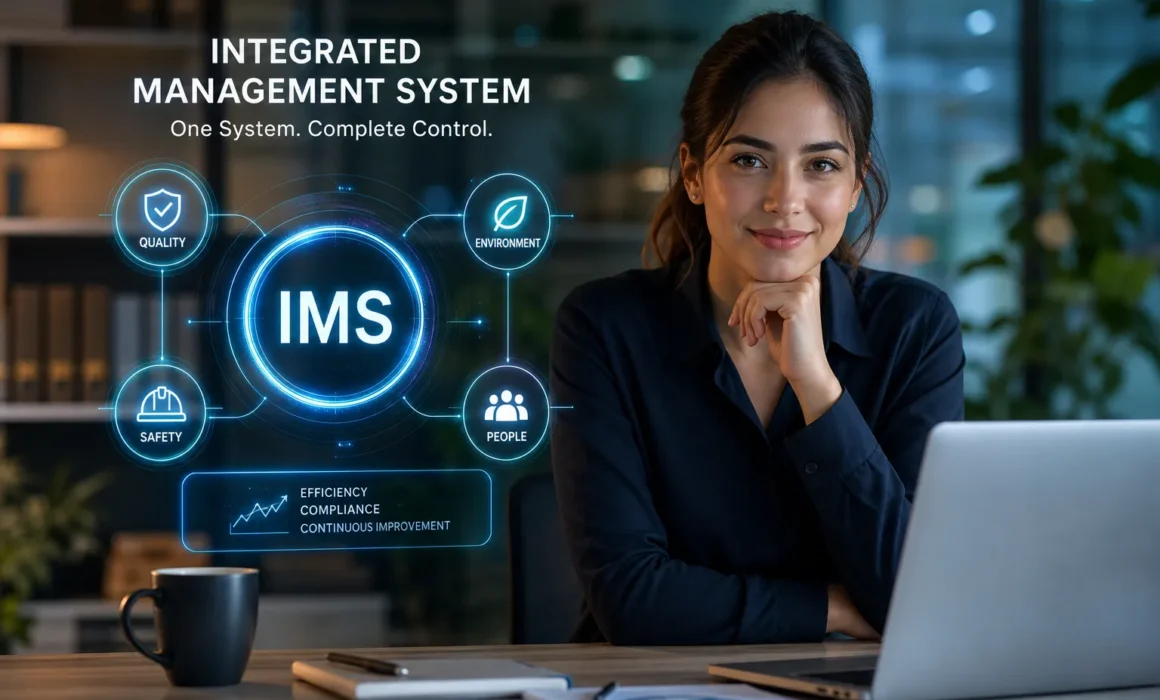
You’ve worked hard to achieve your first ISO certification. Now a key client is asking for a second standard, or a tender requirement has landed on your desk specifying three. The moment you start running two separate management systems, the administrative overhead increases significantly: two audit cycles, two sets of policies, two internal audit programmes, and two sets of annual fees. It quickly starts to feel like operating parallel businesses inside the same organisation.
This is exactly the problem an integrated management system (IMS) is designed to solve. Rather than treating each ISO standard as its own silo, an integrated management system brings two or more standards together into a single coordinated framework. You manage one system, undergo one audit cycle, and maintain one set of shared documentation. ISO-Cert Online Ltd has made single-audit IMS certification accessible to UK SMEs without dedicated compliance teams, at a fixed, transparent price point.
This article covers what an IMS actually is, which standards get combined most often, how to build one from the ground up, what auditors look for at certification, and what it realistically costs. By the end, you’ll have a clear picture of whether the integrated route makes sense for your business.
An IMS is not a separate ISO standard you apply for. It’s a design decision. Instead of running three management systems that each have their own policies, risk assessments, internal audits, and management reviews, you build one system that satisfies the requirements of all your chosen standards simultaneously. The structure is shared; only the domain-specific requirements sit apart.
Any well-built integrated management system rests on the same core components: a unified policy and objectives, shared documentation and record control, integrated risk management, a single internal audit programme, and one management review cycle. These aren’t duplicated for each standard, they’re designed once and built to serve all of them. That’s where the real efficiency comes from.
ISO deliberately designed its modern management system standards to share the same high-level clause sequence. This framework, formally known as the Harmonized Structure (previously called Annex SL), runs from Clause 4 (context of the organisation) through to Clause 10 (improvement). ISO 9001, ISO 14001, and ISO 45001 all follow this same skeleton, which means the shared requirements covering leadership, planning, support, performance evaluation, and continual improvement can be written once and applied across all three.
This structural alignment is what makes an integrated management system practical rather than just a good idea on paper. The groundwork is already done inside the standards themselves. Your job during implementation is to build your system to take advantage of it, rather than recreating the same clauses three times over in three separate folders.
The most frequently combined set is ISO 9001 (quality management), ISO 14001 (environmental management), and ISO 45001 (occupational health and safety). This trio is particularly common in manufacturing, construction, and operations-heavy environments where quality, environmental impact, and worker safety are all active concerns. Their requirements genuinely overlap in areas like operational planning, risk assessment, competence and training, internal audit, and continual improvement.
ISO 27001 (information security management) is increasingly added by technology companies and businesses handling sensitive client data. ISO 50001 (energy management) is a natural addition for energy-intensive organisations, and ISO 22301 (business continuity) is frequently included by businesses where service resilience is critical. An IMS isn’t a fixed combination, it scales with whatever standards your business actually needs, making it a flexible form of integrated ISO management.
Each standard also carries domain-specific requirements that can’t be shared across the whole system. ISO 14001 requires an assessment of environmental aspects and impacts. ISO 45001 requires formal hazard identification. ISO 27001 goes further, requiring a formal information security risk treatment plan and a structured approach to asset classification. These requirements sit alongside the shared structure rather than conflicting with it. A well-designed IMS handles them as discipline-specific modules within one overall framework, not as separate systems bolted awkwardly together.
Implementation follows a clear progression. Start by defining your scope: which standards you’re integrating and what business outcomes the IMS needs to support. Then secure leadership alignment, because an IMS that lacks genuine buy-in from the top rarely survives contact with day-to-day operations. After that comes a gap analysis comparing your current practices against the combined requirements of all chosen standards. This stage is where most of the design decisions get made, and it’s worth taking seriously.
Once the gaps are mapped, you move into process and documentation design: creating shared policies, procedures, and work instructions that satisfy all applicable clauses without duplication. A phased rollout follows alongside employee training and a full cycle of internal auditing before the certification stage.
Timelines vary considerably depending on your starting point. SMEs building on an existing certified standard can often reach certification readiness in 3 to 6 months, but businesses starting from scratch or integrating more than three standards should typically allow 6 to 12 months. Existing management maturity, team capacity, and the number of standards involved all affect the pace.
A common concern is that an IMS means three times the paperwork. It doesn’t. The goal is shared documentation where requirements align, and standard-specific documentation only where they genuinely diverge. Auditors expect an integrated policy, a scope document, and shared procedures for risk management, internal audit, corrective action, and management review. Standard-specific procedures cover the unique requirements, such as environmental aspects registers for ISO 14001 or hazard and risk assessments for ISO 45001.
The guiding principle here is worth remembering: documents should exist because they help you run the system, not because they fill a folder. Over-documentation is one of the most common ways IMS projects grind to a halt, so keep it lean and purposeful from the start.
The gap analysis stage catches most businesses out, but it’s rarely the only stumbling block. The first mistake is treating integration as a filing exercise: putting three separate documents into one folder and calling it an IMS. Auditors see through this immediately, and it means you’ve gained none of the efficiency benefits. Rushing the gap analysis is the second problem; businesses that skip past this step tend to discover compliance gaps during the certification audit, which is the worst possible moment. The third pitfall is failing to train staff adequately, so the system exists on paper but not in practice.
Each of these is avoidable with proper planning. Build your shared processes first, verify them through internal audit, and make sure your team can explain what they do and why before the external auditor arrives.
Rather than three separate certification audits with three separate audit teams, an integrated management system is assessed in a single audit against all your chosen standards simultaneously. The auditors examine the combined management system as a whole: shared processes, combined management review records, and a single internal audit programme that covers all standards rather than just one. This approach is typically faster, less disruptive, and cheaper than running separate audits.
The two-stage certification process still applies. Stage 1 reviews your documentation and assesses readiness; Stage 2 assesses implementation on the ground. Both stages cover all integrated standards in one process, so your team only goes through the experience once rather than repeatedly across different audit cycles.
Auditors want to see that the system is genuinely integrated, not merely co-located. This means combined internal audit reports that cross-reference all standards, management review minutes that address all three domains, and staff who understand and follow shared procedures confidently. Experienced auditors are skilled at spotting a system assembled for the audit rather than operated in daily practice.
The most effective preparation is simply running the system properly from the start. If your internal audits are thorough, your management review is substantive, and your team understands the processes they follow, the certification audit becomes a confirmation of what you already know rather than an anxious test.
For a smaller UK business pursuing three-standard IMS certification, realistic Year 1 all-in costs (covering implementation support and certification fees) sit in the region of £3,200 to £12,000 depending on complexity and whether external consultancy is involved. A combined audit typically costs less than three separate audits, with indicative savings of roughly £700 to £2,500 per year on audit fees alone, though the actual figure varies by company size and audit scope. Documentation and admin overhead is often reported to run around 30% lower under an IMS compared with managing separate systems, and many SMEs find that the efficiency gains offset first-year investment costs within twelve months, though payback depends on your existing setup and the standards involved.
Timeframes for SMEs range from 3 to 6 months for businesses with an existing certified standard as a base, up to 12 months for those building from scratch across multiple disciplines. Surveillance visits are also consolidated under a single annual cycle, reducing the ongoing disruption that comes with staggered separate audits.
For SMEs without a dedicated compliance team, two barriers tend to dominate: cost uncertainty and process complexity. ISO-Cert Online Ltd is designed to address both. They offer single-audit IMS certification delivered entirely via remote audit, with a fixed-price model and a document portal that guides businesses through the documentation process step by step. You don’t need to know exactly where to start, the portal shows you.
Their scope covers multiple ISO standards including ISO 9001, ISO 14001, ISO 45001, ISO 27001, and ISO 22301, meaning most common IMS combinations can be handled under one provider, one process, and one annual audit cycle. For an SME managing multiple standards, that consolidation alone is worth considerable time and money each year. The service is built around the needs of smaller organisations, so the process is scaled appropriately rather than borrowed from an enterprise compliance model.
An integrated management system isn’t a luxury reserved for large organisations with compliance departments. It’s a smarter way for any business holding, or planning to hold, more than one ISO standard to manage its obligations without duplicating effort across parallel systems. The Harmonized Structure already does much of the structural heavy lifting at the standards level. Your job is to design shared processes that genuinely serve the business, then demonstrate through evidence that they work.
For UK SMEs looking to certify across multiple standards, the single-audit route is measurably more affordable and far less disruptive than managing separate certifications in parallel. The documentation is lighter, the audit process is streamlined, and the ongoing maintenance burden is significantly reduced.
If you’re ready to explore which IMS combination suits your business, visit ISO-Cert Online Ltd to find out more and get a fixed-price quote. One system, one audit, one straightforward path to certification.
Ready to get started?
Contact us today on +44 (0)333 014 7720 or email info@isocertonline.net for a free consultation. You can also get a quote online in minutes.
Don’t let cost hold you back from achieving ISO certification. With ISO-Cert Online, management systems certification is affordable for every business.





Copyright © 2025 ISO-Cert Online Ltd. All Rights Reserved




Recent Comments