Articles Tagged with
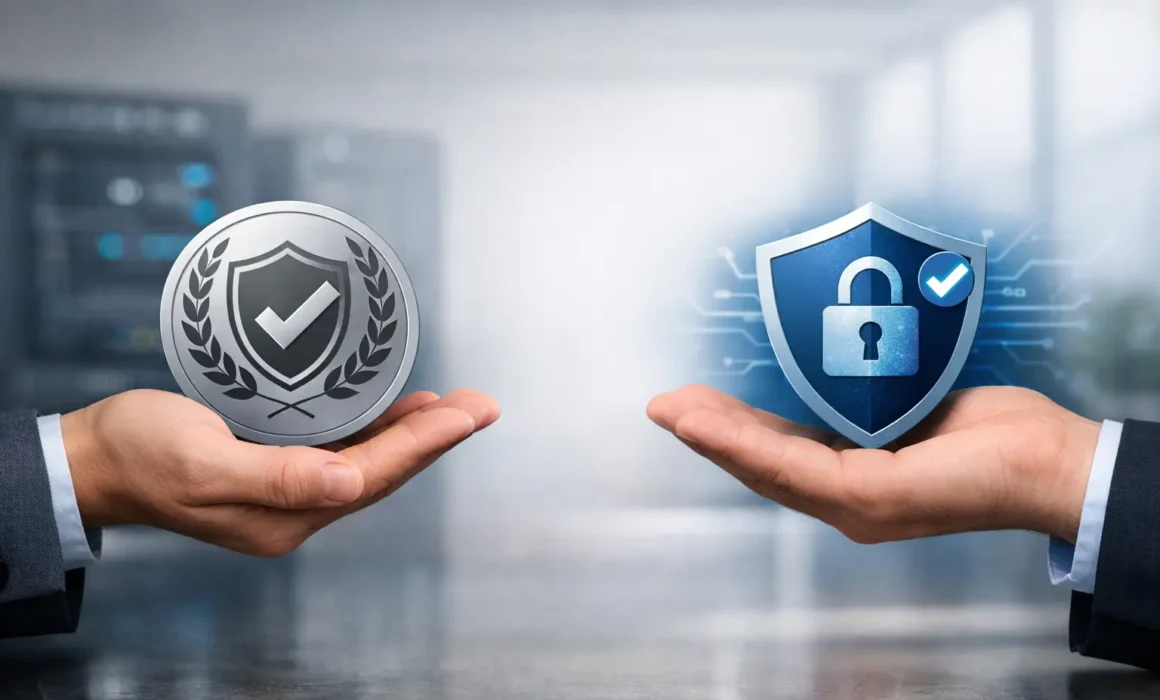
If you are weighing up iso 27001 vs cyber essentials, you are probably not doing it for academic reasons. You need to win work, satisfy customer security checks, reduce risk, or stop security compliance turning into a long, expensive project your team has no time for. For most UK SMEs, the real question is not which one sounds better. It is which one solves the business problem in front of you.
ISO 27001 vs Cyber Essentials: the short answer
Cyber Essentials is the lighter, faster option. It focuses on a defined set of technical controls designed to protect against common cyber threats. ISO 27001 is broader and more demanding. It is a full information security management system that looks at how your organisation identifies, manages and improves information security risks over time.
That means Cyber Essentials is often the quickest route if a client or tender simply asks for baseline cyber assurance. ISO 27001 is usually the better fit if you need a recognised framework for managing information security across the business, especially where customer expectations, contractual requirements or data sensitivity are higher.
They are not direct substitutes in every situation. In many cases, they sit well together.
What Cyber Essentials is really for
Cyber Essentials was designed to help organisations put basic cyber hygiene in place. It looks at practical technical areas such as firewalls, secure configuration, access control, malware protection, patch management and device security.
For smaller businesses, that can be a major advantage. The scope is easier to understand, the evidence burden is lower, and the path to certification is usually much shorter than a full management system standard. If your business needs a credible, practical starting point, Cyber Essentials is often the least painful way to get there.
It also has strong commercial value. Some public sector supply chains and customer procurement teams ask for it because it shows you have taken basic security controls seriously. If the requirement is clear and specific, there is no benefit in overcomplicating the answer.
What ISO 27001 is really for
ISO 27001 goes much further. It is not just about whether anti-malware is installed or devices are patched. It asks how you assess risk, define responsibilities, document controls, manage incidents, train people, review suppliers, set objectives and continually improve your approach to information security.
That broader scope is why ISO 27001 carries more weight in many markets. It shows that security is not being handled as a one-off checklist but as a managed business discipline. For companies handling sensitive client data, operating in regulated environments, working with larger corporate buyers or scaling quickly, that distinction matters.
The trade-off is obvious. ISO 27001 takes more effort. There is more documentation, more decision-making and more internal ownership required. But it also gives you a stronger framework that can grow with the business rather than needing to be replaced once customer expectations become more demanding.
The biggest differences that matter to SMEs
The first difference is scope. Cyber Essentials focuses on specific technical controls. ISO 27001 covers technical, organisational and procedural controls, along with leadership oversight and ongoing improvement.
The second is depth. Cyber Essentials is about proving that key protections are in place. ISO 27001 is about building a repeatable system for identifying risks and applying appropriate controls across the organisation.
The third is business impact. Cyber Essentials can often be achieved relatively quickly and with less disruption. ISO 27001 tends to produce wider operational benefits, such as clearer processes, better supplier control, improved incident handling and stronger internal accountability.
The fourth is perception. Cyber Essentials is widely respected as a baseline. ISO 27001 is generally seen as the more mature and comprehensive standard. If you are bidding for higher-value contracts or dealing with security questionnaires from larger customers, that difference can affect buying confidence.
Which is easier to get?
Cyber Essentials is easier for most SMEs, especially if your IT estate is simple and reasonably well managed already. If you use supported software, apply updates promptly, control admin access and secure endpoints properly, you may be closer than you think.
ISO 27001 is more involved because it requires management system thinking. You need defined scope, policies, risk assessment, control selection, internal review and evidence that the system is being maintained. That can sound heavy, but with the right support and practical templates, it is still very achievable for smaller businesses.
The mistake many SMEs make is assuming ISO 27001 is only for large enterprises. It is not. The real issue is whether you approach it in a pragmatic way or drown in unnecessary paperwork.
Cost, speed and internal effort
For most smaller firms, Cyber Essentials will usually be cheaper and faster. That makes it attractive when you need a result quickly, whether for a live tender, a customer onboarding process or a short-term compliance target.
ISO 27001 requires a bigger investment of time and attention. However, cost should not be judged only by the price of certification. If poor security governance leads to failed tenders, repeated customer questionnaires, duplicated processes or unmanaged risk, the cheaper route can become the more expensive one over time.
This is where a digital-first approach makes a real difference. When implementation, document control, guidance and audit activity are handled remotely and efficiently, ISO 27001 becomes far more accessible for SMEs than many expect. That is one reason businesses often choose practical online support rather than traditional consultancy that drags the process out.
Do you need one or both?
Sometimes the answer is one. Sometimes it is both.
If a tender or customer specifically asks for Cyber Essentials, start there. It is the clearest route to meeting that requirement. If your clients expect a formal information security management system, ISO 27001 is likely to be the stronger answer.
But there are plenty of businesses that benefit from holding both. Cyber Essentials provides visible assurance around baseline cyber controls. ISO 27001 adds the wider governance framework. Together, they create a stronger position commercially and operationally.
This can be especially useful for IT providers, professional services firms, SaaS businesses, manufacturers handling customer data and outsourced service providers. In those sectors, buyers often want confidence that both day-to-day cyber basics and broader security governance are in place.
When Cyber Essentials is enough
Cyber Essentials may be enough if your main goal is to meet a basic supply chain requirement, reassure customers on common cyber risks or put a sensible security foundation in place without committing to a larger programme.
It is also a good fit for businesses at the start of their compliance journey. If your internal processes are still informal and you want a practical first step, Cyber Essentials can create momentum without overwhelming the team.
That said, it has limits. It does not provide the same level of assurance around governance, risk methodology or continuous improvement. If customers start asking harder questions, you may quickly find you need something more comprehensive.
When ISO 27001 is the better choice
ISO 27001 is usually the better choice if information security is central to your service, your customers are more demanding, or your business needs a recognised framework that supports growth. It is particularly relevant where you deal with confidential information, have multiple suppliers and systems to manage, or need a clearer structure for risk ownership.
It is also often the smarter long-term choice if you are repeatedly facing due diligence questions from prospects. Instead of answering each security question from scratch, you build a system that makes those conversations easier and more credible.
For SMEs that want to move upmarket, ISO 27001 can be more than a compliance exercise. It can help remove friction from sales.
How to decide without wasting time
Start with the trigger. Are you responding to a stated tender requirement, trying to reduce actual security risk, or aiming to strengthen market credibility? The trigger usually tells you where to begin.
Then look at your customers. If they only need baseline assurance, Cyber Essentials may be enough for now. If they expect formal governance, supplier controls, risk treatment plans and documented processes, ISO 27001 is likely to be the better fit.
Finally, be honest about internal capacity. A smaller business does not need a large compliance department, but it does need a realistic implementation route. Fast, affordable support matters because the longer certification drags on, the more likely it is to lose momentum.
That is why many SMEs choose guided online delivery. With a clear plan, tailored templates and remote support, certification becomes a manageable project rather than a distraction from running the business. For companies that want speed and clarity, ISO-Cert Online Ltd is built around exactly that model.
The sensible way to think about it
The best decision is not the one with the most paperwork or the best acronym. It is the one that matches your commercial goals, risk profile and timeframe. Cyber Essentials is a strong baseline. ISO 27001 is a broader system with more strategic value. Neither is automatically right for every SME.
If you need a quick, credible answer to common cyber requirements, Cyber Essentials makes sense. If you need a stronger framework that supports trust, tenders and long-term growth, ISO 27001 is often worth the extra effort. And if your business is serious about security and sales readiness, doing both may be the most practical move of all.
Choose the route that solves the problem you have now, but make sure it also leaves room for where the business is heading next.
Ready to get started?
Contact us today on +44 (0)333 014 7720 or email info@isocertonline.net for a free consultation. You can also get a quote online in minutes.
Don’t let cost hold you back from achieving ISO certification. With ISO-Cert Online, management systems certification is affordable for every business.







Recent Comments