Get a Quote
Articles Tagged with

ISO 14001

Home / ISO 14001
ISO certification
Article, News

When Might A Business Need Quality Management Certification?

Companies of all shapes, sizes and scales have expressed an interest in receiving ISO certification, even though it is not a strict business need per se to do so.

There are a lot of benefits to organising your business and running under ISO 9001:2015 quality management standards and practices, but whilst being certified by an accredited company brings with it a wide range of benefits, there is no regulatory or legal requirement to do so.

However, there might be some occasions where an ISO 9001 certificate becomes an effective necessity due to business requirements, rather than a system that allows a company to opt-in to more long-term benefits.

A Prerequisite To Close A Deal

One of the main reasons why companies are interested in ISO 9001, particularly if they want to get certified quickly, is because they need it to meet the prerequisite of a company or government tender.

Many larger businesses who work with a network of smaller suppliers have prerequisites before they allow a business to work with them, and whilst this will naturally vary by market sector and particular need, one of the most common requirements is ISO 9001 certification.

Many government agencies have replaced bespoke standards with one based on ISO 9001 because it allows for a more streamlined approach to tenders and enables these companies to focus on the more specific aspects of a tender application.

Getting certified, therefore, becomes a requirement for many businesses that work closely with government agencies.

This may be the catalyst for getting certified, but it is also an opportunity to make sustained, effective and long-term changes to the business that provides far more than an immediate gain.

Open For International Business

When working with international clients, there is a need for a universal language mutually understood by both parties, which in many cases involves the use of mutually understood and referenced standards.

One of the biggest benefits of ISO standards in general, but particularly ISO 9001, is that they are universal; to date, 167 countries have national ISO members, which means that the standard is understood and recognised practically anywhere you might do business.

This makes an ISO 9001 certificate an effective requirement when doing business overseas, as it means that a company knows that your business is focused on quality management in a way that is universally understood and can therefore focus on what your company brings to the table.

Get The Best Employees

Typically, when businesses talk about ISO 9001 as a requirement, they are generally referring to the needs of customers. However, it can also be an important tool for improving recruitment, with the right candidates knowing how the quality management standard can help them personally and professionally.

One of the key requirements of ISO 9001 concerns employee management and job expectations.

Having a clear set of quality objectives, procedures, instructions and process metrics allows for a culture of constant feedback and improvement, with an emphasis on constantly learning and developing.

Many employees who would be perfect for your corporate culture will see the standard as one that prioritises them and how they can contribute to the goals of the organisation.


Find out more…

If you would like to find out more about Quality Management Systems and how implementing them could benefit your business, the ISO 9001 standard, or any of the other services we offer here at ISO-Cert Online, please contact us on 0333 014 7720 or email info@isocertonline.net.

Abstract technology background. Security system concept with fingerprint.
Article

The Core Quality Management Principles Of ISO Certification

When businesses are interested in ISO certification, the fastest way to achieve this is through a dedicated online service that will help them meet the necessary quality management standards.

When businesses are looking for certification, they are typically thinking about the ISO 9000 family, which is a set of five quality management systems (QMS) that ensure that businesses are meeting their regulatory responsibilities, whilst also ensuring they are keeping up with the demands of customers and stakeholders alike.

Of the five ISO 9000 QMS standards, the one that most companies are looking for is ISO 9001:2015, often known simply as “ISO 9001”, “ISO 9000” or even simply “ISO”.

The standard itself is based around a 30-page set of requirements but its fundamental focus is based on seven quality management principles (QMP) which form or at least should form a foundation for how a business is managed and operated.

Here are the seven and why they matter.

Customer Focus

The first QMP standard is perhaps the most obvious one. As the late entrepreneur and businessman Jack Tramiel put it, businesses are there to serve the customer.

Without customers, businesses simply cannot exist, and with that in mind, companies focused on ISO 9001 should be mindful not only of customer needs right now but the future of their needs in the future.

The priority should be to meet the standards of the customer and serve them, ensuring that the customer’s expectations are understood so they can be delivered upon effectively and efficiently.

Leadership

One of the most critical and misunderstood aspects of many businesses is structure, hierarchy and leadership, as well as the role of leaders in organisations of varying scales.

Leaders need to be the ones to form and shape a united direction and purpose of any organisation and be able to lead a wide range of disparate teams in the same direction to achieve the overarching mission of the company.

Engagement Of People

Companies are ultimately collectives of diverse, skilled individuals, and ultimately no company succeeds without people who are able to do the job they are employed to, are empowered and recognised for their abilities, and buy into the overall goals of the organisation.

Without people on board, you do not have a company.

Process Approach

Business activities are typically a series of interrelated processes that work together to create an overall system, and once a business fully understands this, it can manage and continually improve these processes to achieve consistent output results.

Improvement

Perfection is an overall goal, but not one that is achievable. There is always room for improvement, and an eternal goal for any organisation is to keep getting better, streamline processes and get the greatest return out of every part of the business.

Evidence-Based Decision Making

Data dominates the business world, and whilst one should avoid discounting anything that cannot be quantified, decisions should be made based on effective, objective analysis to as much pertinent information as possible.

Relationship Management

No business exists in a vacuum. Virtually every company has contractors, suppliers, service providers and other stakeholders that are part of symbiotic, interdependent business relationships. It is important to see the value in these relationships and foster them to ensure everyone thrives.


Find out more…

If you would like to find out more about ISO standards and how implementing them could benefit your business, or any of the other services we offer here at ISO-Cert Online, please contact us on 0333 014 7720 or email info@isocertonline.net.

A hand holding a set of gold cogs with a futuristic background.
Article

Streamline your success: the advantages of integrating ISO standards

Home ISO 14001 Page 2

Are you a business owner or leader who has already implemented multiple ISO standards in your organisation? If so, you’ll know that it can be challenging to manage them all with the same focus and approach. But did you know that you can streamline your standards into an integrated management system (IMS)? So, in this article, we’ll explore the advantages of integrating ISO standards and how this will help you to streamline your success and experience a boost to your business.

Enhance efficiency:

By integrating your ISO standards, you can draw together how to approach your management systems. So instead of juggling separate processes and documentation for each standard you can use a unified framework. By doing this, you can optimise how you allocate resources, avoid duplication of effort, and increased efficiency in how you implement and maintain compliance across your business.

Create synergy:

Teamwork makes the dream work, right? And integrating your ISO standards helps you to develop closer working between your colleagues. Across your ISO standards, such as, ISO 9001, ISO 14001, ISO 27001, ISO 45001, ISO 50001, or ISO 22301 (to name a few), there are common elements or similar themes which you can organise into a comprehensive and harmonised system. Everyone pulling in the same direction brings with it fewer conflicting requirements, improved consistency and more effective communication and collaboration across your teams.

Save time and money:

Although the benefits of ISO certification are not in question, some businesses find that managing multiple ISO standards individually can be time-consuming and costly. Did you know that, by integrating ISO standards, you can simplify the overarching management process and make significant savings on operational downtime? This is because that there’s no need to conduct separate audits for each standard. You can also slim down the number of records and documentation you need to maintain. Plus, you can train your staff more quickly on an integrated management system than on several individual standards.

Reduce risks:

Integrating ISO standards enables you to identify and mitigate risks more effectively. Through joined-up thinking, your teams can work together to evaluate potential risks across your whole organisation. This can lead to much faster identification and more strategic risk management, which delivers greater protection for your business.

Encourage continual improvement:

At their core, ISO standards aim to support ongoing, continual improvement. Integrating your ISO standards supports the leaders in your business to think along the same lines when identifying areas of improvement, monitoring performance, and implementing corrective actions. This, in turn, encourages a common sense of approach, which can be calibrated across different teams, to continual improvement, advancing innovation and improving your overall business performance.

“Where appropriate, we always recommend that our clients consider integrating their management systems. It makes sense to work from a single manual rather than having to refer to multiple sets of documentation. And the benefits go far beyond simple efficiency, with clients reporting fundamental improvements in teamwork which have significantly improved morale and their bottom line!”

Claire Howard, Director of ISO-Cert Online Ltd

Next steps

At ISO-Cert Online Ltd, we specialise in helping businesses to achieve an integrated management system with ease. For more information on our services or to discuss your requirements please contact us on 0333 014 7720 or email info@isocertonline.net.

A factory scene. New bottles are lined up along a conveyor belt.
Article

The importance of ISO standards in the food industry

Home ISO 14001 Page 2

Globally, the food and drink manufacturing industry is one of the most strictly controlled industries. It has regulations governing everything from food safety and production processes through to labelling and packaging. What’s more, quality and safety levels must be maintained at all times across supply chains. ISO certification provides those in the food industry with a comprehensive framework to make meeting these requirements more manageable. So, in this article, we’ll explore the importance of ISO certification in the food industry.

ISO 22000 and food safety management systems:

Regardless of the size of an organisation or its product, all food producers and distributors have a responsibility to manage the safety of their products and the well-being of their consumers. Compliance with current food safety standards, potentially across different continents of the world, is essential but can be complex. So the International Organization for Standardization developed ISO 22000 for use within the global food supply chain. Its aim was to bring people food that they can trust.

The consequences of unsafe food can be serious. So implementing a food safety management system (FSMS), such as ISO 22000, is essential. It guides you through how to make careful risk assessments as well as manage hazards, monitor processes, and apply controls. By achieving certification, firms clearly establish themselves as advocates for sustainability and safe practices. Also significantly reducing the likelihood of foodborne illness outbreaks – e.g. Norovirus, Salmonella and Listeria. Such outbreaks are not only unpleasant for consumers. They can lead to product recalls, reputational damage, the risk of penalties and fines. Moreover, in very serious instances, company closure.

Other ISO standards in the food industry:

Although ISO 22000 is specifically relevant to the food industry, there are a range of other ISO standards which are popular and appropriate for the sector.

ISO 9001: The most common ISO standard supports businesses in improving their quality management processes. This leads to food products being high quality and meeting customer requirements.

ISO 14001: Consumers are placing greater value on the provenance of what they eat and how it’s packaged. So implementing an environmental management system encourages businesses to improve their environmental impact and operate sustainably.

ISO 45001: Regardless of your industry, you should want to provide a safe workplace for your staff. In food manufacturing specifically, heavy machinery used in the production process can pose a risk if not used correctly or safely. An occupational health and safety management system provides a framework for managing safety at work. This improves the protection of your staff in their day-to-day roles.

“Food is essential in our lives – not just for sustenance but for socialising and cultural identity. Whether your company is involved in the production, processing, and distribution of food products, or you supply ingredients or packaging materials to the food industry, ISO standards enable you to uphold the highest standards, demonstrating your commitment to delivering reliable and trustworthy products to consumers.”

Claire Howard, Director of ISO-Cert Online Ltd

Not yet ISO certified?

For more information on ISO-Cert Online’s services or to discuss your requirements please contact us on 0333 014 7720 or email info@isocertonline.net.

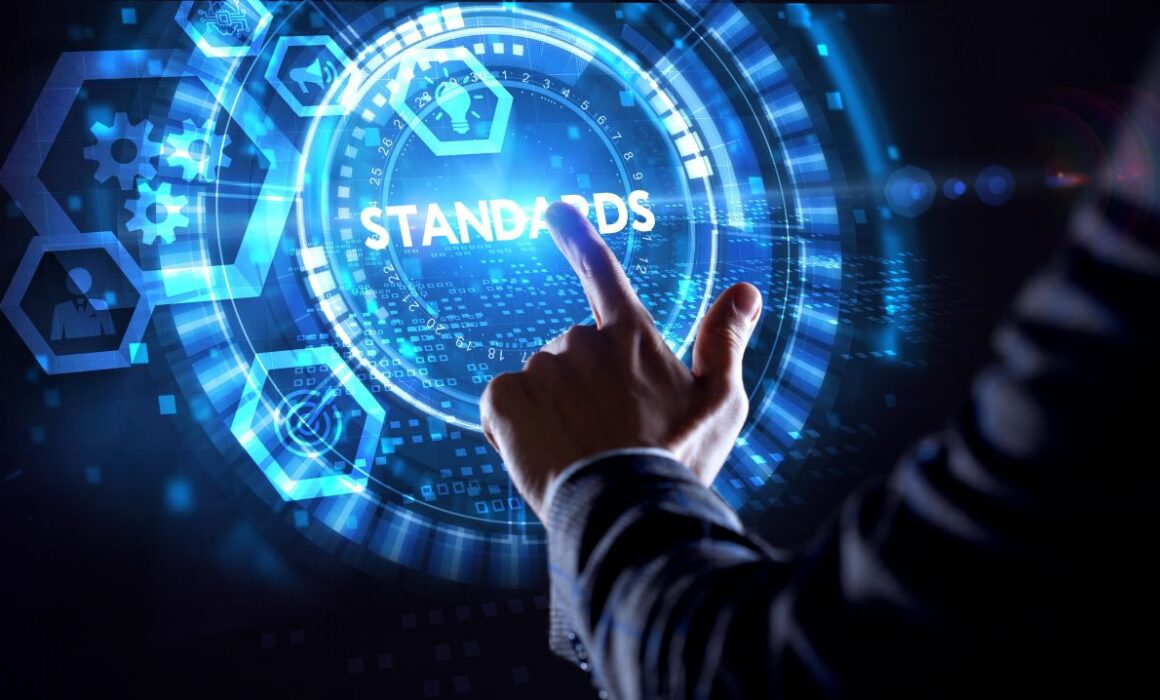
Digital screen entitled Standards with relevant icons, such as a target, a lightbulb, cogs and people.
Article

Driving operational excellence: how ISO standards empower SMEs

Home ISO 14001 Page 2

Every day, small and medium size businesses (SMEs) face a range of operational challenges that can hinder growth and success. Often, the fundamental areas of concern include process efficiency, health and safety, information security, environmental responsibilities, and business continuity. So, in this blog, we’ll highlight how ISO standards can provide a solution for getting over these hurdles and enhancing your competitive edge.

ISO standards can be implemented in businesses of any size and across all industries and sectors. They have been developed to make life easier, safer and better. So how exactly can they help you?

ISO 9001: Enhancing quality management

If you’re looking to improve the quality of your products or services, ISO 9001 can help you to develop your process management. It offers guidance-based solutions. And provides insights on documented workflows, specific directions, and standardised operation procedures. Thereby leading to quality delivery while ensuring efficiency with your resources. This standard enables SMEs to identify areas for improvement and achieve consistent quality. In so doing, companies can meet customer expectations, resulting in enhanced credibility and customer loyalty.

ISO 14001: Driving environmental sustainability

Embracing environmental responsibilities is not only the right thing to do for the planet. Also, it brings many benefits to companies. As a result, environmental sustainability is an increasingly important consideration for businesses. ISO 14001 provides SMEs with guidelines for implementing effective environmental management systems. By adopting ISO 14001, SMEs can minimise their environmental impact, reduce waste generation, conserve resources, and comply with environmental regulations. So this not only demonstrates their commitment to sustainability, but also opens doors to eco-conscious customers and business opportunities.

ISO 50001: Optimising energy management

Effective energy management is crucial for SMEs seeking to improve operational efficiency and reduce costs. ISO 50001 offers a systematic approach to optimising energy use. By implementing ISO 50001, SMEs can identify energy-saving opportunities. Also, it helps them to establish effective energy management systems. And it can support them in reducing their carbon footprint. Furthermore, this results in significant cost savings, enhanced environmental performance, and a competitive edge in a sustainability-focused market.

ISO 45001: Ensuring occupational health and safety

Ensuring the health and safety of employees is a top priority for SMEs. So ISO 45001 assists SMEs in establishing robust occupational health and safety management systems. By adopting ISO 45001, SMEs can identify potential hazards, mitigate risks, and create a safe working environment. Indeed, this leads to a reduction in accidents and reduced unforeseen stoppage time. Additionally, it results in improved employee morale and increased productivity, while also ensuring compliance with relevant regulations.

ISO 27001: Safeguarding information security

Information security is essential in today’s rapidly changing digital age. ISO 27001 provides a comprehensive framework for managing information security risks. By implementing ISO 27001, SMEs can identify vulnerabilities, establish information security policies and procedures, and protect sensitive data. This helps build customer trust, prevents data breaches, and ensures compliance with data protection regulations.

ISO 22301: Enabling business continuity

When it comes to continuously meeting customer expectations, the challenge of maintaining business continuity through unpredictable standalone events could be daunting. ISO 22301 provides businesses with actionable strategies to proactively establish comprehensive plans that help minimise downtime, discouraging bottom-line losses while continuity of service remains unaffected by situational disruptions. This promotes the stability of critical functions, safeguards customer relationships, and enables rapid recovery.

“Implementing ISO standards is like putting your business in a suit of armour. It shields you from risks, fortifies your processes, and defends your reputation. With any of these standards, or a selection, your business becomes a formidable force, empowered to conquer challenges and withstand competition.”

Claire Howard, Director of ISO-Cert Online Ltd

For more information on ISO-Cert Online’s services or to discuss your requirements please contact us on 0333 014 7720 or email info@isocertonline.net.
Aerial view of a city, featuring a wooded space and lots of skyscrapers. Across the image there are sustainability themed icons, such as water, plants, trees, recycling, a globe, knives and forks, cogs, solar panels, a wheelchair user, a graph showing results, and a heart.
Article

Let ISO 14001 certification give your business a sustainable advantage

Home ISO 14001 Page 2

Responsibility for the environment is now one of the most significant considerations for consumers and businesses around the world. People judge the impact that businesses have on the environment with greater scrutiny. So the opportunity arises for organisations to boost their brand and reputation and create a sustainable advantage through green practices. By aligning with consumer values and demonstrating a strong commitment to protecting our planet, let ISO 14001 certification give your business a sustainable advantage. After all, businesses which prioritise sustainability are better placed to succeed in the future.

Figures from recent studies appear to confirm this:

  • Global Google searches for topics related to sustainable products increased by around 130% between 2017 and 2022.
  • 78% of consumers feel that sustainability is important.
  • 55% of consumers are willing to pay more for eco-friendly brands.
  • In 2021, 50% of global consumers said that they had become more eco-friendly in the past six months.

Conversely, poor environmental practices can alienate customers. Importantly, the following factors play a role in making consumers turn their backs on a brand:

  • Poor environmental track record (84%)
  • Unsustainable packaging (83%)
  • Poor compliance record (82%)
  • Irresponsible sourcing of materials (82%)
  • Poor human rights track record (82%)

How can you bring your operations more in line with these values?

One way that you can demonstrate your business’ commitment to sustainability is to obtain ISO 14001 certification. In brief, this is awarded to businesses which have implemented an effective environmental management system (EMS). And ISO 14001 certification gives your business a sustainable advantage in several ways:

Improving your brand reputation:

ISO 14001 certification is recognised around the world as a mark of environmental excellence. By obtaining this certification, you are making a clear statement to your key stakeholders. (For example, your existing and potential customers, suppliers and society in general.) Above all, you are showing that you are committed to sustainability and responsible environmental management.

Increasing operational efficiency:

An effective EMS can help you detect opportunities for improvement. For instance, reducing waste, improving energy efficiency, and optimising how you use resources within your organisation. By implementing these improvements, you can reduce your environmental impact. Additionally, you can reduce costs and make cost savings.

Guaranteeing regulatory compliance:

Businesses which operate in highly regulated industries or sectors may need to demonstrate compliance with environmental regulations. Indeed, ISO 14001 certification provides a comprehensive framework for compliance, helping businesses to avoid penalties and legal risks.

Reducing environmental risks:

Environmental risks, such as pollution, climate change, and resource depletion can pose a significant threat to businesses. Here, ISO 14001 certification can help you identify and mitigate these risks. In fact, it can help you to reduce the likelihood of disruptions to your operations and supply chain. In turn, this will keep your customers satisfied.

Gaining a competitive edge:

In obtaining ISO 14001 certification, your business will stand out from your competitors that have not made the same commitment to sustainability. Of course, this can give you a competitive advantage in your marketplace, attracting environmentally conscious customers.

How can you let consumers know that you are taking steps to reduce your environmental impact?

Some businesses struggle to communicate their green credentials. Typically, for fear of people accusing them of greenwashing. However, with ISO certification under your belt and an effective EMS in place, you only need to look to how your business operates to find things which will appeal to environmentally conscious consumers. As a starting point:

Incorporate sustainability into your brand messaging:

Make sure that your brand messaging reflects your commitment to sustainability. Create a brand promise with sustainability at its core. It will reassure consumers that reducing your environmental impact is at the heart of how you deliver your products/services.

Use eco-friendly packaging:

Across the world, packaging is a huge source of waste. And consumers are increasingly concerned and frustrated about its environmental impact. Have you considered using eco-friendly packaging materials? For instance, recycled materials, biodegradable alternatives or even simply reducing the amount of packaging you use. After all, your packaging is a tangible element of your brand. So, you can show consumers that you are committed to playing your role in protecting the planet through responsible environmental management.

Communicate your sustainability initiatives:

Share your successes! Let people know about any activities or schemes you’re involved in which contribute to improving the environment. Moreover, use social media, your website, email newsletters, advertising and other channels to communicate your sustainability initiatives. For example, reducing carbon emissions, conserving water, or supporting environmental causes.

Partner with environmentally focused organisations:

Teaming up with carefully-chosen organisations which are focused on environmental issues can help you demonstrate your commitment to sustainability. And boost your brand reputation. So, consider allying yourself with local or national non-profit organisations that focus on environmental causes. Or work with suppliers that have strong sustainability initiatives.

Finally, an EMS provides a framework for continuous improvement. It helps you identify areas where you can reduce your environmental impact and implement solutions to address these areas. So, achieving ISO 14001 certification is just the start of an exciting journey of you becoming increasingly environmentally friendly. Let ISO 14001 certification give your business a sustainable advantage today!

“It seems that almost every day there’s a new story about how companies have fallen foul of their environmental duties. As an environmentalist, I am particularly passionate about ISO 14001 and its value in supporting businesses to implement and maintain an Environmental Management System so that they can operate as sustainably as possible. And, based on consumer trends, ultimately being a responsible business is good for business too.”

Steve Weaver, Director of ISO-Cert Online Ltd

For more information on ISO-Cert Online’s services or to discuss your requirements please contact us on 0333 014 7720 or email info@isocertonline.net.

Sources: The Roundup | Google | McKinsey | GWI | Facilities Management UK

1 2
Privacy Settings
We use cookies to enhance your experience while using our website. If you are using our Services via a browser you can restrict, block or remove cookies through your web browser settings. We also use content and scripts from third parties that may use tracking technologies. You can selectively provide your consent below to allow such third party embeds. For complete information about the cookies we use, data we collect and how we process them, please check our Privacy Policy
Youtube
Consent to display content from - Youtube
Vimeo
Consent to display content from - Vimeo
Google Maps
Consent to display content from - Google
Spotify
Consent to display content from - Spotify
Sound Cloud
Consent to display content from - Sound
Get a Quote