Articles Tagged with

The year 2025 is a significant year for ISO certification, as two of the most widely used ISO standards are set to be updated after nearly a decade of waiting.…

The year 2025 is a significant year for ISO certification, as two of the most widely used ISO standards are set to be updated after nearly a decade of waiting.…
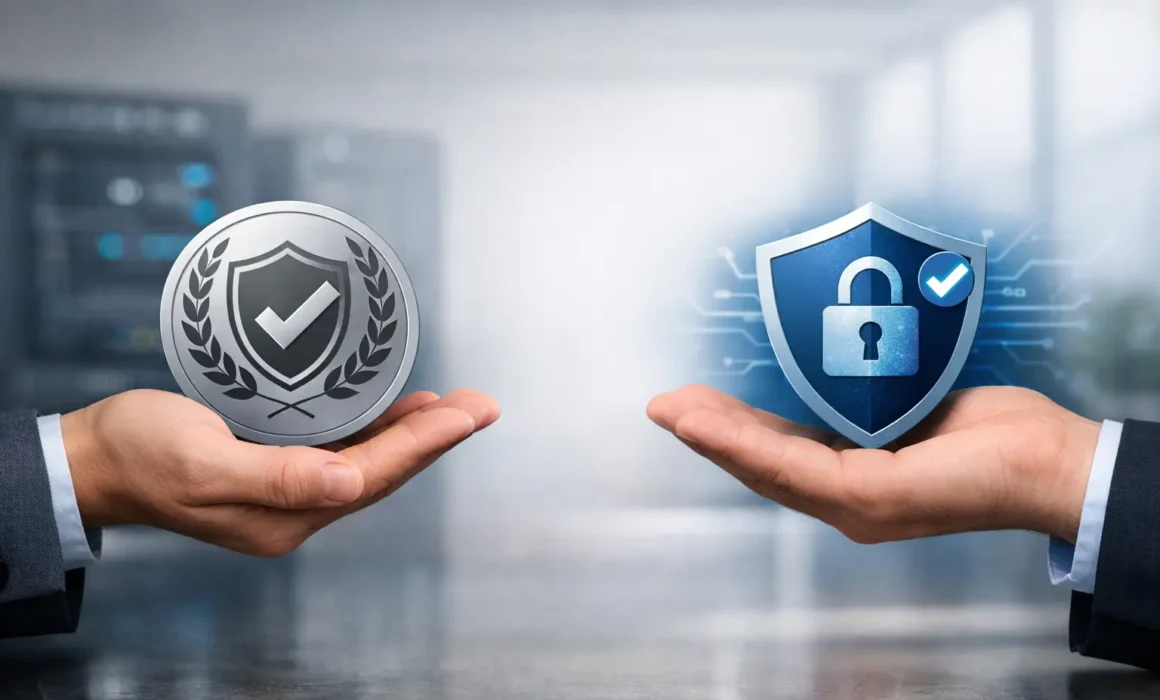
If you are weighing up iso 27001 vs cyber essentials, you are probably not doing it for academic reasons. You need to win work, satisfy customer security checks, reduce risk, or stop security compliance turning into a long, expensive project your team has no time for. For most UK SMEs, the real question is not which one sounds better. It is which one solves the business problem in front of you.
Cyber Essentials is the lighter, faster option. It focuses on a defined set of technical controls designed to protect against common cyber threats. ISO 27001 is broader and more demanding. It is a full information security management system that looks at how your organisation identifies, manages and improves information security risks over time.
That means Cyber Essentials is often the quickest route if a client or tender simply asks for baseline cyber assurance. ISO 27001 is usually the better fit if you need a recognised framework for managing information security across the business, especially where customer expectations, contractual requirements or data sensitivity are higher.
They are not direct substitutes in every situation. In many cases, they sit well together.
Cyber Essentials was designed to help organisations put basic cyber hygiene in place. It looks at practical technical areas such as firewalls, secure configuration, access control, malware protection, patch management and device security.
For smaller businesses, that can be a major advantage. The scope is easier to understand, the evidence burden is lower, and the path to certification is usually much shorter than a full management system standard. If your business needs a credible, practical starting point, Cyber Essentials is often the least painful way to get there.
It also has strong commercial value. Some public sector supply chains and customer procurement teams ask for it because it shows you have taken basic security controls seriously. If the requirement is clear and specific, there is no benefit in overcomplicating the answer.
ISO 27001 goes much further. It is not just about whether anti-malware is installed or devices are patched. It asks how you assess risk, define responsibilities, document controls, manage incidents, train people, review suppliers, set objectives and continually improve your approach to information security.
That broader scope is why ISO 27001 carries more weight in many markets. It shows that security is not being handled as a one-off checklist but as a managed business discipline. For companies handling sensitive client data, operating in regulated environments, working with larger corporate buyers or scaling quickly, that distinction matters.
The trade-off is obvious. ISO 27001 takes more effort. There is more documentation, more decision-making and more internal ownership required. But it also gives you a stronger framework that can grow with the business rather than needing to be replaced once customer expectations become more demanding.
The first difference is scope. Cyber Essentials focuses on specific technical controls. ISO 27001 covers technical, organisational and procedural controls, along with leadership oversight and ongoing improvement.
The second is depth. Cyber Essentials is about proving that key protections are in place. ISO 27001 is about building a repeatable system for identifying risks and applying appropriate controls across the organisation.
The third is business impact. Cyber Essentials can often be achieved relatively quickly and with less disruption. ISO 27001 tends to produce wider operational benefits, such as clearer processes, better supplier control, improved incident handling and stronger internal accountability.
The fourth is perception. Cyber Essentials is widely respected as a baseline. ISO 27001 is generally seen as the more mature and comprehensive standard. If you are bidding for higher-value contracts or dealing with security questionnaires from larger customers, that difference can affect buying confidence.
Cyber Essentials is easier for most SMEs, especially if your IT estate is simple and reasonably well managed already. If you use supported software, apply updates promptly, control admin access and secure endpoints properly, you may be closer than you think.
ISO 27001 is more involved because it requires management system thinking. You need defined scope, policies, risk assessment, control selection, internal review and evidence that the system is being maintained. That can sound heavy, but with the right support and practical templates, it is still very achievable for smaller businesses.
The mistake many SMEs make is assuming ISO 27001 is only for large enterprises. It is not. The real issue is whether you approach it in a pragmatic way or drown in unnecessary paperwork.
For most smaller firms, Cyber Essentials will usually be cheaper and faster. That makes it attractive when you need a result quickly, whether for a live tender, a customer onboarding process or a short-term compliance target.
ISO 27001 requires a bigger investment of time and attention. However, cost should not be judged only by the price of certification. If poor security governance leads to failed tenders, repeated customer questionnaires, duplicated processes or unmanaged risk, the cheaper route can become the more expensive one over time.
This is where a digital-first approach makes a real difference. When implementation, document control, guidance and audit activity are handled remotely and efficiently, ISO 27001 becomes far more accessible for SMEs than many expect. That is one reason businesses often choose practical online support rather than traditional consultancy that drags the process out.
Sometimes the answer is one. Sometimes it is both.
If a tender or customer specifically asks for Cyber Essentials, start there. It is the clearest route to meeting that requirement. If your clients expect a formal information security management system, ISO 27001 is likely to be the stronger answer.
But there are plenty of businesses that benefit from holding both. Cyber Essentials provides visible assurance around baseline cyber controls. ISO 27001 adds the wider governance framework. Together, they create a stronger position commercially and operationally.
This can be especially useful for IT providers, professional services firms, SaaS businesses, manufacturers handling customer data and outsourced service providers. In those sectors, buyers often want confidence that both day-to-day cyber basics and broader security governance are in place.
Cyber Essentials may be enough if your main goal is to meet a basic supply chain requirement, reassure customers on common cyber risks or put a sensible security foundation in place without committing to a larger programme.
It is also a good fit for businesses at the start of their compliance journey. If your internal processes are still informal and you want a practical first step, Cyber Essentials can create momentum without overwhelming the team.
That said, it has limits. It does not provide the same level of assurance around governance, risk methodology or continuous improvement. If customers start asking harder questions, you may quickly find you need something more comprehensive.
ISO 27001 is usually the better choice if information security is central to your service, your customers are more demanding, or your business needs a recognised framework that supports growth. It is particularly relevant where you deal with confidential information, have multiple suppliers and systems to manage, or need a clearer structure for risk ownership.
It is also often the smarter long-term choice if you are repeatedly facing due diligence questions from prospects. Instead of answering each security question from scratch, you build a system that makes those conversations easier and more credible.
For SMEs that want to move upmarket, ISO 27001 can be more than a compliance exercise. It can help remove friction from sales.
Start with the trigger. Are you responding to a stated tender requirement, trying to reduce actual security risk, or aiming to strengthen market credibility? The trigger usually tells you where to begin.
Then look at your customers. If they only need baseline assurance, Cyber Essentials may be enough for now. If they expect formal governance, supplier controls, risk treatment plans and documented processes, ISO 27001 is likely to be the better fit.
Finally, be honest about internal capacity. A smaller business does not need a large compliance department, but it does need a realistic implementation route. Fast, affordable support matters because the longer certification drags on, the more likely it is to lose momentum.
That is why many SMEs choose guided online delivery. With a clear plan, tailored templates and remote support, certification becomes a manageable project rather than a distraction from running the business. For companies that want speed and clarity, ISO-Cert Online Ltd is built around exactly that model.
The best decision is not the one with the most paperwork or the best acronym. It is the one that matches your commercial goals, risk profile and timeframe. Cyber Essentials is a strong baseline. ISO 27001 is a broader system with more strategic value. Neither is automatically right for every SME.
If you need a quick, credible answer to common cyber requirements, Cyber Essentials makes sense. If you need a stronger framework that supports trust, tenders and long-term growth, ISO 27001 is often worth the extra effort. And if your business is serious about security and sales readiness, doing both may be the most practical move of all.
Choose the route that solves the problem you have now, but make sure it also leaves room for where the business is heading next.
Ready to get started?
Contact us today on +44 (0)333 014 7720 or email info@isocertonline.net for a free consultation. You can also get a quote online in minutes.
Don’t let cost hold you back from achieving ISO certification. With ISO-Cert Online, management systems certification is affordable for every business.

If a client has asked for ISO 27001, the real question is rarely whether you need it. It is how to implement ISO 27001 without turning your business into a paperwork project for the next six months. For most SMEs, the challenge is not understanding that information security matters. It is building a system that satisfies the standard, fits the business, and does not drain time from sales, delivery, and day-to-day operations.
That is why the most effective approach is practical rather than academic. ISO 27001 is not about producing thick manuals or copying enterprise controls that do not suit a smaller company. It is about creating an Information Security Management System, or ISMS, that identifies your real risks, puts sensible controls in place, and shows that you manage security in a consistent way.
The businesses that move fastest are usually the ones that keep the project tight. They define what needs to be protected, who is responsible, what the main risks are, and which controls make sense. They do not try to document every possible scenario from day one.
Start by deciding why you are pursuing certification. Sometimes the driver is a tender requirement. Sometimes it is a customer questionnaire that keeps coming back with the same security questions. Sometimes it is a genuine need to tighten internal controls as the business grows. Your reason matters because it shapes scope, timescales, and how much change the business will tolerate.
Next, define the scope of the ISMS. This is one of the most important decisions in the whole project. A narrow scope can make implementation faster and cheaper, especially if only one part of the business handles sensitive information. A wider scope can be more useful commercially because it covers more of your operation. There is no single right answer. It depends on your customers, your risk profile, and what you need the certificate to support.
Once the scope is clear, appoint ownership. In an SME, this does not always mean a full-time compliance manager. It may be an operations director, IT lead, or senior manager with enough authority to get decisions made. What matters is accountability. ISO 27001 expects leadership involvement, and in smaller businesses that usually means practical direction from the top rather than a separate governance team.
Templates help. They save time, create consistency, and stop teams from starting with a blank page. But templates on their own do not implement ISO 27001. The standard is built around risk, so your documentation and controls need to reflect how your business actually works.
Begin with an information security risk assessment. Identify your information assets, where they sit, who uses them, and what could go wrong. That includes obvious threats such as phishing, weak passwords, accidental data sharing, poor access control, and supplier exposure. For some businesses, remote working and cloud platforms will be the main concern. For others, it may be customer records, software development, or shared devices.
At this stage, keep the exercise grounded. You do not need to invent dramatic scenarios if the real issue is that ex-employees still have access to systems, laptops are not encrypted, or key processes rely on informal habits. ISO 27001 is stronger when it reflects reality.
After the risk assessment, decide how you will treat those risks. Some can be reduced with technical controls such as multi-factor authentication, endpoint protection, backups, or restricted permissions. Others need procedural controls, including onboarding and leavers processes, incident reporting, document control, and supplier checks. Some low-level risks may simply be accepted if the cost of treatment outweighs the benefit. That is allowed, provided the decision is reasoned and recorded.
The Statement of Applicability then ties your chosen controls back to the standard. This document often causes confusion, but the principle is simple. It explains which Annex A controls are relevant to your business, whether they are applied, and why. It is not about ticking every box. It is about showing that your control set is considered and justified.
A common mistake is assuming ISO 27001 demands endless policies. In practice, you need a controlled set of documents that support your ISMS and can be used by the business. If nobody reads them or follows them, they will not help you in an audit.
Most SMEs will need an information security policy, scope statement, risk assessment methodology, risk treatment plan, Statement of Applicability, and clear procedures around incidents, access control, backups, asset management, supplier management, and corrective action. You will also need records that prove the system is active, such as training logs, review notes, internal audit findings, and evidence that controls are operating.
The exact level of documentation depends on the size and complexity of the business. A ten-person consultancy using standard cloud platforms will not need the same depth as a software business handling large volumes of client data. This is where proportionality matters. Too little documentation creates gaps. Too much slows everything down and becomes hard to maintain.
Training is another area where SMEs can keep things straightforward. Staff do not need a lecture on every clause of the standard. They need practical awareness of phishing, passwords, handling customer data, reporting incidents, and following company procedures. Role-specific training may be needed for IT administrators, HR teams, or people dealing with supplier onboarding, but the principle is always the same: relevant, understandable, and evidenced.
No ISMS is perfect at first draft. Before certification, you need to check whether the system works in practice. That means more than reading policies back to yourself.
Internal audit is the main sense check. It tests whether your documented system matches what people actually do and whether the standard’s requirements have been addressed. For SMEs, internal audit often highlights predictable issues: actions not recorded, policies approved but not communicated, inconsistent access reviews, or risk treatments started but not completed. These are fixable if you find them early.
Management review is also essential. Leadership needs to review the performance of the ISMS, look at risks, incidents, audit findings, objectives, and improvement actions, and confirm that the system remains suitable. In a smaller business, this does not need to become a boardroom ceremony. It does need to happen properly and be documented.
Then comes corrective action. Auditors will expect to see that when something goes wrong, the business investigates the cause, not just the symptom. If a staff member shared sensitive information incorrectly, for example, the answer may not be another reminder email. It may point to unclear classification rules, weak approval steps, or missing training.
Speed comes from structure, not shortcuts. If you want to implement ISO 27001 quickly, the best route is usually a guided process with proven templates, expert input, and a clear implementation plan. Trying to interpret every requirement from scratch often costs more in management time than businesses expect.
For many SMEs, remote support is the most efficient option because it avoids the delays and cost that come with traditional consultancy models. A digital portal, shared document set, and scheduled consultancy support can keep the project moving while allowing your team to stay focused on normal operations. That matters if you need certification for a live tender or customer deadline.
It also helps to phase the work logically. Scope first, then gap analysis, then risk assessment and core documentation, then implementation of controls, then internal audit and review, then certification. Businesses get into trouble when they try to do all of this at once or spend weeks polishing low-priority documents before basic controls are in place.
A gap analysis is especially useful at the start because it shows where you already meet requirements and where effort is needed. Many SMEs are not beginning from zero. They already use cloud security tools, restrict access, train staff, and manage incidents informally. The job is often to formalise and evidence what is already happening, then close the gaps that remain.
The biggest delay is not complexity. It is indecision. Teams spend too long debating scope, postponing risk workshops, or waiting for the perfect set of policies. ISO 27001 does require thought, but it rewards momentum.
Another common issue is overengineering. Smaller companies sometimes copy large corporate controls that are too heavy for their structure. That creates unnecessary admin and makes the ISMS harder to maintain after certification. A lean system that people follow is far better than a sophisticated one that sits untouched in a folder.
The final issue is lack of ownership. If implementation is treated as a side task with no clear lead, deadlines slip and evidence goes missing. Even with external support, someone inside the business needs to keep decisions moving.
ISO 27001 should make your business easier to trust, not harder to run. If you keep the scope sensible, focus on real risks, and build a system your team can actually use, certification becomes far more achievable than many SMEs expect. And once the framework is in place, it does more than satisfy auditors – it gives you a cleaner, more credible way to manage security as the business grows.
Ready to get started?
Contact us today on +44 (0)333 014 7720 or email info@isocertonline.net for a free consultation. You can also get a quote online in minutes.
Don’t let cost hold you back from achieving ISO certification. With ISO-Cert Online, management systems certification is affordable for every business.
A customer asks for proof that your business takes information security seriously. A tender asks for ISO 27001. A cyber incident in your supply chain makes directors ask uncomfortable questions about access, backups and risk. That is usually the point when people start searching what is ISO 27001 and whether they actually need it.
The short answer is this: ISO 27001 is an internationally recognised standard for building, running and improving an information security management system, or ISMS. In practice, that means a structured way to protect business information from loss, misuse, unauthorised access and disruption.
For SMEs, ISO 27001 is not just an IT badge. It is a business framework. It helps you decide what information matters, what could go wrong, what controls you need, and how to manage those controls properly over time. If your business handles client data, employee records, commercial contracts, financial information, systems access or confidential files, it is relevant.
ISO 27001 sets out the requirements for an ISMS. That sounds technical, but the idea is straightforward. Instead of dealing with information security in an ad hoc way, you put a management system around it.
A management system is simply a planned, repeatable approach. You define responsibilities, assess risks, set rules, put controls in place, train people, monitor performance and fix issues when they arise. The standard does not tell every business to use the exact same controls in the exact same way. It expects you to make sensible decisions based on your own risks, size, activities and data.
That flexibility matters. A software company storing customer data in the cloud will not look identical to a manufacturer with a small office team and outsourced IT support. Both can work to ISO 27001, but the way they apply it should reflect the reality of their operation.
When people hear “information security”, they often think only about hackers. ISO 27001 is wider than that. It is built around protecting confidentiality, integrity and availability.
Confidentiality means information is only accessible to the right people. Integrity means information stays accurate and complete. Availability means people can access the information and systems they need when they need them.
So the standard covers far more than firewalls and passwords. It can include staff awareness, supplier controls, access permissions, incident response, backup arrangements, document handling, mobile working, asset management and business continuity considerations. Human error, weak processes and poor oversight can create just as much risk as external threats.
In many sectors, ISO 27001 has moved from “nice to have” to practical requirement. Clients want reassurance that their suppliers can protect sensitive information. Procurement teams use it to screen risk. Larger organisations often expect it from smaller providers in their supply chain, especially in technology, professional services, healthcare, finance, defence-related work and outsourced business support.
There is also a commercial reason to take it seriously. Certification can shorten security questionnaires, strengthen tender responses and remove doubt during supplier onboarding. For smaller businesses competing with larger firms, that matters. It gives you a recognised framework to point to instead of relying on informal promises about how security is handled.
That said, not every business needs certification immediately. Some benefit from implementing the standard first and certifying later. Others need the certificate quickly because a contract depends on it. The right route depends on your market, customer expectations and internal readiness.
The standard is built around a risk-based approach. You identify the information assets that matter to your business, assess the risks affecting them, and decide what controls are appropriate.
In practical terms, that usually includes defining the scope of your ISMS, setting an information security policy, assigning roles and responsibilities, carrying out risk assessments, choosing controls, documenting key procedures, managing incidents, reviewing performance and running internal audits and management reviews.
One part of ISO 27001 that often gets attention is Annex A. This contains a set of reference controls covering areas such as organisational controls, people controls, physical controls and technological controls. You do not simply tick every control and move on. You decide which controls are relevant to your risks and justify those decisions in a Statement of Applicability.
This is where expert support often makes the process faster and more practical. Businesses can waste time over-documenting simple issues or copying templates that do not match how they really work. A lean, well-fitted system is usually more effective than a large set of documents nobody uses.
If you are wondering what is ISO 27001 certification rather than just the standard itself, certification is the formal assessment that checks whether your ISMS meets the requirements.
That process usually starts with implementation. You build the system, define your scope, complete risk assessment work, put controls in place and generate the records needed to show the system is operating. After that, an auditor reviews the ISMS and checks whether it conforms to the standard.
The exact timeframe varies. A business with strong existing controls, clear ownership and straightforward processes can move quickly. A business with unclear responsibilities, scattered documents and no formal security structure will need more work. There is no sensible one-size-fits-all answer here.
The good news for SMEs is that certification does not need to mean lengthy disruption, expensive site visits or months of consultancy. A digital-first approach with remote audits, guided templates and focused support can make the process much more manageable, especially for smaller teams that cannot stop day-to-day operations to build a system from scratch.
One of the biggest myths is that ISO 27001 is only for large tech businesses. It is not. Any organisation that handles valuable or sensitive information can benefit from it.
Another myth is that it is purely an IT standard. IT is part of the picture, but ISO 27001 also covers leadership, people, process, supplier management and continual improvement. If a member of staff can accidentally send confidential data to the wrong person, that is an information security issue. If nobody knows how to respond to a breach, that is an information security issue too.
There is also a belief that certification guarantees you will never suffer a cyber incident. It does not. No standard can promise that. What ISO 27001 does is help you reduce risk, put better controls in place and respond in a more controlled way when problems happen.
The certificate matters, especially when customers ask for it. But the operational gains are often just as valuable.
Most businesses become clearer on what information they hold, who has access to it, where the weak points are and how decisions should be made. That often leads to tighter processes, better staff awareness, cleaner supplier oversight and less reliance on informal workarounds.
There can also be a financial upside. Preventing one avoidable incident, reducing duplicated effort in customer due diligence, or improving success in tenders can justify the investment quickly. For smaller businesses, the real value is often confidence. You are no longer guessing whether your security arrangements are good enough.
If your clients ask security questions, if you handle confidential or regulated data, if you rely heavily on digital systems, or if tenders mention information security requirements, it is worth serious consideration.
It may be especially useful if your business is growing and your current controls depend too much on a few individuals remembering what to do. Growth tends to expose gaps. New starters join, suppliers change, systems multiply and access rights get messy. ISO 27001 gives you a structure before those issues become expensive.
On the other hand, the scope should be proportionate. A small business does not need an enterprise-sized system. The goal is not paperwork for its own sake. The goal is a credible, working ISMS that fits your operation and supports commercial objectives.
For many SMEs, that is exactly why a fast, affordable and guided route works best. With the right support, ISO 27001 becomes far less daunting than it first appears. It turns from a confusing standard into a practical way to protect information, satisfy customers and strengthen the business. If you are asking what is ISO 27001, the better question may be whether your business can afford to keep treating information security as an informal afterthought.
Ready to get started?
Contact us today on +44 (0)333 014 7720 or email info@isocertonline.net for a free consultation. You can also get a quote online in minutes.
Don’t let cost hold you back from achieving ISO 27001 certification. With ISO-Cert Online, information security management certification is affordable for every business.
In today’s digital economy, information is one of the most valuable assets a business possesses. Whether you handle customer data, financial records or intellectual property, protecting that data is critical to maintaining trust and meeting legal obligations. As the volume and sophistication of cyber attacks rise, information security is no longer a concern only for large corporations – small and medium‑sized enterprises are frequent targets because attackers perceive them as easier prey.
ISO 27001 provides a comprehensive framework for establishing, implementing and improving an information security management system (ISMS). Unlike ad‑hoc security measures, an ISMS is systematic, risk‑based and continually evolving. It starts by identifying the information assets that need protection and assessing the threats and vulnerabilities that could affect them. From there, it defines controls covering technology, people and processes to mitigate those risks.
One of the key benefits of ISO 27001 certification is structure. The standard lays out clear requirements for governance, leadership commitment, risk assessment, incident response, training and monitoring. Businesses often have informal security practices that depend on individual staff members. An ISMS formalises these practices and ensures that responsibilities are assigned and documented. This clarity helps everyone in the organisation understand their role in protecting information.
Certification also signals credibility. When customers see that a supplier holds ISO 27001 certification, they know that the organisation follows recognised best practice and has been independently audited. In sectors like technology, finance and healthcare, suppliers often need to prove that they have robust information security controls before they can win contracts. For SMEs, certification can therefore open doors to new markets and partnerships.
Modern regulations, including the General Data Protection Regulation (GDPR) and other privacy laws, impose strict obligations on data controllers and processors. ISO 27001 helps businesses meet these obligations by embedding privacy protection within the ISMS. Controls such as access restrictions, encryption, secure disposal and incident reporting are directly relevant to compliance. In the event of a data breach, documented processes enable rapid response and minimise the impact on individuals and the business.
Cyber resilience is another outcome of ISO 27001. Resilience means the ability to withstand disruptions and recover quickly. By regularly assessing risks and testing controls, organisations uncover weaknesses before attackers do. Incident management procedures ensure that when an attack occurs, the response is coordinated and effective. Over time, lessons learned feed back into the system, creating a cycle of continual improvement. This resilience is particularly important for SMEs, who may not have the resources to survive a prolonged outage or reputational damage.
Implementing ISO 27001 does require commitment, but it doesn’t need to be a burden. The standard is flexible and scalable. Businesses can tailor controls to the size, complexity and nature of their operations. For example, a small consultancy might focus on secure file sharing, laptop encryption and staff awareness, while a manufacturer might emphasise network segmentation and physical security. The risk assessment process ensures that attention is focused on areas where threats are greatest.
Remote work has added new challenges to information security. Employees access systems from home networks and use personal devices more often than before. ISO 27001 helps organisations manage these risks by defining policies for remote access, multifactor authentication and secure communications. It also emphasises the importance of training employees to recognise phishing attempts and other social engineering attacks. Without this human element, technical controls alone cannot provide adequate protection.
Working with ISO‑Cert Online Ltd makes the certification process accessible to SMEs. Their fully remote assessment means that businesses can pursue ISO 27001 without the costs and disruptions associated with on‑site audits. Consultants guide you through risk assessment, control selection and documentation. The company’s experience with multiple standards also makes it easy to integrate information security with quality, environmental and health and safety systems if desired.
For businesses wondering whether ISO 27001 is worth the effort, consider the broader landscape. Cyber attacks continue to make headlines, and regulators impose heavy fines for data breaches. Customers are increasingly aware of privacy and security issues and may choose suppliers accordingly. An information security incident can be catastrophic for a small business’s reputation and bottom line. Investing in a systematic, recognised framework reduces these risks and demonstrates professionalism.
Securing certification is only the beginning. Maintaining it requires ongoing effort: regular internal audits, management reviews and updates to reflect changes in technology and threats. However, this ongoing attention ensures that information security remains at the forefront of business strategy rather than an afterthought. It encourages continuous learning and improvement, which ultimately benefits the entire organisation.
In conclusion, ISO 27001 certification is a powerful tool for building cyber resilience and trust. It provides a structured, scalable approach to information security that aligns with modern regulations and customer expectations. With remote assessments and expert guidance available from ISO‑Cert Online Ltd, SMEs can achieve certification without undue disruption. As cyber threats continue to evolve, a strong ISMS is an investment in long‑term stability, reputation and growth.
Managing multiple ISO standards separately can be cumbersome. Separate manuals, overlapping procedures and multiple audits eat up time and resources. An integrated management system (IMS) simplifies this complexity by combining the requirements of different standards into a single framework. For growing businesses seeking efficiency and a competitive edge, integrating standards is becoming the norm.
ISO standards share many common elements: the Plan‑Do‑Check‑Act cycle, leadership commitment, risk‑based thinking and documented information requirements. When organisations maintain separate systems for quality, environment, health and safety or information security, they often duplicate processes and policies. For example, one department might conduct a risk assessment for ISO 9001 while another performs a similar exercise for ISO 14001. An IMS aligns these activities, eliminating redundancy and allowing resources to be focused on improvement rather than administration.
Combining ISO 9001 (quality), ISO 14001 (environment) and ISO 45001 (health and safety) yields powerful synergies. Quality and environmental objectives often overlap; reducing defects, for instance, cuts waste and energy use. Health and safety initiatives improve workforce morale, which in turn leads to higher quality products. Integrating ISO 27001 (information security) or ISO 22301 (business continuity) further strengthens resilience by ensuring that processes remain secure and operational during disruptions. An integrated system makes it easier to manage these interdependencies because objectives, resources and responsibilities are aligned.
The primary benefit of an IMS is efficiency. With a unified manual, businesses reduce the amount of documentation they need to create and maintain. Audits can be combined, saving time and reducing disruption. Training becomes simpler, as staff learn one system rather than several. Decision‑making improves when information flows through a single system – managers can see how a change in one area affects other parts of the business. A coherent management system also presents a consistent message to customers and regulators, reinforcing the organisation’s commitment to quality, sustainability and safety.
Cost savings are another significant advantage. By eliminating duplicate processes and consolidating audits, an IMS reduces administrative overhead. Certification bodies often offer discounted audit rates for integrated systems because auditors can cover multiple standards in a single visit. Internally, teams spend less time preparing for separate audits and more time working on improvements that drive value.
After certification, the focus shifts to continual improvement. Use management reviews to assess performance across all standards, identify trends and set new objectives. Encourage employees to suggest improvements and report issues. Monitor regulatory changes; for example, if new environmental legislation emerges, update your system accordingly. Keep an eye on emerging standards like ISO 50001 (energy management) or ISO/IEC 42001 (AI governance), which may become relevant as your business evolves.
An integrated management system supports growth by providing a scalable framework. When entering new markets, adding products or acquiring other companies, an IMS allows you to incorporate new activities without reinventing your management systems. Integrated systems can also improve customer trust and market access; many clients prefer working with suppliers who hold multiple certifications because it reduces risk. Additionally, integrated systems provide better data for decision‑making, enabling leaders to balance quality, sustainability and safety considerations effectively.
As markets demand greater transparency and responsibility, integrated management systems will become increasingly common. Organisations that combine standards not only streamline compliance but also demonstrate maturity and foresight. Trends such as climate‑related disclosure, heightened cyber threats and emerging AI regulation will favour businesses with flexible, holistic management systems. By embracing integration now, you create a robust foundation for innovation, resilience and sustainable growth.
Find out more…
If you would like to find out more about ISO standards, or any of the other services we offer here at ISO-Cert Online, please contact us on 0333 014 7720 or email info@isocertonline.net.
Digital transformation is reshaping nearly every aspect of business, including the way organisations achieve and maintain ISO certification. Paper‑based documents, manual audits and in‑person meetings are giving way to cloud portals, remote assessments and even artificial intelligence. For small and medium enterprises looking to certify quickly and efficiently, embracing these technological tools isn’t a luxury – it’s a necessity.
Historically, certification meant lengthy on‑site audits, boxes of paperwork and waiting for physical signatures. Today, software platforms manage documents and evidence, auditors review files via secure portals and sign‑offs happen electronically. Digital certification reduces travel time, shortens approval cycles and makes it easier for geographically dispersed teams to collaborate. In the wake of the pandemic, many accreditation bodies have formalised remote auditing procedures, providing clear guidelines for video conferencing, screen sharing and secure file transfer. This has opened ISO certification to businesses in rural areas or overseas markets who previously struggled with travel logistics.
A robust document management system is the backbone of a modern ISO programme. Templates, policies, procedures and records must be controlled, versioned and easily accessible. Cloud‑based platforms like SharePoint or specialised ISO management software allow teams to collaborate in real time, assign tasks and track progress. They also enable remote auditors to access documentation without the need for endless email chains. When choosing a platform, look for features such as user permissions, audit trails, encryption at rest and in transit, and integration with common productivity suites. These features not only simplify certification but also help meet ISO 27001 requirements for protecting information.
The next frontier in ISO certification involves artificial intelligence (AI). AI doesn’t replace human judgement, but it can automate routine tasks and highlight areas of concern. For instance, natural language processing can analyse policies and identify clauses that deviate from standard requirements. Machine learning algorithms can review incident logs or non‑conformity reports to detect patterns and predict future risks. Chatbots integrated into your portal can answer basic questions from staff about procedures or explain the purpose of a particular form. Implemented thoughtfully, AI reduces the administrative burden on quality managers and auditors, freeing them to focus on strategic improvements.
With the rise of AI, the International Organisation for Standardisation and the International Electrotechnical Commission introduced ISO/IEC 42001, the first management system standard for artificial intelligence. It provides a framework for organisations to responsibly govern AI systems, ensuring transparency, accountability and alignment with ethical principles. For businesses already certified to ISO 9001 or ISO 27001, adopting ISO/IEC 42001 can slot into existing structures, particularly if they use an integrated management system. The standard covers topics such as data quality, algorithm bias, human oversight and continual improvement – areas that will become increasingly important as AI permeates supply chains and service delivery.
Remote audits require more planning than on‑site visits. Before the audit, ensure that all documents are uploaded to your portal and correctly named. Check that your video conferencing tools are working and that everyone knows how to share screens. During the audit, maintain open communication with the assessor. Use a headset with a quality microphone to avoid miscommunications, and prepare to demonstrate processes live using webcams or recorded footage. After the audit, record lessons learned to streamline the next one. Many organisations report that remote audits are less disruptive to business operations and reduce the environmental impact associated with travel.
Training is a core requirement of many ISO standards, and technology has transformed how it’s delivered. Interactive online courses, virtual classrooms and micro‑learning modules allow employees to learn at their own pace. They also make it easier to schedule training around busy workloads. Digital training platforms often include knowledge checks, certificates of completion and integration with HR systems to keep records up to date. When employees can access training materials on demand, they are more likely to retain knowledge and apply it to their work, strengthening your management system.
With digital tools come new responsibilities. Storing and transmitting sensitive documents requires strong security controls. Encryption, multi‑factor authentication, and regular vulnerability assessments are essential. Organisations seeking ISO 27001 certification should ensure that their chosen platforms comply with the standard’s Annex A controls. Data protection laws like the General Data Protection Regulation (GDPR) in Europe also impose strict requirements on how personal data is collected and processed. By choosing vendors that prioritise security and privacy, you not only protect your business but also build trust with customers and auditors.
No single tool will meet every organisation’s needs. Start by mapping your current processes and identifying pain points – perhaps version control is a headache, or you struggle to schedule training. Research solutions that address those specific issues and ask vendors about integration capabilities. Consider scalability: will the platform support additional standards like ISO 45001 or ISO 22301 as your management system evolves? Evaluate the vendor’s support model, as responsive support is vital when issues arise during an audit. Finally, involve your team in the selection process to ensure that the solution is user‑friendly and aligns with company culture.
Technology will continue to shape how organisations achieve and maintain certification. Advances in AI, blockchain for secure record keeping, and virtual or augmented reality for training and process demonstration are already on the horizon. By embracing digital tools today, you set your organisation up for agility and resilience. Remote audits, automated document management and AI‑driven insights streamline compliance, reduce costs and free up time for innovation. In the coming years, businesses that adopt technology as part of their ISO journey will not only meet regulatory requirements but also gain a competitive edge.
Find out more…
If you would like to find out more about ISO standards, or any of the other services we offer here at ISO-Cert Online, please contact us on 0333 014 7720 or email info@isocertonline.net.

The team here at ISO-Cert are proud to announce the launch of our brand-new online management systems portal, ISO-Cert UniteTM, which has been designed with the aim of helping to make ISO certification as stress-free and efficient as possible.
This is the only online portal in the industry that will guide you through every step of the implementation process from start to finish, with appropriate tasks set each month to ensure that you stay on track and hit the pre-defined targets.
We also automatically monitor your progress 24/7 so you can catch any problems early on, enabling you to take action immediately to prevent potential delays. Flexibility and versatility are also assured, as the portal can be used for any ISO management system standard.
If you’re looking for globally recognised ISO certification delivered efficiently and cost effectively, the ISO-Cert team can help you every step of the way.
As well as our industry-first online portal, we also offer management systems consultancy and training, designed to help you take your business to the next level.
Find out more…
If you would like to find out more about the ISO-Cert UniteTM portal, how your business could benefit from implementing a Management System, or any of the other services we offer here at ISO-Cert Online, please contact us on 0333 014 7720 or email info@isocertonline.net.

Digital health technology is becoming increasingly commonplace, helping to transform patient care pathways, boosting health and wellbeing, making health systems more efficient, delivering cost savings and empowering people to manage their own conditions more successfully.
Virtual care is capable of reaching significantly more people than in-person appointments, but there are some concerns about healthcare digitisation, particularly from the perspective of businesses operating in this sector, which demands consistent service delivery and proactive risk management.
Digital health solutions of all kinds, including the likes of software as medical devices, artificial intelligence as medical devices, 3D printing, mobile apps, virtual assistants, wearable medical devices, robotics and virtual care provision, must remain compliant with all relevant regulations and standards, including DCB 0129, the Data Security and Protection toolkit and Digital Technology Assessment Criteria.
These standards (among others) serve to ensure that products, processes and systems are secure, robust, accessible and clinically safe – but it’s important to note that they don’t cover complete organisational structures, so it may be beneficial to investigate ISO 9001 certification as well.
The ISO 9001 standard is currently undergoing major amendments (having been left unchanged for ten years or so), with the expected updates now delayed until September 2026… so it’s perhaps fair to say that they’re likely to be quite significant.
As such, now’s the perfect time to prepare for potential changes and it’s likely that there will be even greater focus placed on digital transformation.
This particular standard isn’t industry-specific, but it is highly relevant to those businesses working in digital health. Certification will ensure that your organisation has a clear framework in place to deliver your products and services consistently, and efficiently, as well as driving improvements as appropriate over time.
You’ll also find that your approach to risk management is properly supported, improving both the patient experience and your organisation’s activities, and making sure that your business is able to maintain this as you grow and thrive.
If you’re involved in the design, production and servicing of medical devices, you’ll need to consider ISO 13485 certification to ensure patient safety and compliance with regulations.
This would be a good option if you’re keen to tick all the ISO 9001 boxes but want to be particularly vigilant and ensure compliance as your products and services develop.
As digital health technologies continue to emerge, with key innovations including the likes of mobile health apps, connected wearable devices, digitised health systems, patient data and prescription delivery, telemedicine, health data analytics, personalised medicine and both AI and machine learning (ML), regulations are certain to evolve to ensure that safety, quality and performance standards continue to be met.
Key areas of focus include data protection and privacy, ensuring compliance with GDPR by safeguarding patient data. Medical device regulation (prioritising safety, quality and performance of tech), telemedicine and remote care, and clinical safety and effectiveness continue to be of particular importance for businesses.
Finally, cybersecurity is another area of focus that companies would be wise to put at the top of the agenda, making sure that health data is secure and the appropriate levels of protection against cyber attacks are implemented.
Find out more…
If you’d like to find out more about the evolving digital health landscape and what you can do to prepare for regulatory changes, please contact us on 0333 014 7720 or email info@isocertonline.net.

The idea of business continuity is something that means different things to different people. There was a time when it would mostly relate to the physical premises of a company, where work could be disrupted by a major calamity, such as a fire, flood, major power outage, or terrorist attack. However, in a more interconnected world, it now extends to the online realm.
Many an organisation can face genuine threats from hackers and other cybercriminals, who may use denial-of-service attacks or malware to prevent a firm’s operations from functioning. But sometimes it can come from an internal problem, such as a software glitch.
The latter issue occurred in July this year when software firm Crowdstrike attempted a new software upload on Microsoft systems and a software bug led to massive IT outages across the globe, impacting everything from airports to banks and healthcare systems.
Such issues highlight the need for organisations to have back-up systems in place to achieve business continuity even in the face of calamity.
Whether that is about having alternative premises to work in, the ability to switch to remote working (something most firms developed the capacity to do during the pandemic lockdowns if they hadn’t already), or back-up IT systems, the best-prepared firms will be able to maintain their work, providing a better service and increasing client confidence as a result.
An ISO 22301 is a certification that shows you have met the international standard for business continuity management systems.
The purpose of attaining it is to demonstrate that you have measures in place that offer a reliable contingency when disaster strikes. In addition, it shows that you have taken clear steps to make such problems less likely to occur in the first place.
For example, when it comes to your IT systems, it could involve having strong cyber security systems and practices that make it less likely you will fall victim to cybercrime and suffer a loss of system functions as a result, as well as having measures to get your system back up and running swiftly if problems do occur.
The benefits of this are not just about being resilient in a crisis. It also means you will benefit from having a clear systemic approach to dealing with a challenging situation, so that when problems arise, you and your staff will know exactly what to do, while having better processes for managing risk.
When you have all this in place, it will increase confidence among everyone who matters, from your colleagues who can get on with their work to company shareholders who will be pleased to see earnings are not badly impacted by disruption, not to mention your clients to whom you can continue to provide a service when others might not have done.
This means the benefits of attaining an ISO 22301 are twofold. Firstly, the very act of qualifying for one means you will have established strong means of maintaining business continuity, which will benefit your business when it needs to weather the storm (sometimes literally). Secondly, having it increases the confidence others have in you.
This is why it makes sense to start working towards ISO 22301 certification today.
Find out more…
If you would like to find out more about ISO 22301, how implementing a Business Continuity Management System could benefit your business, or any of the other services we offer here at ISO-Cert Online, please contact us on 0333 014 7720 or email info@isocertonline.net.
Most firms will want to show their clients and customers that they are recognised as being competent and indeed excellent at what they do. Look at any company website and you will see them displaying their awards, accreditation kitemarks and memberships of trade bodies like an old soldier displays his medals.
There are some trades where certification is essential, such as Gas Safe Register membership for firms and their employees that are involved in work on gas appliances, which is required by law.
However, ISO certification is more about demonstrating standards and control than mandatory attainment of a standard to be allowed to practise.
Nonetheless, ISO certification is very much worth having, because it does provide an internationally recognised measurement of competence and standards. However, it is useful to understand the difference between certification and accreditation.
The simplest point to understand is that when it comes to ISO standards, accreditation is not something the companies being certificated attain. Rather, it applies to the bodies and organisations that can issue the certificates, which in this case includes ourselves at ISO-Cert Online.
While this accreditation is not itself a mandatory thing for certificate-issuing bodies, many organisations, such as government departments and other companies, will require that the certificate has come from an accredited body. That is the main reason why we are accredited, as that brings more benefits for you in terms of recognition.
Accreditation is also a matter of process, of course. Accreditation for individuals, for instance, comes from undertaking and passing courses to be able to practise, be they doctors, lawyers, or gas engineers. In the case of ISO certification, this is awarded based on a company demonstrating they are compliant with the requirements of their industry.
Consequently, the path to becoming certificated is a different one to accreditation. It is not about training and passing exams, a process by which you would be learning and gaining experience as you work your way up towards a particular standard. Rather, it is about being rigorously assessed to establish if your current practices meet the required standard.
This assessment, therefore, is about where you are at, not a standard you are working towards.
Of course, there is a possible scenario in which the audit shows that you have fallen short of the ISO standard you need to demonstrate to achieve certification. In that event, we would of course let you know why, and you can seek to address these issues before being assessed again.
That may be analogous to retaking an exam, except that in this case you know what the answers are. It is about whether you can achieve and demonstrate the required standard.
Of course, the assessment will be a thorough one, but that is something you should welcome. Because ISO certificates are not simply given out to anyone who wants one, your clients and customers can be assured that they are dealing with a company that has demonstrated standards that they can trust. Add in our accreditation and that trust will be all the greater.
Find out more…
If you would like to find out more about ISO standards and how implementing them could benefit your business, or any of the other services we offer here at ISO-Cert Online, please contact us on 0333 014 7720 or email info@isocertonline.net.

When many businesses think about ISO, they are typically looking for an accredited body to provide them with ISO 9001 certification.
They want to be certified either as a condition for a particular client, as part of a reorganisation or simply to add value to the business by celebrating a system that they have either already implemented or are in the process of implementing.
There are a lot of motivations to receive certification, but it can sometimes be easy to miss what that standardisation represents and ultimately why it matters within a business and to other businesses.
An answer to both of these questions comes, somewhat unusually, from another critical part of many businesses: a cup of tea.
There is perhaps no singular beverage that has so many variations and preferences as tea, as whilst the basic process of steeping tea leaves in water is universal, every other element from the blend to the use of teabags and the addition of milk and sugar is a matter of fierce and intense debate.
However, ISO 3103:2019 (formerly BS 6008:1980) describes a standard method of brewing and serving tea that will produce consistent results every time.
It describes two testing pots (310 ml or 150 ml) with loosely fitting lids as well as two testing bowls (380 ml and 200 ml). Both the pots and bowls are made of white porcelain (or white glazed earthenware), with a partly serrated edge.
For every 100 ml of water that will be added to the pot, 2g of tea is also placed within the pot, before that measured amount of freshly boiled water (described as similar to nearby drinking water) is added.
The tea is then brewed for six minutes before being poured into the bowl, with 5ml (or 2.5ml for a smaller bowl) milk added beforehand (although alternative suggestions are made for adding milk after).
The resulting standard won an Ig Nobel Prize and serves as a perfect example of how standards can often be misinterpreted as a prescriptive method towards a platonic ideal for the object, method or system being standardised.
However, this somewhat misses the point, as ISO 3103:2019 is not intended to make the best cup of tea or a “perfect” cup of tea by the standards of a tea drinker, but is instead intended to create a standard cup of tea that is relatively easily reproducible.
The reason for this is the same reason why no specific type or blend of tea is described in the standard. It is designed for tea tasting and for making sensory comparisons.
Many criticisms of the process, such as no prewarming of the pot, a brewing time that is relatively lengthy compared to the typical three-minute brewing times used when brewing a tea bag, and pouring milk in before tea largely misses the point.
These are not cups that are made to be enjoyed, but ones that create a benchmark for meaningful analysis and studies, such as taste testing or quality control.
On that same token, ISO certification means adopting a universal set of standards and protocols so that other businesses and customers understand how an order is managed by your company.
Find out more…
If you would like to find out more about ISO standards and how implementing them could benefit your business, or any of the other services we offer here at ISO-Cert Online, please contact us on 0333 014 7720 or email info@isocertonline.net.
When businesses are interested in ISO certification, the fastest way to achieve this is through a dedicated online service that will help them meet the necessary quality management standards.
When businesses are looking for certification, they are typically thinking about the ISO 9000 family, which is a set of five quality management systems (QMS) that ensure that businesses are meeting their regulatory responsibilities, whilst also ensuring they are keeping up with the demands of customers and stakeholders alike.
Of the five ISO 9000 QMS standards, the one that most companies are looking for is ISO 9001:2015, often known simply as “ISO 9001”, “ISO 9000” or even simply “ISO”.
The standard itself is based around a 30-page set of requirements but its fundamental focus is based on seven quality management principles (QMP) which form or at least should form a foundation for how a business is managed and operated.
Here are the seven and why they matter.
The first QMP standard is perhaps the most obvious one. As the late entrepreneur and businessman Jack Tramiel put it, businesses are there to serve the customer.
Without customers, businesses simply cannot exist, and with that in mind, companies focused on ISO 9001 should be mindful not only of customer needs right now but the future of their needs in the future.
The priority should be to meet the standards of the customer and serve them, ensuring that the customer’s expectations are understood so they can be delivered upon effectively and efficiently.
One of the most critical and misunderstood aspects of many businesses is structure, hierarchy and leadership, as well as the role of leaders in organisations of varying scales.
Leaders need to be the ones to form and shape a united direction and purpose of any organisation and be able to lead a wide range of disparate teams in the same direction to achieve the overarching mission of the company.
Companies are ultimately collectives of diverse, skilled individuals, and ultimately no company succeeds without people who are able to do the job they are employed to, are empowered and recognised for their abilities, and buy into the overall goals of the organisation.
Without people on board, you do not have a company.
Business activities are typically a series of interrelated processes that work together to create an overall system, and once a business fully understands this, it can manage and continually improve these processes to achieve consistent output results.
Perfection is an overall goal, but not one that is achievable. There is always room for improvement, and an eternal goal for any organisation is to keep getting better, streamline processes and get the greatest return out of every part of the business.
Data dominates the business world, and whilst one should avoid discounting anything that cannot be quantified, decisions should be made based on effective, objective analysis to as much pertinent information as possible.
No business exists in a vacuum. Virtually every company has contractors, suppliers, service providers and other stakeholders that are part of symbiotic, interdependent business relationships. It is important to see the value in these relationships and foster them to ensure everyone thrives.
Find out more…
If you would like to find out more about ISO standards and how implementing them could benefit your business, or any of the other services we offer here at ISO-Cert Online, please contact us on 0333 014 7720 or email info@isocertonline.net.

Cybersecurity is a growing concern for businesses of all sizes, and small and medium-sized enterprises (SMEs) are no exception. Often, with constrained resources and limited cybersecurity training, SMEs are vulnerable to cyber-attacks. Critically, these can result in data breaches, downtime, and financial losses. So, in this article, we explore the reasons why your business should be ISO 27001 certified.
The statistics provide compelling evidence that cyber-attacks are a significant threat to SMEs. Indeed studies are conducted all the time to monitor changes to these trends.
So that’s where ISO 27001 certification comes in:
Undoubtedly, cyber-attacks are becoming increasingly popular and sophisticated. Accordingly, SMEs need to identify and address potential security risks and vulnerabilities in your information systems, networks, and applications. Here, ISO 27001 provides a framework for SMEs. Since it supports you in implementing effective security measures, it protects your business against cyber threats and data breaches.
ISO 27001 certification demonstrates your commitment to information security best practices. As a result, it can enhance your reputation with customers, partners, and stakeholders. Primarily, it evidences clearly that you take cybersecurity seriously and are taking appropriate measures to safeguard your business and customers.
Implementing ISO 27001 can help you to streamline your information security management processes. Thus improving operational efficiency. In turn, this can reduce the risk of downtime and data loss. Ultimately resulting in cost savings, improved business performance and more engaged and empowered staff.
Many SMEs operate in sectors and industries that are subject to regulatory requirements for information security. Typically, these include such as healthcare, finance, and government. Hence ISO 27001 can help SMEs meet these requirements and avoid potential fines and legal liabilities.
ISO 27001 certification can give you a competitive advantage by demonstrating your commitment to information security. Naturally, this opens up new business opportunities with clients in both domestic or international markets. Companies which understand the risk of poor information security are more likely to require their suppliers to have ISO certification.
In summary, ISO 27001 certification is a valuable and sensible investment for all businesses. But especially for SMEs looking to protect your sensitive information, build trust with stakeholders, improve operational efficiency, comply with regulatory requirements, and increase business opportunities.
Don’t wait until it’s too late. Invest in ISO 27001 certification today to defend your business against cyber threats and data breaches.
For more information on ISO-Cert Online’s services or to discuss your requirements please contact us on 0333 014 7720 or email info@isocertonline.net.





Copyright © 2025 ISO-Cert Online Ltd. All Rights Reserved



Recent Comments